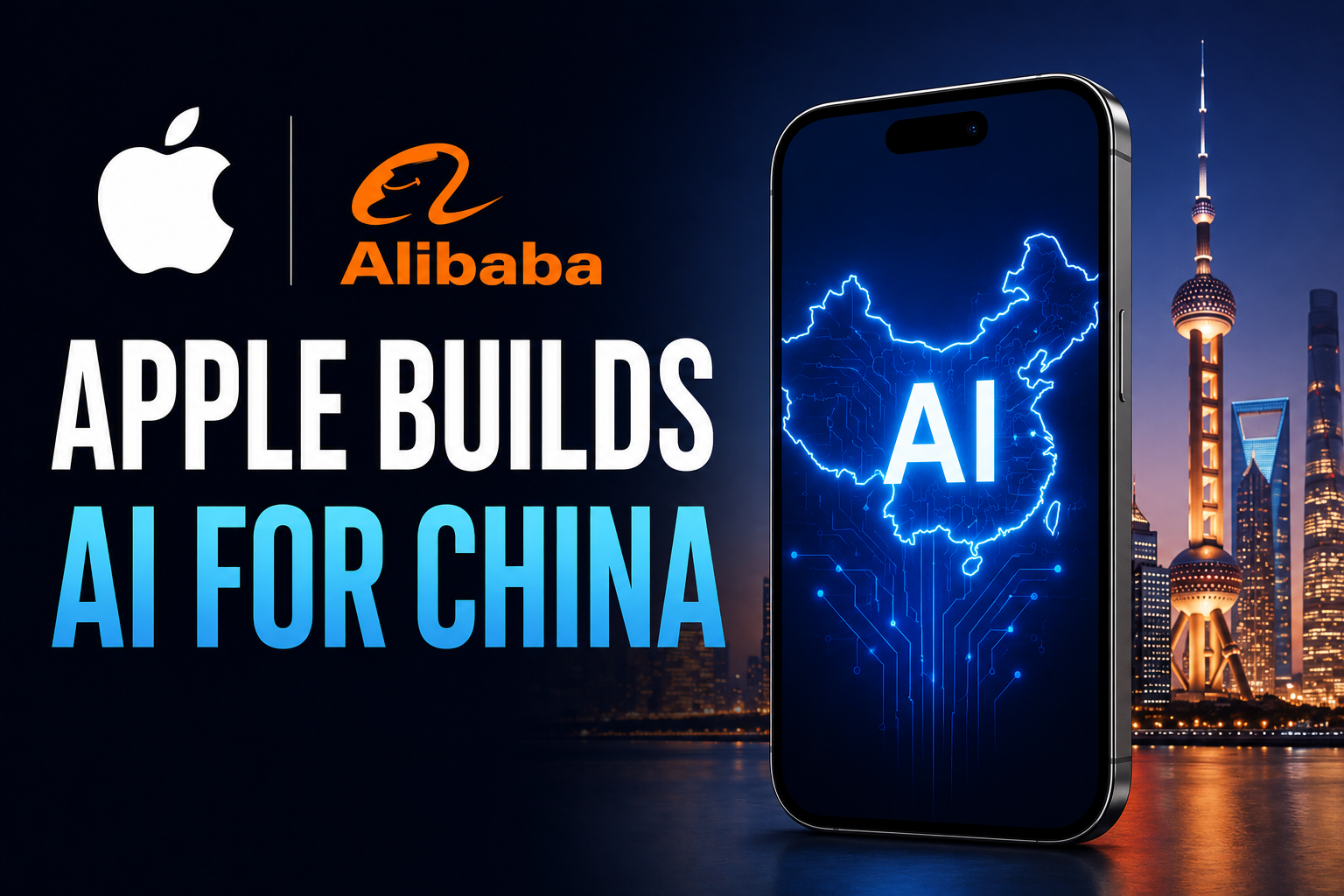

Apple has trained its own large language model (LLM) specifically for the Chinese market, with support from Alibaba, according to an exclusive Reuters report. The move marks a major change in Apple’s AI strategy and could finally bring Apple Intelligence to users in mainland China.
The development is important because Apple has previously relied on Chinese technology companies and their AI models to support its AI plans in the country. Now, Apple appears to be taking more control by building its own China-specific AI model.
Apple and Alibaba Are Working Together
According to Reuters, Apple developed the model with help from Alibaba Group, which provided support during the training process. Three people familiar with the matter told Reuters about the development.
Apple’s model is designed specifically for China rather than being simply the same AI system used in other markets.
The partnership allows Apple to combine its own AI technology with Alibaba’s experience in China’s AI market and its local computing infrastructure.
Why Does Apple Need a China-Specific AI Model?
The biggest reason is China’s AI regulations.
Apple Intelligence has been available in many markets, but its rollout in mainland China has been delayed.
AI services in China must meet local rules and receive approval from Chinese regulators.
Services such as ChatGPT are also restricted in China, meaning Apple cannot simply use the same AI partnerships it uses in other countries.
This has forced Apple to find a different approach for the Chinese market.
Apple Intelligence Could Finally Launch in China
Apple has been working toward bringing Apple Intelligence to China for some time.
According to Reuters, Apple’s China-specific AI system is expected to become part of Apple Intelligence, Apple’s collection of AI features for iPhone, iPad, Mac and other devices.
Apple’s generative AI service received regulatory registration in China in July, clearing an important step toward a local launch.
The company is expected to introduce Apple Intelligence in China in the coming months, although the exact launch date has not been announced.
Alibaba’s Qwen Is Also Part of Apple’s China AI Strategy
Apple’s relationship with Alibaba is not limited to training its own model.
Apple has also been working with Alibaba’s Qwen AI models.
Earlier this month, Apple published a guide explaining how users in mainland China could connect Qwen with Siri and Apple’s Writing Tools on Mac. The guide was later removed.
Qwen could therefore remain part of Apple’s China AI system even as Apple develops its own model.
The exact way Apple’s model and Qwen will work together has not yet been fully explained.
Why Apple Wants Its Own Model
Building its own model could give Apple more control.
Instead of depending entirely on another company’s AI, Apple could control more of the technology behind Apple Intelligence.
This could help with:
- AI features inside iOS
- Siri improvements
- Writing Tools
- Image and document understanding
- Privacy and data handling
- Local regulatory requirements
- Future AI features
However, Apple’s model does not necessarily replace Alibaba’s Qwen. The two technologies could be used for different tasks.
China Is Too Important for Apple to Ignore
China is one of Apple’s most important markets.
But the company is facing growing competition from Chinese smartphone manufacturers, especially companies such as Huawei, which are increasingly promoting AI features on their devices.
Apple’s delayed AI rollout has therefore become a disadvantage.
Chinese smartphone users are increasingly seeing AI features as a normal part of a modern phone.
Apple needs Apple Intelligence to compete more effectively.
A Major Change in Apple’s AI Strategy
Apple’s move is particularly interesting because the company has historically focused heavily on building technology itself and controlling the user experience.
For its global AI strategy, Apple has also worked with outside AI companies.
But China presents a different situation.
Apple now appears to be following a local AI strategy:
Apple technology + Alibaba support + China-specific AI model
This gives Apple a way to adapt its AI products to the country’s technical and regulatory environment.
Could Apple Become the First Foreign Company With Its Own Approved AI Model?
According to Reuters, Apple’s approach could make it the first foreign company approved by Chinese authorities to offer its own proprietary AI model in China.
That would be a notable development.
China has built a large domestic AI industry with companies such as Alibaba, Baidu, Tencent, DeepSeek and others.
Foreign companies face a much more complex regulatory environment when deploying AI services in the country.
Apple’s progress could therefore be closely watched by other international technology companies.
What Does This Mean for Users?
For Chinese Apple users, the biggest impact could be the arrival of Apple Intelligence features that users in other countries already have access to.
Depending on the final product, users could get AI-powered features for:
- Siri
- Writing
- Text summarization
- Image understanding
- Document analysis
- AI-generated content
- Other Apple Intelligence features
The exact features available in China may differ from those offered in other countries because of local rules and product decisions.
The Bigger AI Battle Between the U.S. and China
Apple’s decision also shows how different the AI markets in the United States and China have become.
In the U.S., Apple can work with companies such as OpenAI and other major AI providers.
In China, regulatory restrictions mean Apple needs a different strategy.
This is creating two separate AI ecosystems.
U.S. AI ecosystem:
OpenAI, Google, Anthropic, Meta and others.
Chinese AI ecosystem:
Alibaba, Baidu, Tencent, DeepSeek, Zhipu and others.
Apple is now trying to operate between these two worlds.
Why This News Matters
Apple building its own China-specific model is bigger than simply another AI model announcement.
It shows that AI is becoming increasingly local.
Companies can no longer assume that one global AI model will work everywhere.
Different countries have different:
- Regulations
- Data rules
- AI policies
- Technology ecosystems
- Consumer expectations
Apple’s partnership with Alibaba shows how major technology companies may increasingly need local partners to bring AI products to specific markets.
The Bigger Picture
Apple has been slower than some competitors in bringing generative AI into its products.
But its China strategy shows that the company is now taking a more serious approach.
With Alibaba’s support, Apple has reportedly trained a model specifically for China and is preparing to bring Apple Intelligence to the country’s huge smartphone market.
The move could help Apple regain some ground against AI-focused Chinese smartphone makers while giving the company greater control over its AI technology.
For Alibaba, the partnership strengthens Qwen’s role in one of the world’s biggest technology markets.
And for the wider AI industry, the message is clear:
The future of AI may not be powered by one model everywhere. Different markets may increasingly require different AI systems, partnerships and strategies.
Apple’s China-specific model could be one of the clearest examples of this shift yet.

 By
By