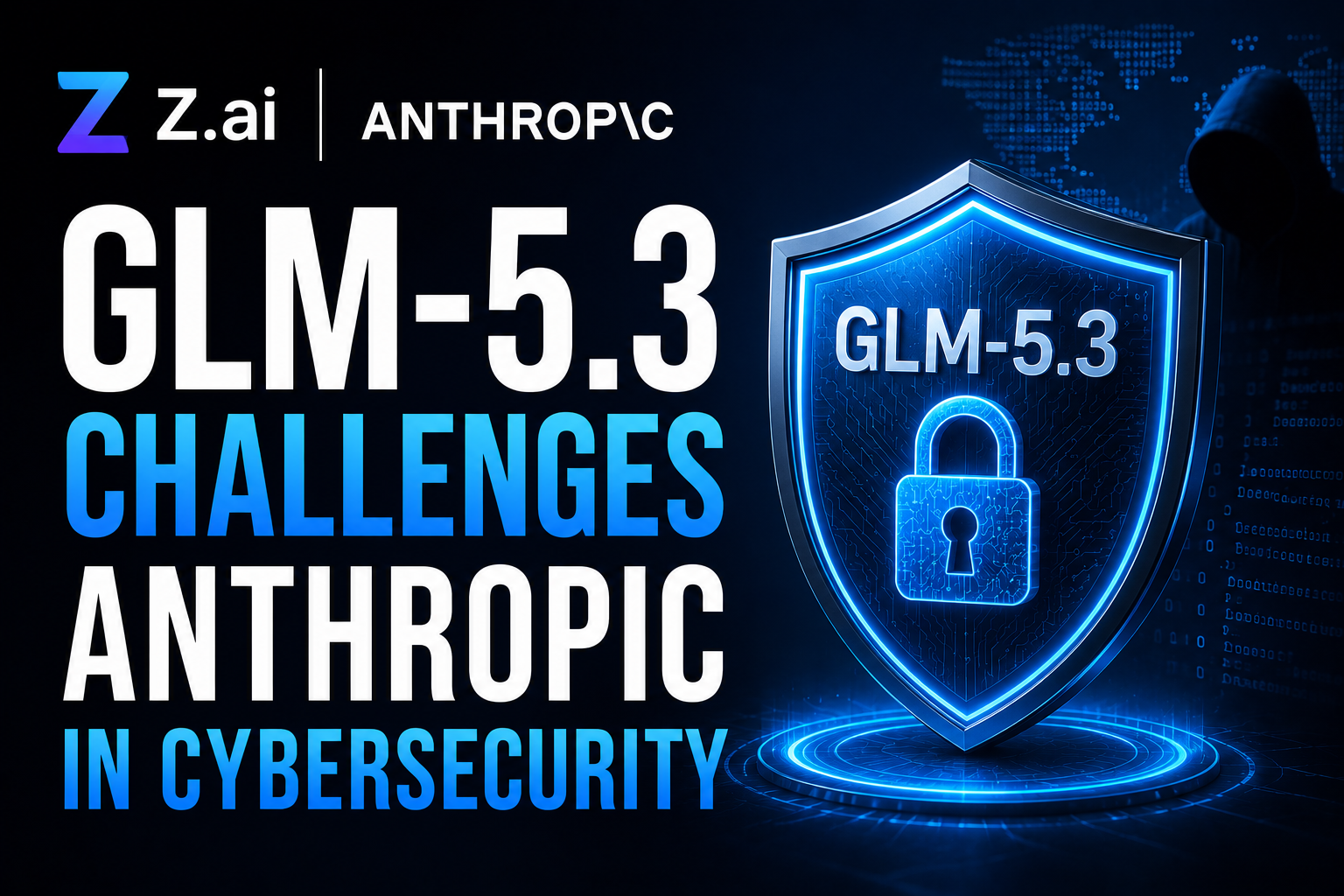

China’s Z.ai has released GLM-5.3, a new AI model that is showing strong results in cybersecurity tests and is challenging Anthropic’s restricted Mythos 5. Z.ai says GLM-5.3 can find software security problems at a level close to Anthropic’s model, while also being designed as a more open and accessible AI system.
The announcement is significant because cybersecurity is becoming one of the most important areas in the AI race. AI models are getting better at finding weaknesses in software, and companies are now using them to help security teams discover and fix problems before attackers can exploit them.
GLM-5.3 Gets a Strong Cybersecurity Score
Z.ai says GLM-5.3 scored 84.5% on CyberGym, a test designed to measure how well an AI can examine software, find security weaknesses and confirm that those weaknesses are real.
Anthropic’s Mythos 5 scored 83.8% in Z.ai’s comparison.
That puts GLM-5.3 slightly ahead on this particular test.
However, there is an important point: these results have not yet been independently verified. The numbers come from Z.ai’s own testing and comparison.
So it would be too early to say that GLM-5.3 is better than Mythos 5 overall.
GLM-5.3 Still Trails Anthropic on Exploit Development
Finding a security problem is only one part of cybersecurity.
The next step can involve creating a working exploit that demonstrates how the weakness could actually be used.
Here, Anthropic’s Mythos 5 has a clear advantage.
According to Z.ai:
| Cybersecurity Test | GLM-5.3 | Anthropic Mythos 5 |
|---|---|---|
| CyberGym | 84.5% | 83.8% |
| ExploitBench | 54.4% | 78.0% |
GLM-5.3 therefore performs very well at finding vulnerabilities, but Mythos 5 remains considerably stronger at turning those findings into working exploits.
This makes the comparison more interesting than simply saying one model has beaten another.
The two models show different strengths.
Mythos 5 Is a Restricted Cybersecurity Model
Anthropic’s Mythos 5 is not a normal consumer AI model.
It is a version of Anthropic’s AI that has additional cybersecurity restrictions removed for approved organizations.
Access is limited because a model that can discover and exploit software vulnerabilities can be useful to defenders—but the same capabilities could also help attackers.
Anthropic therefore provides access only to vetted organizations.
Z.ai is taking a different approach with GLM-5.3.
The company wants to make advanced cybersecurity capabilities available to a much wider group of developers and security teams while adding safeguards around the most sensitive functions.
GLM-5.3 Is Not Just a Cybersecurity Model
Another interesting part of GLM-5.3 is that it was not originally built as a dedicated cybersecurity system.
Z.ai says the model is based on its general-purpose GLM-5.2 model.
The company then used additional training and reinforcement learning with longer and more complex tasks to improve its ability to work on cybersecurity problems.
This is important.
It suggests that advanced cybersecurity skills can increasingly emerge from general AI models as their coding and reasoning abilities improve.
In other words, an AI doesn’t necessarily need to be built only for cybersecurity to become very capable at cybersecurity.
GLM-5.3 Can Complete Long Cyber Tasks
Z.ai also tested how quickly GLM-5.3 could complete cybersecurity tasks.
In a two-hour test:
- GLM-5.3 completed 105 tasks
- Mythos 5 completed 181 tasks
Over six hours:
- GLM-5.3 completed 130 tasks
- Mythos 5 completed 247 tasks
These results show that Mythos 5 still has a strong advantage when it comes to completing large numbers of attack-development tasks under time pressure.
So while GLM-5.3 is competitive in vulnerability discovery, Anthropic’s system remains ahead in some of the more advanced parts of cybersecurity work.
Z.ai Wants Cybersecurity AI to Be More Open
The bigger goal behind GLM-5.3 is not just beating Anthropic on benchmarks.
Z.ai is positioning the model as an open alternative to closed AI systems.
The company argues that advanced cybersecurity tools should not be available only to large companies with access to expensive private AI systems.
Smaller security teams and open-source developers could also use AI to find bugs and protect their software.
Z.ai is therefore launching an initiative called Open Source Shield.
The program is intended to support security work on selected open-source projects and provide AI-powered code auditing.
But Open AI Cybersecurity Comes With Risks
Making powerful cybersecurity AI more accessible also creates a difficult problem.
A model that can find security weaknesses can potentially be used for both good and bad purposes.
For example, a security team could use it to:
- Find bugs
- Check code
- Test software
- Improve security
- Fix vulnerabilities
But attackers could potentially try to use similar capabilities to:
- Find vulnerable systems
- Build attacks
- Automate security research
- Discover weaknesses faster
This is why Z.ai says GLM-5.3 includes several security controls.
The company says it has added systems that:
- Check risky requests
- Monitor model activity
- Train the model to reject malicious tasks
The most sensitive cybersecurity functions will also be limited to verified users through a trusted access program.
The Open-Source Problem
There is still a major question.
Z.ai plans to release GLM-5.3 publicly after completing more security testing and improving its safeguards.
Once a model is publicly available, however, developers can potentially modify it or connect it to other tools.
That makes safety controls more difficult to guarantee.
A company can control access to its own AI service.
It has much less control over what happens after model weights are released and developers begin building their own systems around them.
This is becoming one of the biggest debates around open AI models.
Why This Matters for the AI Industry
The GLM-5.3 announcement shows that the cybersecurity AI race is becoming global.
Anthropic is building specialized systems.
OpenAI is developing advanced cyber capabilities.
Chinese AI companies such as Z.ai are also pushing forward.
The competition is no longer simply:
Who has the smartest chatbot?
It is increasingly:
Who has the AI that can actually find, understand and fix real-world security problems?
That is a much more important question for businesses.
China Is Becoming a Serious AI Competitor
GLM-5.3 is also another example of the rapid progress of Chinese AI companies.
Z.ai’s earlier GLM models have gained attention among developers for coding and AI-agent tasks.
The new model takes that progress into cybersecurity.
This is important because the AI competition between China and the United States is increasingly moving beyond general chatbots.
Companies are competing across:
- AI models
- Coding
- AI agents
- Cybersecurity
- AI chips
- Data centers
- AI infrastructure
GLM-5.3 is another sign that Chinese AI companies are trying to compete directly with leading U.S. AI labs in advanced areas.
What Happens Next?
Z.ai says GLM-5.3 will be made publicly available after around two weeks of additional security testing and model hardening.
The company plans to keep its most sensitive cybersecurity functions behind its trusted-access system.
The next important step will be independent testing.
If outside researchers reproduce Z.ai’s CyberGym results, the model’s position in the cybersecurity AI market could become much clearer.
It will also be important to see how GLM-5.3 performs in real security work rather than only controlled benchmarks.
The Bigger Picture
GLM-5.3 is an important development because it shows how quickly AI models are becoming capable of working on real cybersecurity problems.
Z.ai’s model is already close to Anthropic’s Mythos 5 in vulnerability discovery according to the company’s tests, while still trailing Mythos 5 in exploit development.
That makes the story more balanced than simply calling GLM-5.3 a winner.
The real takeaway is that AI cybersecurity capabilities are spreading rapidly across the industry.
And as these models become better at finding software weaknesses, companies will have to use AI defensively just to keep up.
The future of cybersecurity could therefore look like an ongoing race:
AI finds vulnerabilities → defenders fix them → attackers use better AI → defenders build even better AI.
GLM-5.3 shows that this race is no longer limited to a handful of U.S. AI companies.
China’s Z.ai wants to be one of the major players—and cybersecurity may become one of its biggest battlegrounds.

 By
By