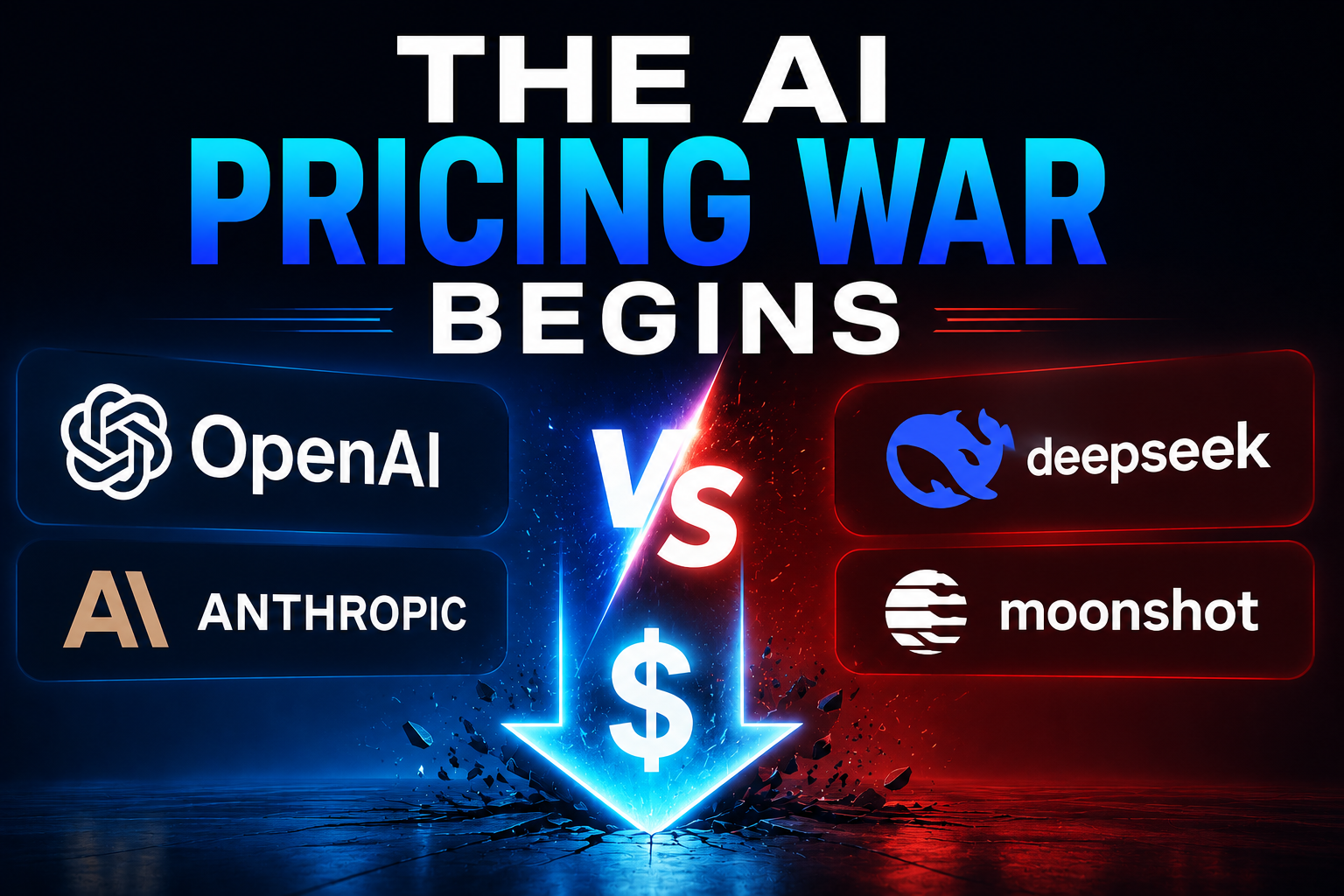

The AI industry is entering a new price war. OpenAI and Anthropic are cutting the cost of some of their mid-range AI models as cheaper Chinese competitors such as DeepSeek and Moonshot put increasing pressure on the market.
The changes show that the AI race is no longer only about building the smartest model. Price, speed and cost per task are becoming just as important, especially for businesses running AI at large scale.
OpenAI Makes a Huge Price Cut
OpenAI made one of the biggest moves in late July when it cut the price of its GPT-5.6 models.
The company’s GPT-5.6 Luna saw its price reduced by about 80%.
Its GPT-5.6 Terra received a smaller 20% price cut, while the company’s top-end GPT-5.6 Sol model was left unchanged.
The Luna price dropped to around:
- $0.20 per million input tokens
- $1.20 per million output tokens
Terra now costs:
- $2 per million input tokens
- $12 per million output tokens
The cuts are aimed at customers who want strong AI performance without paying the highest prices.
Anthropic Is Also Pushing Lower-Cost Models
Anthropic has been following a similar strategy.
Its Claude Opus 5 was launched at roughly half the price of its more powerful Fable 5 model while offering performance that Anthropic says comes close to the flagship system on many tasks.
There is an important detail here: Opus 5 itself did not receive a 50% price cut from its predecessor. Its $5 per million input-token and $25 per million output-token pricing is the same as Opus 4.8. The “50% cheaper” comparison is against Anthropic’s higher-end Fable 5.
Anthropic is also offering Claude Sonnet 5 at an introductory price of $2 per million input tokens and $10 per million output tokens through August 31, after which standard pricing is scheduled to rise to $3 and $15.
So the broader trend is clear: AI companies are creating cheaper models that can handle more of the work previously reserved for expensive systems.
Why Are Prices Falling?
One major reason is competition from China.
Companies such as DeepSeek and Moonshot AI have shown that highly capable AI models can be offered at much lower prices.
Chinese models have become increasingly competitive in coding, reasoning and AI-agent tasks.
That has made businesses more willing to consider alternatives to expensive U.S. models.
The Financial Times reports that companies including DoorDash and Airbnb are using Chinese AI alternatives to reduce costs, adding pressure on U.S. AI companies.
DeepSeek Changed the Pricing Conversation
DeepSeek has played an important role in changing expectations around AI costs.
The company became famous for producing powerful models at extremely low prices.
Its latest V4 models have continued that focus, although DeepSeek has now announced significant price increases for its V4 API models, with new peak and off-peak pricing scheduled to begin in August.
Even after those increases, DeepSeek’s pricing remains competitive with major Western AI providers.
This creates a difficult situation for companies such as OpenAI and Anthropic.
They need to convince customers that their models are worth paying more for.
Moonshot Is Adding More Pressure
Moonshot AI is another Chinese company attracting attention with its Kimi models.
The company’s Kimi K3 has narrowed the performance gap between Chinese and U.S. AI models, particularly in areas such as coding and agent tasks.
If businesses can get similar results from a cheaper model, the decision becomes simple:
Why pay more?
That question is forcing AI companies to rethink their pricing.
AI Is Becoming a Commodity
This could be one of the biggest changes in the AI industry.
A few years ago, access to the best AI models was a major competitive advantage.
Today, companies can choose from dozens of powerful models.
There are models from:
- OpenAI
- Anthropic
- DeepSeek
- Moonshot
- Z.ai
- Alibaba
- Meta
- Other open-source developers
As the number of capable models grows, model intelligence alone becomes less valuable.
The cost of running the model becomes much more important.
Businesses Are Watching Their AI Bills
Another major reason for the price war is that companies are becoming more careful about AI spending.
Running an AI application at small scale can be inexpensive.
Running it millions of times every day is very different.
A company building an AI customer-service system, coding agent or document-processing tool could generate billions of tokens.
Even a small difference in price can therefore become millions of dollars in annual savings.
That makes AI pricing a major business decision.
Cheaper AI Could Actually Increase AI Usage
There is an interesting effect happening in the market.
When AI becomes cheaper, companies may not simply save money.
They may use much more AI.
OpenAI’s recent price cuts provide an early example. According to analysts cited by Business Insider, usage of GPT-5.6 Luna increased about 14 times after its major price reduction, while Terra usage increased around five times.
This means lower prices can create much higher demand.
Businesses that previously avoided using AI for certain tasks may suddenly find those tasks affordable.
For example:
Expensive AI → only important tasks
Cheap AI → AI everywhere
That could dramatically increase the size of the AI market.
The Real Competition Is Cost Per Task
Token pricing alone does not tell the whole story.
A cheaper model is not always cheaper to use.
If one model needs 10 times more tokens to complete a task, its lower token price may not matter.
Companies are therefore increasingly looking at:
How much does it cost to complete the job?
This could include:
- Number of tokens
- Response speed
- Number of model calls
- Tool usage
- Hardware costs
- Reliability
- Human intervention
The winner may not be the model with the cheapest token price.
It could be the model that delivers the lowest cost for a completed task.
The Price War Could Hurt AI Companies Too
Lower prices are great for customers, but they create a difficult problem for AI companies.
Training frontier models costs billions of dollars.
Running them also requires huge amounts of:
- GPUs
- Data centers
- Electricity
- Networking
- Cooling
If companies keep cutting prices, they need to make up the difference through much higher usage.
This is why efficiency is becoming so important.
The companies that can reduce the cost of running their models have more room to lower prices while still making money.
The AI Race Is Changing
The industry used to ask:
Who has the smartest AI model?
Now businesses are asking:
Which model gives me the best result for the lowest cost?
That is a much harder competition.
OpenAI and Anthropic still have major advantages in areas such as enterprise adoption, developer ecosystems and advanced AI capabilities.
But Chinese competitors are making the market more competitive.
The gap between performance and price is becoming increasingly important.
What This Means for AI Users
For developers and businesses, the price war could be very good news.
They will have more choices and lower costs.
It could become easier to build:
- AI agents
- Customer-service systems
- Coding tools
- Research assistants
- AI-powered applications
- Automated business workflows
Developers may also increasingly use multiple AI models instead of relying on one provider.
For example, a company could use an expensive model for difficult tasks and a cheaper model for routine work.
This could become the normal way AI systems are built.
The Bigger Picture
The AI pricing war is becoming one of the most important developments in the industry.
OpenAI’s 80% reduction for GPT-5.6 Luna shows just how quickly prices can fall. Anthropic is also offering more capable models at lower prices compared with its highest-end systems. Meanwhile, Chinese companies such as DeepSeek and Moonshot are putting further pressure on the market.
This could lead to a major change in how AI is sold.
Instead of paying a premium simply for access to a powerful model, customers may increasingly compare performance per dollar.
And as AI becomes cheaper, companies may use it for more and more tasks.
The biggest winner could ultimately be the customer.
But for AI companies, the next challenge is much harder:
How do you keep making billions of dollars when the price of intelligence keeps falling?
That question could define the next phase of the AI industry.

 By
By