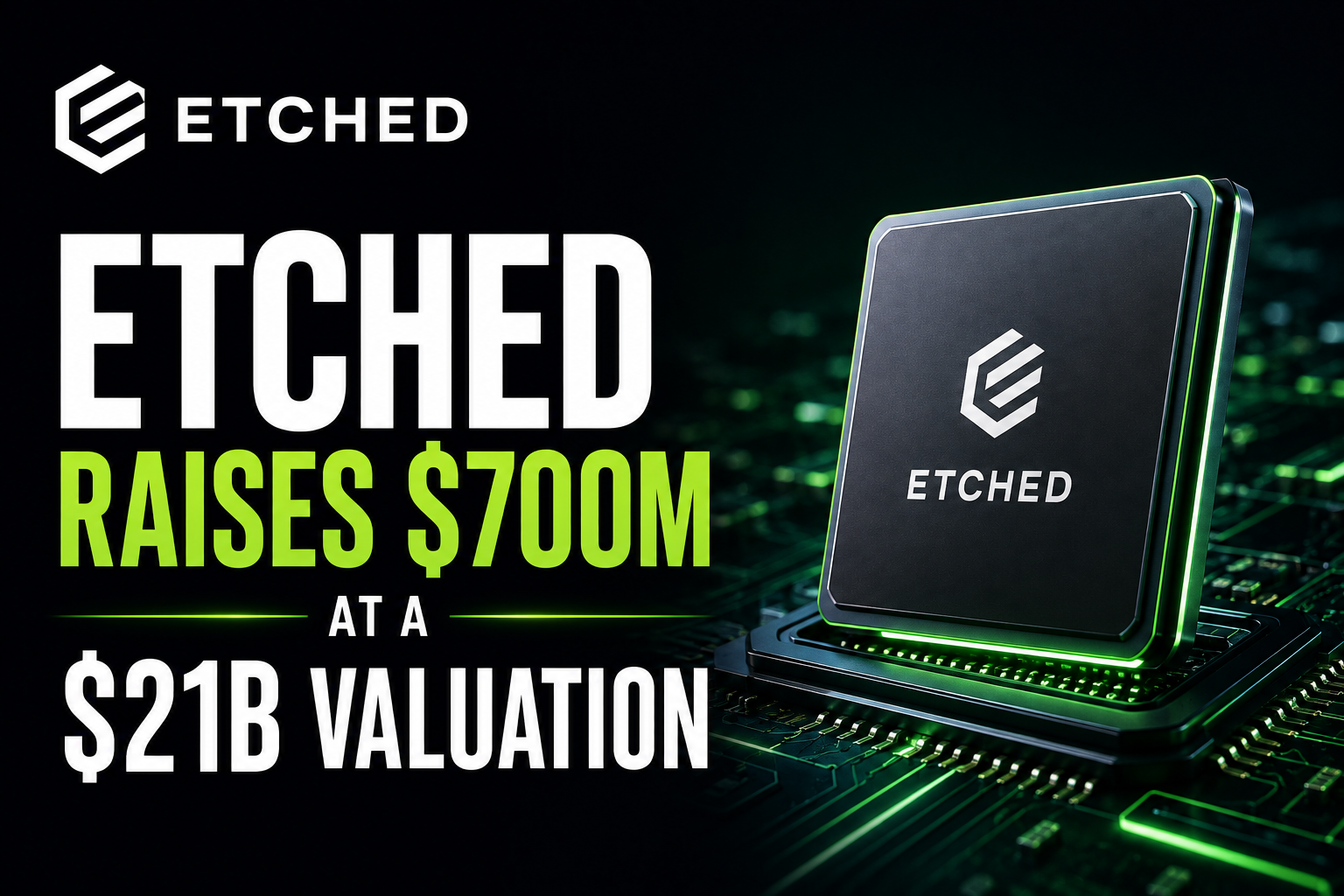

AI chip startup Etched has raised $700 million in a new funding round, pushing its valuation to $21 billion and more than doubling the company’s value in less than a month.
The massive round shows how aggressively investors are betting on the next generation of AI infrastructure, especially chips designed to handle AI inference — the process of running trained AI models to generate answers, images, code and other outputs.
The San Jose-based company is positioning itself as a challenger to Nvidia by developing specialized hardware designed to make AI models faster and cheaper to run.
Etched’s Valuation Has Exploded
Etched was valued at $10.3 billion in July after raising $300 million in a Series C round led by Sequoia Capital.
Now, just weeks later, the company has raised another $700 million at a $21 billion valuation.
That means Etched’s valuation has more than doubled in an extremely short period.
The latest round was led by Jane Street, with participation from major investors including:
- Kleiner Perkins
- Sequoia
- Andreessen Horowitz
- Tiger Global
- Other existing and new investors
Jane Street is not only an investor. It is also Etched’s first customer and has already started deploying the company’s hardware.
What Does Etched Build?
Etched develops specialized AI chips and complete computing systems designed specifically for AI inference.
Most AI models require enormous amounts of computing power when users interact with them.
Every time someone asks an AI chatbot a question, generates an image or uses an AI coding agent, the model needs to process that request.
This is inference.
As AI applications become more popular, the amount of inference computing required is growing rapidly.
Etched believes existing general-purpose GPUs are not always the most efficient solution for this workload.
Its goal is to build hardware that can process AI models:
Faster + Cheaper + With Less Energy
Why Inference Is Becoming So Important
The AI industry initially focused heavily on training.
Training is the process of teaching a model using huge amounts of data.
But once a model is trained, companies need to run it millions or billions of times for users.
That is where inference comes in.
For AI companies, inference can become one of the largest ongoing costs.
As more people use:
- AI chatbots
- AI coding agents
- AI search
- AI video tools
- AI assistants
- Autonomous agents
the demand for inference computing keeps increasing.
Etched is betting that this market will become enormous.
Etched Wants to Challenge Nvidia
Nvidia currently dominates the AI accelerator market.
Its GPUs are used extensively for both training and inference.
Etched is taking a different approach.
Rather than building a general-purpose processor that can handle many workloads, the company is designing hardware specifically around the requirements of modern AI inference.
The company says its systems can make AI models run faster and more efficiently.
That puts Etched among a growing group of startups attempting to reduce dependence on Nvidia.
However, Nvidia’s enormous software ecosystem, hardware scale and customer base make it extremely difficult to compete with the company.
Etched Already Has More Than $1 Billion in Customer Contracts
One of the biggest reasons investors are taking Etched seriously is customer demand.
The company says it has secured more than $1 billion in customer contracts across public and private AI companies and cloud providers.
That is significant for a startup that is still relatively young.
Jane Street has already received its first Etched rack and has started deploying the technology for its workloads.
This gives Etched something many semiconductor startups struggle to obtain:
real customers testing and deploying its hardware.
Etched Has More Than 400 Employees
The company has also grown quickly.
Etched now has more than 400 employees and has a working chip.
That represents a major change from the company’s early days.
Etched was founded in 2022 by a group of young entrepreneurs who believed AI inference would eventually require specialized hardware.
The company has since attracted major investors and built its own AI computing infrastructure.
Why Investors Are Betting So Heavily
The latest funding round shows that investors believe the AI infrastructure market could become much larger.
There is a simple reason.
AI models are getting more powerful, but running those models at scale is expensive.
If a company can reduce the cost of serving each AI response, it could potentially save enormous amounts of money.
That makes metrics such as:
Tokens per dollar
and
Tokens per watt
increasingly important.
Kleiner Perkins managing partner Mamoon Hamid said inference will be one of the most important infrastructure markets in AI, with winners measured by efficiency.
Etched’s Technology Focuses on Inference
Etched has designed its systems specifically around the two major stages of inference:
Prefill
This is where the system processes the user’s prompt and context.
It can involve significant computation.
Decode
This is where the model generates the response token by token.
Decode requires very fast access to large amounts of memory.
Etched has developed custom technologies for both stages.
Earlier this year, the company described its approach as using low-voltage inference for compute and cluster-scale memory to improve communication between chips and memory.
The goal is to reduce bottlenecks that can slow down AI workloads.
The AI Chip Race Is Getting Bigger
Etched is not alone.
A growing number of companies are developing specialized AI processors to challenge Nvidia.
The market includes companies working on:
- AI inference
- AI training
- Memory systems
- Networking
- Custom accelerators
- Energy-efficient computing
This is happening because AI workloads are becoming more specialized.
A chip designed specifically for one type of AI workload can potentially outperform a general-purpose processor on that workload.
The trade-off is that specialized hardware can be harder and more expensive to develop.
There Is Still a Big Risk
Despite the huge valuation, Etched has not yet proven that it can become a major semiconductor business.
The history of the chip industry is full of technically impressive companies that struggled commercially.
Building a working chip is only the beginning.
Etched still needs to:
- Manufacture at scale
- Deliver systems reliably
- Support customers
- Compete on price
- Maintain performance advantages
- Build software around its hardware
- Scale production
Reuters noted that semiconductor history contains many examples of promising chips that never became successful businesses.
That makes the $21 billion valuation particularly ambitious.
Why This Funding Matters for AI
The funding is another sign that the AI infrastructure race is moving beyond Nvidia GPUs.
For years, the AI hardware story was dominated by one question:
How many GPUs can we get?
Now the conversation is becoming:
What is the most efficient hardware for each AI workload?
As inference becomes a larger part of AI spending, specialized chips could become increasingly valuable.
If Etched can deliver its promised performance and efficiency at scale, it could become an important alternative in the AI infrastructure market.
The Bigger Picture
Etched’s $700 million funding round at a $21 billion valuation is one of the strongest signals yet that investors expect AI inference to become a massive infrastructure market.
The company has already secured more than $1 billion in customer contracts, has a working chip and is beginning to deploy its systems with customers such as Jane Street.
But the real challenge starts now.
Etched must prove that its specialized hardware can move from promising technology to a large-scale commercial business.
If it succeeds, the company could become one of the most important challengers to Nvidia in AI inference.
If it fails to scale, its huge valuation could quickly become difficult to justify.
For now, however, investors are clearly betting that the future of AI will require much more than powerful models — it will require entirely new hardware to run them efficiently.

 By
By