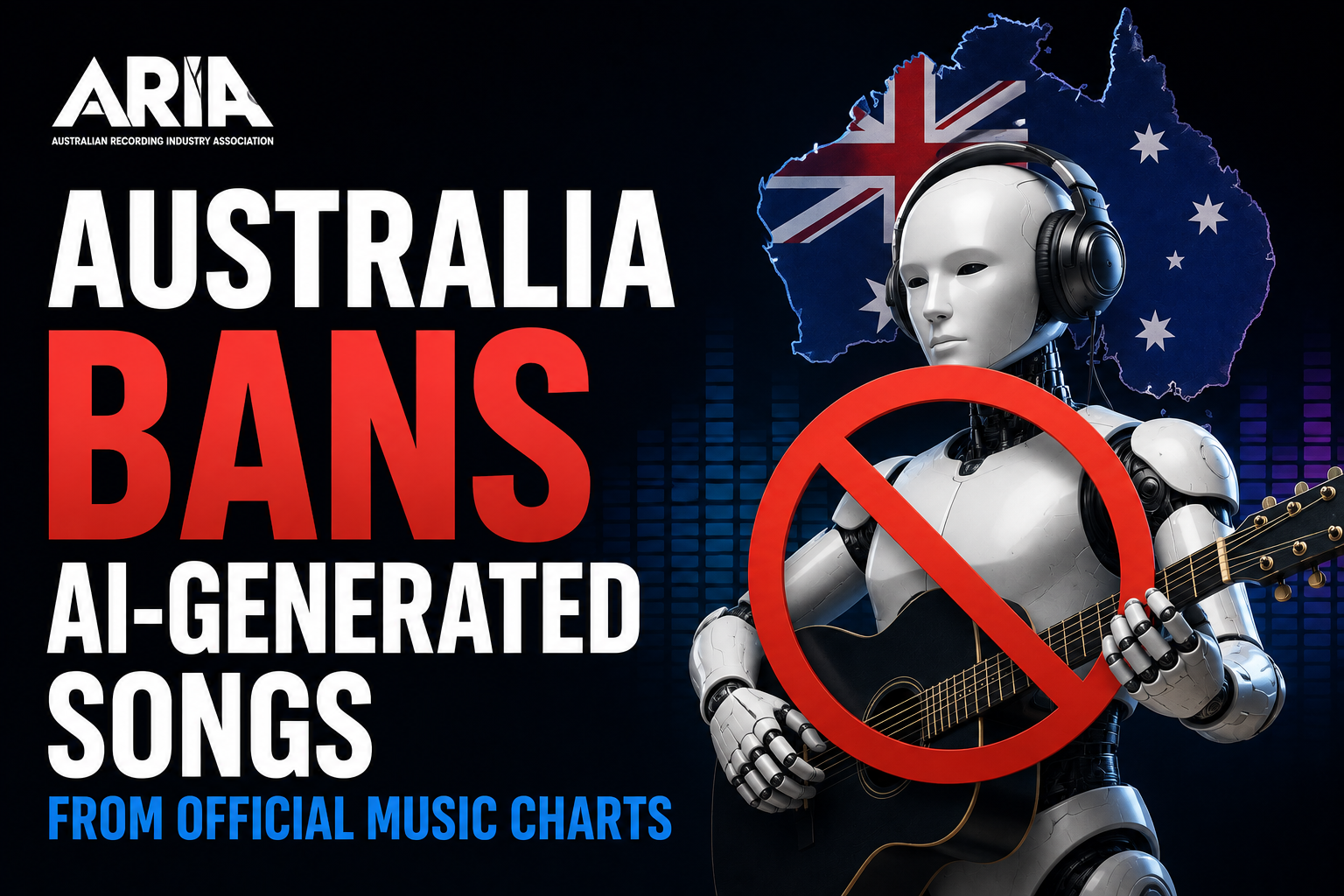

Australia is drawing a clear line between music made by people and music made entirely by AI. The Australian Recording Industry Association (ARIA) has announced new rules that will keep fully AI-generated songs out of Australia’s official music charts.
The new rules will take effect with the ARIA chart dated August 31, 2026, which will be published on August 28.
However, this is not a complete ban on AI in music.
Artists can still use AI as a tool. Songs can use AI for supporting tasks, as long as the final recording is substantially human-made and meets ARIA’s other requirements.
The decision comes as AI-generated music is becoming increasingly popular on streaming platforms—and after an AI-assisted version of Madonna’s “Like a Prayer” became a major hit in Australia.
What Exactly Is Australia Banning?
Under the new ARIA rules, songs that are wholly generated by AI will not be eligible for the official ARIA Charts.
For a song using generative AI to remain eligible, ARIA says it must be:
- Substantially human-made
- Created using legal and authorized AI services
- Free from concerns about stream or chart manipulation
- Based on meaningful human creative work
This means Australia is not banning musicians from using AI.
Instead, ARIA is trying to separate:
AI-assisted music
from
AI-generated music.
AI-Assisted Music Can Still Enter the Charts
This is one of the most important parts of the new policy.
A musician can still use AI during the creative process.
For example, AI could help with:
- Mixing
- Mastering
- Editing
- Sound design
- Production ideas
- Other supporting tasks
If humans remain the main creators, the song can still qualify.
ARIA says the rules are intended to leave room for artists who use AI as a creative tool while preventing completely AI-generated recordings from competing directly with human-created music.
Humans Need to Remain the Main Creators
The new rules set a fairly clear direction for what ARIA considers human-made music.
According to reporting on the rules, eligible tracks are expected to have humans responsible for key creative parts such as:
Songwriting + lead vocals + primary instruments
AI can assist, but it cannot replace the main human creative contribution.
This creates an important difference.
Example 1 — Likely allowed
A singer writes a song, records the vocals and instruments, then uses AI to improve the mix.
Human-made → AI-assisted → Eligible
Example 2 — Likely not allowed
A person enters a prompt into an AI music generator and receives the lyrics, vocals, melody and instruments entirely from the system.
AI-made → Not eligible
The exact eligibility decision can still depend on ARIA’s review.
Why Did ARIA Make This Decision?
The decision comes after AI-generated music started gaining real attention in Australia’s music charts.
One of the biggest examples is an AI-assisted version of Madonna’s “Like a Prayer”, created by Queensland DJ and producer Josh Fawaz.
The track became the most-played song on Australian radio in July and reached No. 4 on two ARIA charts.
It also spent a long period inside Australia’s top 20.
The song became controversial after Fawaz acknowledged that AI had been used to create parts of it, including the vocals and drums.
That created a difficult question for the music industry:
Should a song partly or largely created by AI be allowed to compete for the same chart positions as music created by human artists?
ARIA has now answered that question.
The “Like a Prayer” Controversy
The Fawaz track became an important example of how quickly AI music can enter the mainstream.
The song was popular with listeners and radio stations, but its use of AI raised concerns among people in the music industry.
According to ABC, Fawaz initially described AI as a tool and later updated the song’s Spotify credits to identify AI-generated vocals and drums.
Under the new ARIA rules, tracks using AI in major creative roles could potentially fail the requirement that a recording be substantially human-made.
That means the song’s chart status could come under review under the new system.
AI Music Is Growing Very Quickly
Australia’s decision comes at a time when AI-generated music is spreading rapidly across streaming platforms.
AI music tools can now create:
- Complete songs
- Vocals
- Instrumentals
- Background music
- Different singing styles
- Music in different genres
A person without traditional music-production skills can create a song in minutes.
That has opened music creation to many new people.
But it has also created major concerns for professional musicians.
Artists Are Worried About Their Work Being Used to Train AI
One of the biggest concerns is not simply that AI can make music.
It is how AI music models are trained.
Some AI systems have been trained using very large collections of music.
Artists and rights holders have raised concerns about whether their recordings were used without permission.
ARIA’s new rules specifically say eligible AI-assisted music must use legal and authorized AI services.
This is an important part of the policy.
ARIA is not only asking:
“Was AI used?”
It is also asking:
“Was the AI used legally, and was the human contribution meaningful?”
What Happens If a Song Breaks the Rules?
ARIA has given itself stronger powers under the updated rules.
If a recording is found to be ineligible, ARIA can:
- Remove it from the charts
- Change chart positions
- Withdraw chart recognition
- Remove it from consideration for ARIA Awards
- Revoke awards that were already given
Artists and representatives will also have a process to challenge eligibility decisions.
This gives ARIA a way to respond even if an AI-generated track manages to become popular before its use of AI is discovered.
Why Chart Rules Matter
Music charts are not just lists of popular songs.
They are also used to measure success.
A high chart position can help an artist receive:
- More attention
- Radio play
- Streaming activity
- Media coverage
- Awards
- Brand opportunities
- Concert opportunities
If a fully AI-generated song takes a chart position away from a human artist, it could affect that artist’s career.
ARIA CEO Annabelle Herd said the charts are intended to celebrate human artistry and that allowing unlicensed AI output could undermine the purpose of the recorded-music industry.
Australia Is Following a Larger Global Trend
Australia is not making this decision in isolation.
ARIA said its new rules are aligned with principles developed by the International Federation of the Phonographic Industry (IFPI).
The global music industry has been working on ways to distinguish between:
AI-generated recordings
and
recordings where AI is simply used as a tool.
More than 20 official chart programs were reportedly moving toward similar principles.
This means Australia’s decision could become a model for other music markets.
AI Is Not Being Removed From Music
It is important not to misunderstand the announcement.
Australia is not saying musicians cannot use AI.
A human musician can still use AI to improve their work.
Think about it like this:
Traditional music production
Human artist → AI-assisted production → Finished song
Allowed
Fully AI-generated music
Prompt → AI creates song → Human uploads it
Not eligible for ARIA charts
This distinction could become common across the music industry.
But Who Decides What Is “Human-Made”?
This may become the hardest part of the new rules.
Imagine a song where:
- A human writes the lyrics
- AI creates the melody
- A human sings
- AI creates the drums
- AI generates background vocals
- A human edits the final recording
Is that human-made or AI-generated?
There may not always be an easy answer.
That’s why ARIA’s rules focus on whether the recording is “substantially human-made” and whether the human contribution is meaningful.
ARIA can also review individual cases.
As AI tools become more advanced, these decisions could become increasingly complicated.
This Could Change How Artists Use AI
The new rules may encourage musicians to keep better records of their creative process.
Artists may need to show:
- What they created themselves
- Which AI tools they used
- What parts were generated by AI
- How much they changed the AI output
- Whether the AI service was authorized
This could eventually lead to something similar to AI credits in music.
Instead of hiding AI use, artists may openly explain how it was used.
Streaming Platforms Face a Similar Problem
Music charts are only one part of the issue.
Streaming platforms are also dealing with huge numbers of AI-generated songs.
Spotify, for example, has been working on ways to identify AI-related artist identities and improve transparency around AI content.
But platform policies and chart policies are not necessarily the same.
A song may be allowed to appear on a streaming service while still being ineligible for an official music chart.
That distinction could become increasingly important.
Could Other Countries Follow Australia?
Very possibly.
The music industry is facing the same problem around the world.
If fully AI-generated songs begin taking significant chart positions in one country, other chart organizations may face pressure to establish their own rules.
Australia’s policy provides a simple framework:
AI can be a tool, but humans must remain the main creators.
Other countries could adopt similar rules.
What This Means for AI Music Companies
AI music companies could also face pressure to become more transparent.
Their systems may need to provide clearer information about:
- Training data
- Artist permissions
- Copyright
- AI-generated vocals
- AI-generated instruments
- Commercial rights
- User ownership
The more important AI becomes in music production, the more these questions will matter.
The Bigger Debate: Can AI Music Be Art?
Australia’s decision raises a much bigger question.
If an AI system creates a song, is that song art?
There is no simple answer.
AI can create music that listeners genuinely enjoy.
It can also help human musicians experiment with sounds that would otherwise be difficult to produce.
But the music industry argues that there is a major difference between:
A human artist using AI
and
AI replacing the human artist.
Australia’s new chart rules clearly favor the first approach.
The Bigger Picture
Australia’s decision is an important moment in the growing debate over AI-generated music.
Starting with the August 31 ARIA chart, fully AI-generated songs will no longer be eligible for Australia’s official charts. AI-assisted songs can still qualify, provided they are substantially human-made, use authorized AI services and do not raise concerns about chart manipulation.
The change follows the rapid growth of AI-generated music and the recent success of an AI-assisted “Like a Prayer” cover in Australia’s music market.
For artists, the message is clear:
Using AI is not the problem. Replacing the human creator is where ARIA is drawing the line.
The next challenge will be deciding exactly where that line sits.
As AI music becomes harder to distinguish from human-made music, chart organizations around the world may soon face the same question:
When does AI stop being a tool and start becoming the artist?

 By
By