
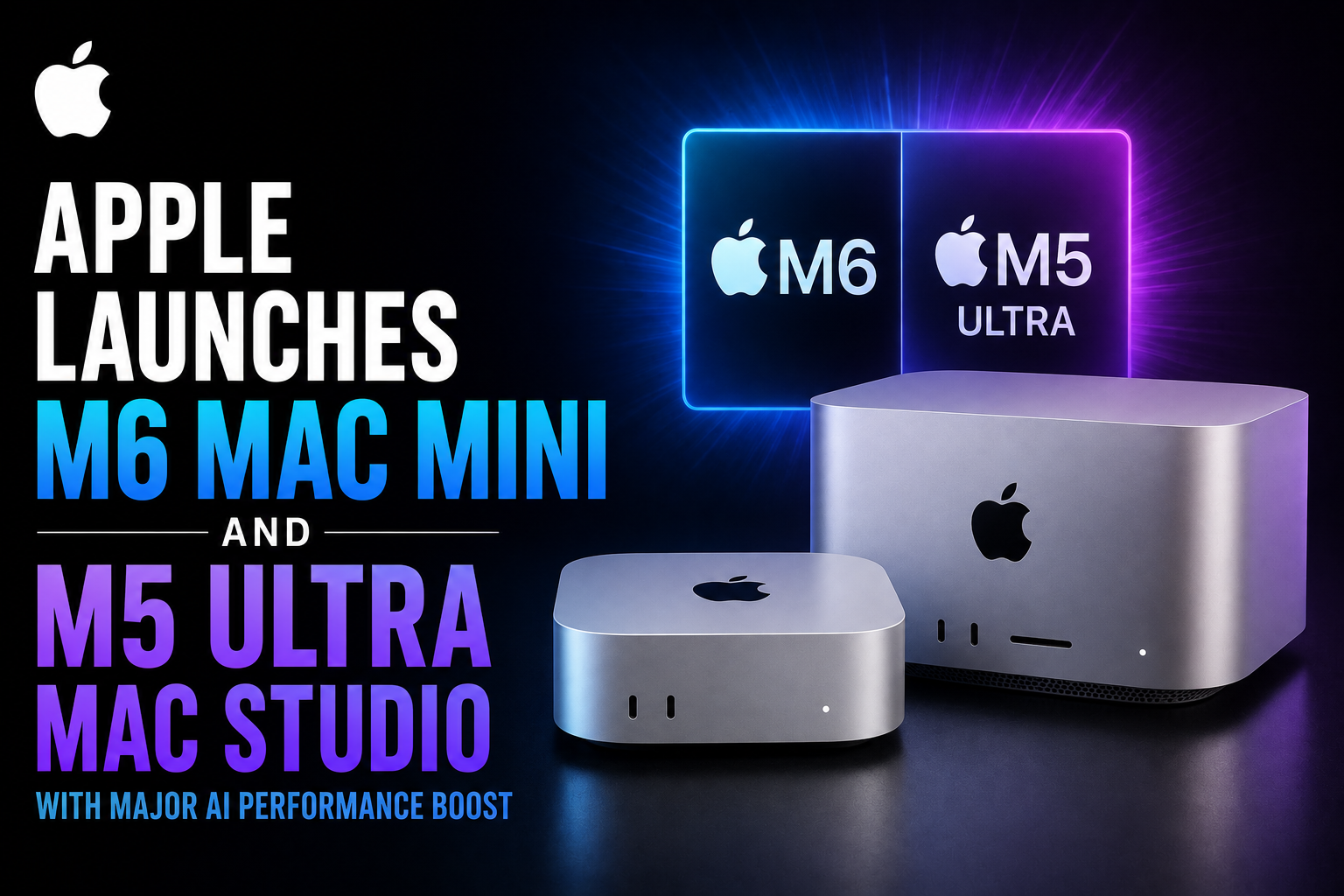

Apple has introduced a new Mac mini powered by the M6 chip and a new Mac Studio powered by the M5 Max and M5 Ultra chips, putting a much stronger focus on local AI, coding and high-performance workloads.
The new machines were announced on August 25, 2026, and preorders are now open. Apple says they will begin reaching customers on September 22.
The launch is important because the new M6 is Apple’s first 2-nanometer Mac chip, while the M5 Ultra becomes Apple’s most powerful chip yet.
Apple Is Putting AI at the Center
The biggest story behind these new Macs is not their design.
It is AI performance.
Apple is increasingly positioning its desktop computers as machines that can run AI models locally rather than sending every task to the cloud.
That is possible because Apple’s chips combine the CPU, GPU, Neural Engine and memory into a unified system.
For AI developers, this can be useful because large models can sometimes be loaded directly into the Mac’s unified memory.
Apple’s previous M3 Ultra Mac Studio could already run language models with more than 600 billion parameters entirely in memory.
The new M5 Ultra pushes this idea much further.
M6: Apple’s First 2nm Mac Chip
The new M6 is the biggest change inside the Mac mini.
It is Apple’s first Mac chip built using a 2-nanometer manufacturing process.
The chip has a 12-core CPU made up of:
- 2 super cores
- 4 performance cores
- 6 efficiency cores
It also includes a 12-core GPU and a dual 16-core Neural Engine designed to speed up AI workloads.
Apple says the M6 can deliver up to 40% faster CPU performance than the M4 in some workloads, while also improving graphics and AI performance.
The chip also has faster memory, with bandwidth reaching up to around 170GB/s, depending on configuration.
The New Mac mini Gets a Big AI Upgrade
The new Mac mini is available with either:
M6
or
M5 Pro
The M6 version starts at $899 with 16GB of unified memory and 256GB of storage.
That is more expensive than the original launch price of the previous M4 Mac mini.
Apple has also improved connectivity.
The new Mac mini includes:
- Wi-Fi 7
- Bluetooth 6
- 2.5Gb Ethernet
- Optional 10Gb Ethernet
- Faster storage
- Updated Apple silicon
For developers, however, the biggest limitation is memory.
The M6 Mac mini can be configured with up to 32GB of unified memory.
That makes it more suitable for smaller local AI models than extremely large models.
M5 Ultra: Apple’s Most Powerful Chip Yet
The real monster in today’s announcement is the M5 Ultra.
Apple describes it as its most powerful chip ever.
The chip uses a new quad-die architecture, connecting four chip dies through Apple’s UltraFusion technology.
It can be configured with up to:
- 36 CPU cores
- 80 GPU cores
- 32-core Neural Engine
- 512GB unified memory
- Up to 1.2TB/s memory bandwidth
That huge memory capacity is particularly interesting for AI developers.
Large AI models can require hundreds of gigabytes of memory.
Instead of sending everything to a cloud GPU, developers can potentially run some very large models directly on a Mac Studio.
Mac Studio Is Becoming an AI Developer Machine
The new Mac Studio comes with two chip choices:
M5 Max
Starting at $2,499
M5 Ultra
Starting at $5,499
The M5 Ultra model starts with 96GB of unified memory and 1TB of storage.
A 512GB memory configuration is also planned, although Apple says that option will not arrive until late October and pricing has not yet been announced.
This makes the Mac Studio particularly interesting for:
- AI developers
- Machine-learning researchers
- Software developers
- Video professionals
- 3D artists
- Data scientists
- AI startups
Running AI Models Locally Is Becoming a Major Trend
One of the most interesting changes in AI is the move toward local AI.
Instead of:
Your computer → Cloud → AI model → Cloud → Your computer
developers can increasingly use:
Your computer → Local AI model
This can provide several advantages.
Privacy
Sensitive data can remain on the machine.
Lower cloud costs
Developers don’t need to pay for every API request.
Speed
There is no need to send every request over the internet.
Offline use
Some AI applications can continue working without an internet connection.
Apple’s unified-memory design is particularly useful here because CPU and GPU workloads can access the same memory pool.
Apple Is Targeting AI Agents
The timing of these Macs is also interesting because AI agents are becoming more popular.
AI agents can perform multiple steps instead of simply answering one question.
For example:
Open a project → read the code → make changes → run tests → find errors → fix them → repeat
These workflows can use large amounts of memory and computing power.
Apple’s new Macs are therefore being positioned as useful machines for developers building and running these systems.
Reuters specifically reported that the new Mac mini is aimed at users running AI agents such as OpenClaw.
Mac Studio Can Go Even Further
Apple is also promoting the ability to connect multiple Mac Studios together through Thunderbolt 5.
This can allow their memory resources to be shared for very large AI workloads.
According to WIRED, Apple demonstrated connecting multiple Mac Studios to run frontier-scale language models with more than one trillion parameters locally.
That doesn’t mean every Mac Studio can independently run a trillion-parameter model.
Instead, multiple systems can work together.
This is an interesting approach for developers who want large local AI systems without buying a traditional GPU server.
AI Performance Is Not the Only Upgrade
The new chips also improve traditional computing.
The M6 includes improvements to:
- CPU performance
- GPU performance
- Ray tracing
- Memory bandwidth
- Storage speed
- Neural processing
Apple says the new systems can deliver significant improvements in graphics and storage performance as well.
For professional users, this means the same machine can handle:
AI + video editing + 3D rendering + software development + graphics
without needing separate hardware.
The Design Has Not Changed Much
If you’re expecting a completely redesigned Mac mini or Mac Studio, there isn’t much to see.
The new machines keep the familiar compact designs.
The biggest changes are inside.
That is actually important for Apple.
Instead of redesigning the products, Apple is using the same small desktop designs while putting significantly more computing power inside them.
Prices Are Going Up
There is one downside.
The new machines are more expensive.
The new Mac mini with M6 starts at $899, while the Mac Studio with M5 Ultra starts at $5,499.
Apple is also dealing with higher memory and storage costs as demand from AI data centers continues to grow.
Reuters reported that rising memory-chip costs are contributing to higher prices for the new Macs.
This is an interesting side effect of the AI boom:
AI is making computing more powerful—but it is also increasing demand for the components used to build computers.
M6 Mac mini vs M5 Ultra Mac Studio
| Feature | Mac mini M6 | Mac Studio M5 Ultra |
|---|---|---|
| Starting price | $899 | $5,499 |
| CPU | Up to 12 cores | Up to 36 cores |
| GPU | Up to 12 cores | Up to 80 cores |
| Neural Engine | Dual 16-core | 32-core |
| Unified memory | Up to 32GB | Up to 512GB |
| Main target | Developers, consumers | AI & professional workloads |
| AI focus | Local AI and agents | Large AI models |
| Chip process | 2nm | M5 generation |
| Availability | September 22 | September 22 |
The Mac mini is designed to bring more AI power to a much wider audience.
The Mac Studio is aimed at people who need serious computing power and huge amounts of memory.
Why This Launch Matters for AI
Apple has traditionally focused more on AI features inside its devices than on selling Macs specifically as AI development machines.
That is changing.
The growth of local AI tools has created a new market.
Developers increasingly want to run:
- LLMs
- Coding agents
- Image models
- Video models
- AI assistants
- Research tools
directly on their computers.
Apple’s unified-memory architecture gives its high-end Macs an interesting advantage for these workloads.
Apple Is Taking a Different AI Approach
Nvidia’s strategy is largely built around powerful dedicated GPUs.
Apple is taking a different approach.
Its chips combine:
CPU + GPU + Neural Engine + Unified Memory
into one system.
That can make the hardware extremely efficient for certain AI workloads.
The M5 generation already introduced Neural Accelerators in every GPU core, which Apple said produced more than four times the peak GPU compute performance for AI compared with M4 in certain workloads.
The M6 and M5 Ultra continue that direction.
The Bigger Picture
Apple’s new Mac mini and Mac Studio show how quickly AI is changing the desktop computer market.
A few years ago, a compact desktop was mainly used for:
Office work + coding + creative work
Now Apple is increasingly selling these machines as platforms for:
AI development + local LLMs + AI agents + professional computing
The M6 Mac mini brings Apple’s new 2nm architecture to a smaller and more affordable desktop, while the M5 Ultra Mac Studio pushes toward workstation-level local AI with up to 512GB of unified memory.
The real question is how many developers will choose local AI over cloud AI.
If local models continue becoming smaller, faster and more capable, machines like these could become important AI development tools.
Apple isn’t just making faster Macs. It is building Macs for a future where AI runs directly on your desk.

 By
By