
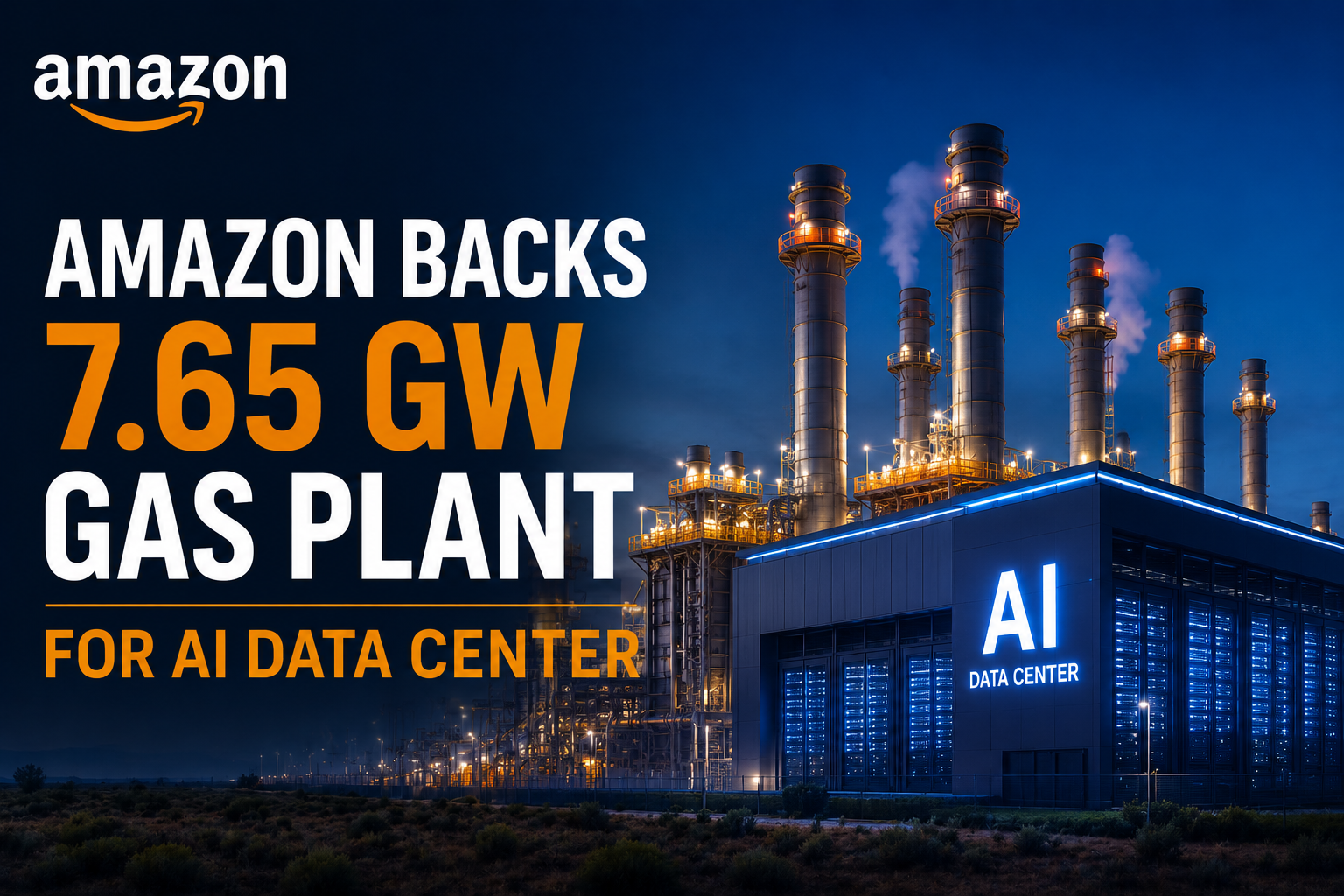

Amazon is investing in a massive natural-gas power project in West Texas that will provide electricity to a planned AI-focused data center campus, highlighting how the enormous energy demands of artificial intelligence are reshaping the relationship between Big Tech and the power industry.
The project, known as GW Ranch, is planned in Pecos County, Texas, and will feature 35 natural-gas turbines capable of generating up to 7.65 gigawatts (GW) of electricity. Amazon has acquired the site and confirmed that it plans to purchase power from the plant.
The project is particularly notable because the power facility is initially expected to operate off the Texas electricity grid, effectively creating a dedicated power system for Amazon’s data center campus.
Why Amazon Needs 7.65 GW of Power
The scale of the project reflects a fundamental problem facing the AI industry: AI data centers require enormous amounts of electricity.
Training and operating advanced AI models requires thousands of high-performance processors running continuously. As companies deploy increasingly powerful models, AI inference workloads are also growing rapidly.
Traditional data centers can often rely on existing electrical infrastructure.
The newest AI campuses are different.
Some require power on the scale of entire cities, and connecting such facilities to existing grids can take years because of transmission, generation, and interconnection constraints.
Amazon’s solution is to develop new generation capacity alongside its data center.
What Is GW Ranch?
GW Ranch is a large power-generation project being developed by Pacifico Energy in Pecos County.
The planned facility includes:
- 7.65 GW of generation capacity
- 35 natural-gas turbines
- A private, behind-the-meter power system
- Electricity primarily dedicated to Amazon’s planned data center
- Future potential for connection to the Texas grid
The Texas Commission on Environmental Quality has granted the project an air permit allowing emissions of up to approximately 33 million tons of greenhouse gases annually. That is a permitted maximum, not a forecast of actual yearly emissions; power plants generally operate below their permitted limits.
At the permitted level, the project could become one of the largest individual sources of greenhouse-gas emissions in the United States.
Amazon’s First Major Off-Grid Data Center Strategy
One of the most important aspects of the project is its relationship with the electricity grid.
Amazon says the planned campus will initially use new on-site generation rather than drawing electricity from the Texas grid.
The company says this approach is intended to ensure that it pays for the power required by its operations without increasing electricity costs for Texas households. Amazon also expects the campus to transition toward grid-connected service as interconnection timelines allow.
This approach is becoming increasingly common among hyperscalers.
Instead of waiting years for grid infrastructure to become available, technology companies are increasingly exploring behind-the-meter power generation.
AI Is Creating a New Energy Race
Amazon’s project is part of a much larger transformation.
Across the United States, technology companies are searching for enormous amounts of new electricity to support AI infrastructure.
Texas has become a major center for this expansion because of its abundant natural-gas resources, large amounts of available land, and rapidly growing data-center industry.
The Texas Tribune reported that more than 80 GW of new gas generation is in the state’s construction pipeline, with roughly half intended to serve data centers, according to Global Energy Monitor.
That represents a major change in how AI infrastructure is being developed.
The data center is no longer simply a building connected to the grid.
Increasingly, it can become part of a much larger infrastructure project involving:
AI chips → data centers → power plants → gas pipelines → cooling systems → water infrastructure
The Environmental Controversy
The project has also generated significant environmental concerns.
The biggest issue is the potential carbon footprint of the gas plant.
A permit allowing up to 33 million tons of greenhouse-gas emissions per year would give the facility an unusually large pollution ceiling. The Texas Tribune reported that the permitted emissions are equivalent to nearly 5% of Canada’s annual greenhouse-gas emissions.
Critics argue that the project demonstrates a growing contradiction in the AI industry.
Technology companies are investing heavily in AI while simultaneously making increasingly large investments in fossil-fuel infrastructure to power that AI.
For Amazon, the issue is particularly sensitive because the company has committed to reaching net-zero carbon emissions by 2040 under The Climate Pledge. Amazon maintains that its climate commitment has not changed.
Amazon Says It Is Exploring Cleaner Options
Amazon says the GW Ranch campus could eventually incorporate additional energy technologies.
The company has said it is exploring:
- Solar power
- Battery storage
- Lower-water cooling technologies
- Non-potable water sources
Amazon says it plans to use water that isn’t suitable for drinking or irrigation and is exploring the use of produced water as another non-potable source.
The company’s broader strategy also includes investments in carbon-free energy. Amazon says it has been expanding renewable and other carbon-free energy projects to support its operations.
However, critics argue that additional clean-energy investments do not eliminate the environmental impact of new fossil-fuel generation.
Why Natural Gas?
Natural gas offers one major advantage for AI data centers: reliability.
Solar and wind generation fluctuate depending on weather conditions and time of day. Batteries can help compensate for those variations, but massive AI facilities require extremely reliable power.
Natural-gas turbines can operate continuously and can potentially be deployed faster than large new nuclear facilities.
This makes gas attractive to companies facing a difficult equation:
AI demand is growing now, but large-scale clean power can take years to build.
The result is a growing interest in natural gas as a bridge—or, critics argue, a potential long-term dependency.
Amazon Isn’t Alone
Amazon’s project is part of a broader movement among technology companies.
Microsoft has explored natural-gas generation for large data-center projects, while Meta and Google have also been involved in efforts to secure additional dedicated power for rapidly expanding computing infrastructure.
In Texas, Chevron is also planning a large natural-gas power complex intended to support data-center development.
The trend suggests that the AI infrastructure race is increasingly becoming an energy infrastructure race.
The Rise of the “Private Power Grid”
The GW Ranch project illustrates a potentially important change in the structure of the electricity market.
Historically, electricity generation and large industrial consumers were connected through centralized grids.
AI data centers are increasingly creating a different model:
Build the computing facility and its power supply together.
This can reduce dependence on grid interconnection timelines and give technology companies greater control over their energy supply.
But it also raises difficult questions about emissions, water consumption, land use, regulation, and the relationship between private infrastructure and public electricity systems.
What This Means for the AI Industry
Amazon’s 7.65 GW project demonstrates just how dramatically the economics of AI infrastructure are changing.
The biggest AI companies are no longer competing only for:
- GPUs
- AI models
- Cloud customers
- Data
They are increasingly competing for electricity.
And electricity availability could become one of the biggest constraints on AI growth.
A company may have the best AI model and enough capital to purchase thousands of GPUs, but without sufficient power capacity, those GPUs cannot operate at scale.
That makes energy procurement a strategic component of AI development.
The Bigger Picture
Amazon’s GW Ranch project is much more than another data center development.
It represents a new phase of the AI infrastructure boom in which computing capacity and electricity generation are becoming inseparable.
The 7.65 GW scale shows how much power hyperscale AI facilities may require in the coming years, while the project’s natural-gas dependence highlights the difficult trade-off between rapidly expanding AI infrastructure and corporate climate commitments.
The question facing the industry is no longer simply:
“How much computing power do we need?”
It is increasingly:
“Where will all that power come from?”
If AI demand continues growing at today’s pace, projects like GW Ranch could become increasingly common. But the industry’s long-term challenge will be finding ways to provide enormous quantities of reliable electricity without creating an equally enormous environmental footprint.
For Amazon and the broader AI industry, the next infrastructure race may ultimately be fought not in the cloud—but at the power plant.

 By
By