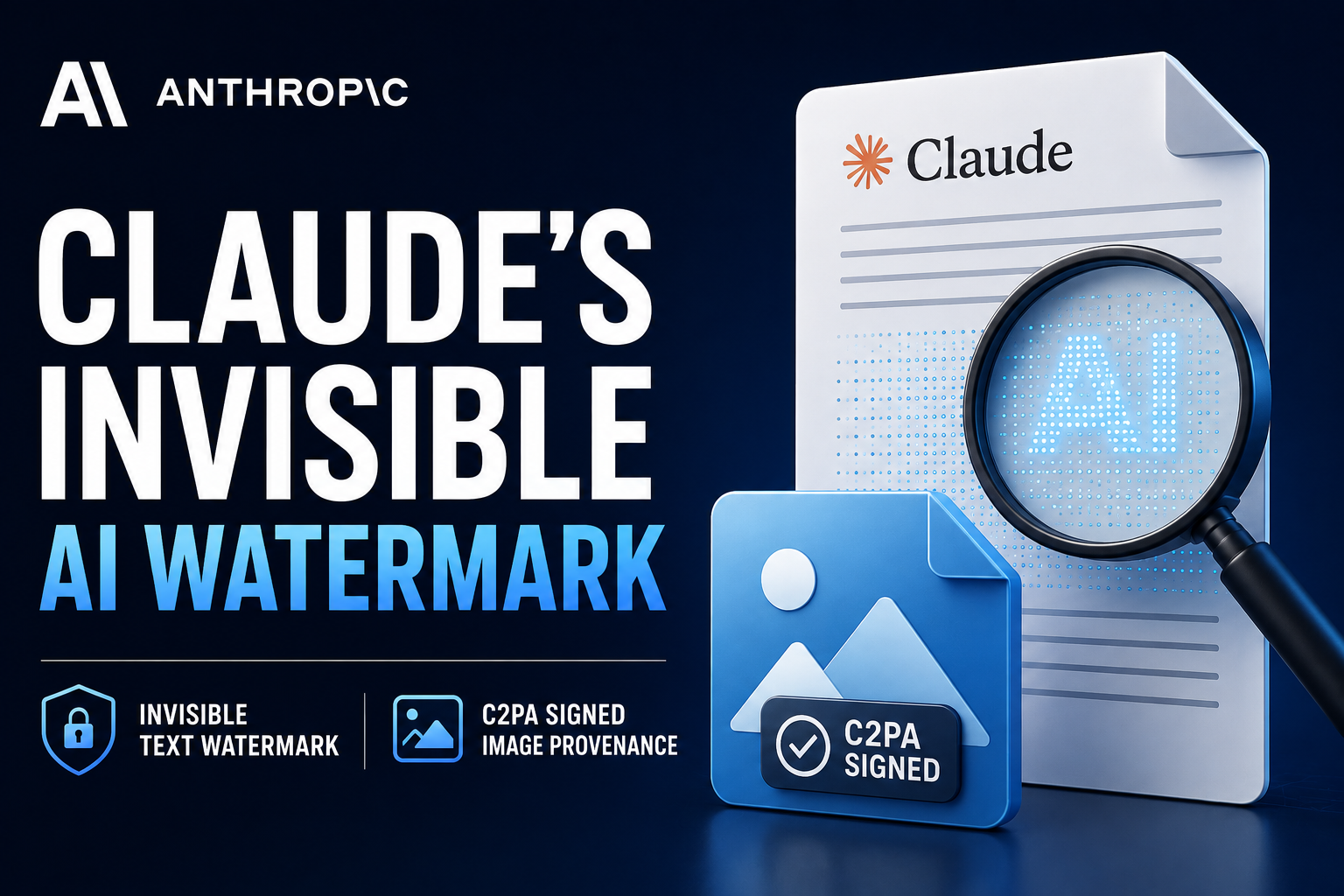

Anthropic is adding invisible, machine-detectable watermarks to text generated by Claude, making it possible to identify AI-generated writing even after it has been copied and lightly edited. The company is also adding signed provenance information to supported image files using the C2PA standard.
The move could become an important step toward making AI-generated content easier to identify as AI use grows across education, publishing, business, and the internet.
What Is Anthropic Changing?
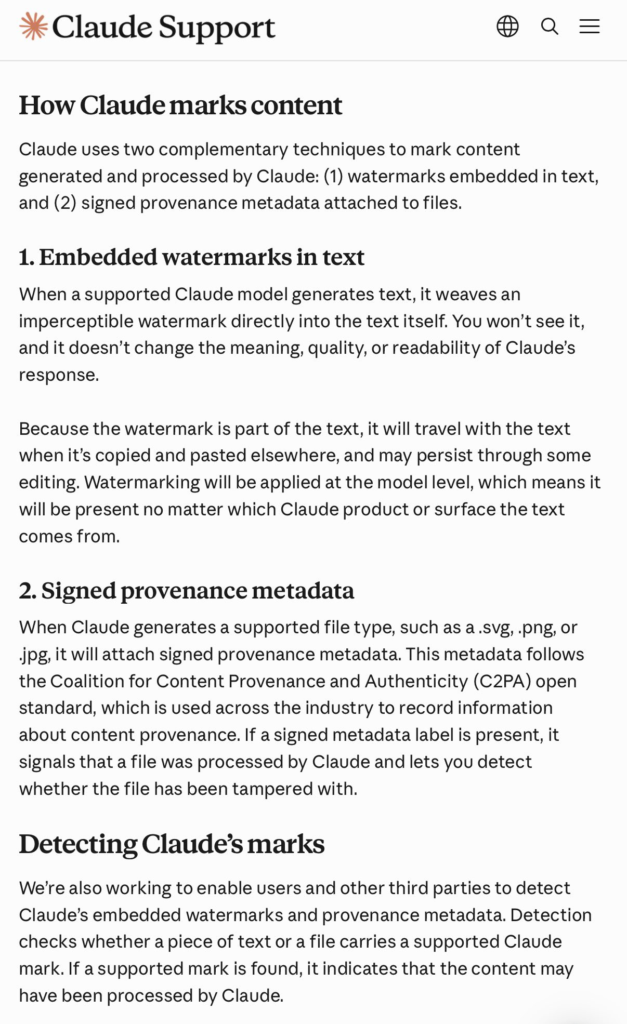
Under the new system, supported Claude models will add a hidden watermark directly to the text they generate.
Users will not see the watermark. It is designed to have no visible effect on the text’s meaning, quality, or readability.
The important part is that the mark is built into the generated text itself rather than being placed in separate metadata.
That means it can travel with the text when someone copies and pastes it somewhere else. Anthropic says the mark can also survive some types of editing.
Anthropic plans to apply the system globally across Claude products, rather than limiting it to users in Europe.
How Does the Invisible Watermark Work?
The exact technical details of Anthropic’s system have not been fully disclosed.
At a high level, the watermark is built into the way the model produces text. It is designed to create a pattern that normal readers cannot notice but a special detection system can recognize.
This is different from adding a hidden note such as “Written by Claude.”
There is no visible label.
Instead, a detector can look at the text and check whether it contains the pattern associated with Claude-generated content.
This approach is intended to make AI-generated text easier to trace even when it leaves the Claude platform.
Copy and Paste Won’t Simply Remove It
One of the most interesting parts of Anthropic’s system is that the watermark is part of the text itself.
If someone copies Claude’s response from the app and pastes it into:
- Microsoft Word
- Google Docs
- A website
- Social media
- Another document
the watermark can remain.
Anthropic says it can also survive some editing.
However, this does not mean the watermark is impossible to remove.
Heavy rewriting, translation, mixing AI text with human writing, or very short pieces of text can make detection harder.
So the technology should be viewed as a provenance signal, not a perfect AI detector.
Claude Images Will Also Get Provenance Data
Anthropic is also adding protection for supported image files.
Instead of using the same text watermark system, supported images will contain digitally signed provenance metadata using C2PA.
C2PA is an open standard designed to record information about where digital content came from and how it was created or changed.
This technology is already being used across the technology and media industries.
The idea is simple:
Text → invisible watermark
Images → signed provenance information
Together, these systems can give people and platforms another way to check whether content came from an AI system.
Why Is Anthropic Doing This?
One major reason is the growing demand for AI transparency.
AI-generated text and images are becoming common everywhere.
People use AI to create:
- News articles
- Marketing content
- School assignments
- Social media posts
- Business documents
- Images
- Presentations
- Software documentation
As this content becomes harder to distinguish from human-created work, knowing where content came from becomes more important.
Anthropic’s move also comes as AI transparency requirements under the European Union’s AI Act begin taking effect. The new rules require certain AI-generated content to be marked in a machine-readable way.
Anthropic is applying the approach globally.
What About Older Claude Models?
The watermarking system is being introduced first with newer Claude models.
Anthropic says models launched on or after August 2, 2026 support the marking from launch, while support for older models is being developed during a transition period.
This means the system will not necessarily appear immediately on every older Claude model.
Over time, Anthropic expects the coverage to expand.
Could This Help Schools Detect AI Writing?
Potentially, yes.
Education is one of the areas where AI-generated text has created major concerns.
Teachers and universities increasingly need to understand whether students are submitting work written by AI.
A reliable watermark could give schools another signal when checking assignments.
However, Anthropic’s technology should not automatically be treated as proof that a student cheated.
Watermarks can sometimes be damaged or removed through major changes to the text, and the absence of a watermark does not necessarily prove that humans wrote the content.
Human review will still be important.
Could Publishers Use It?
The publishing industry could also benefit.
Publishers, news organizations and content platforms increasingly receive large amounts of AI-assisted material.
A machine-readable watermark could help platforms understand whether content was generated by Claude.
This could be useful for:
- Content moderation
- AI disclosure
- Copyright discussions
- Editorial review
- Spam detection
- Content labeling
It could also make it easier for platforms to create their own rules for AI-generated material.
This Is Not a Perfect AI Detector
This is an important point.
An invisible watermark is different from a traditional AI text detector.
Traditional detectors usually examine writing and try to guess whether it was produced by AI.
A watermark works differently.
It looks for a signal that was placed into the content when the AI generated it.
That could make it more reliable for identifying content from a specific AI provider, but only when the watermark is still detectable.
Anthropic itself acknowledges that the watermark may not survive every type of transformation.
What Happens If Someone Rewrites the Text?
This is where things become more complicated.
Imagine someone asks Claude to write an article.
They then completely rewrite the article themselves.
The final version may no longer contain enough of the original watermark pattern for a detector to recognize it.
The same problem can occur when text is:
- Translated
- Heavily paraphrased
- Mixed with human writing
- Shortened significantly
This means watermarking is strongest when the original AI output remains mostly intact.
Why This Could Become an Industry Standard
Anthropic is not alone in working on ways to identify AI-generated content.
Google has developed SynthID, which adds invisible signals to AI-generated media, while C2PA has become an increasingly common standard for recording the origin of digital content.
The industry is gradually moving toward a future where digital content can carry information about its origin.
That could become increasingly important as AI-generated media becomes almost impossible to distinguish by appearance alone.
A New Layer of Trust for the Internet
The bigger idea behind Anthropic’s move is content provenance.
In the future, a piece of digital content could potentially answer questions such as:
Who created it?
Was AI involved?
Which system generated it?
Has it been edited?
Where did the original file come from?
C2PA and watermarking are two different technologies, but they are both moving toward the same goal: giving people more information about where digital content came from.
The Privacy Question
The move will also raise questions about user privacy and control.
For example, users may wonder whether platforms will be able to identify every piece of Claude-generated writing they publish.
The watermark itself is not a visible personal identifier. It is intended to identify AI-generated content.
But how detection tools are eventually used will matter.
Schools, employers, publishers and online platforms could potentially use AI-origin signals when making decisions about content.
That makes clear policies and responsible use important.
Why This Matters
Anthropic’s announcement shows that the AI industry is moving beyond simply creating more powerful models.
Companies are now also working on ways to make AI-generated content traceable.
That could become increasingly important as AI becomes a normal part of writing, design, software development and media production.
The challenge will be finding the right balance.
AI-generated content should be easier to identify when transparency matters, but watermarking should not become a reason to automatically distrust every piece of AI-assisted work.
The Bigger Picture
Anthropic’s invisible watermark system could mark an important change in how we think about AI-generated content.
For years, the main question was:
“Was this made by AI?”
In the future, the internet may increasingly have technical ways to answer that question.
Claude’s hidden text watermark and C2PA information for supported images are steps toward that future.
The technology is not perfect, and it can be weakened by heavy editing or other changes. But as AI-generated content becomes more common, systems that provide reliable signals about content origin could become an important part of the digital world.
The next phase of generative AI may not just be about creating content. It may also be about proving where that content came from.

 By
By