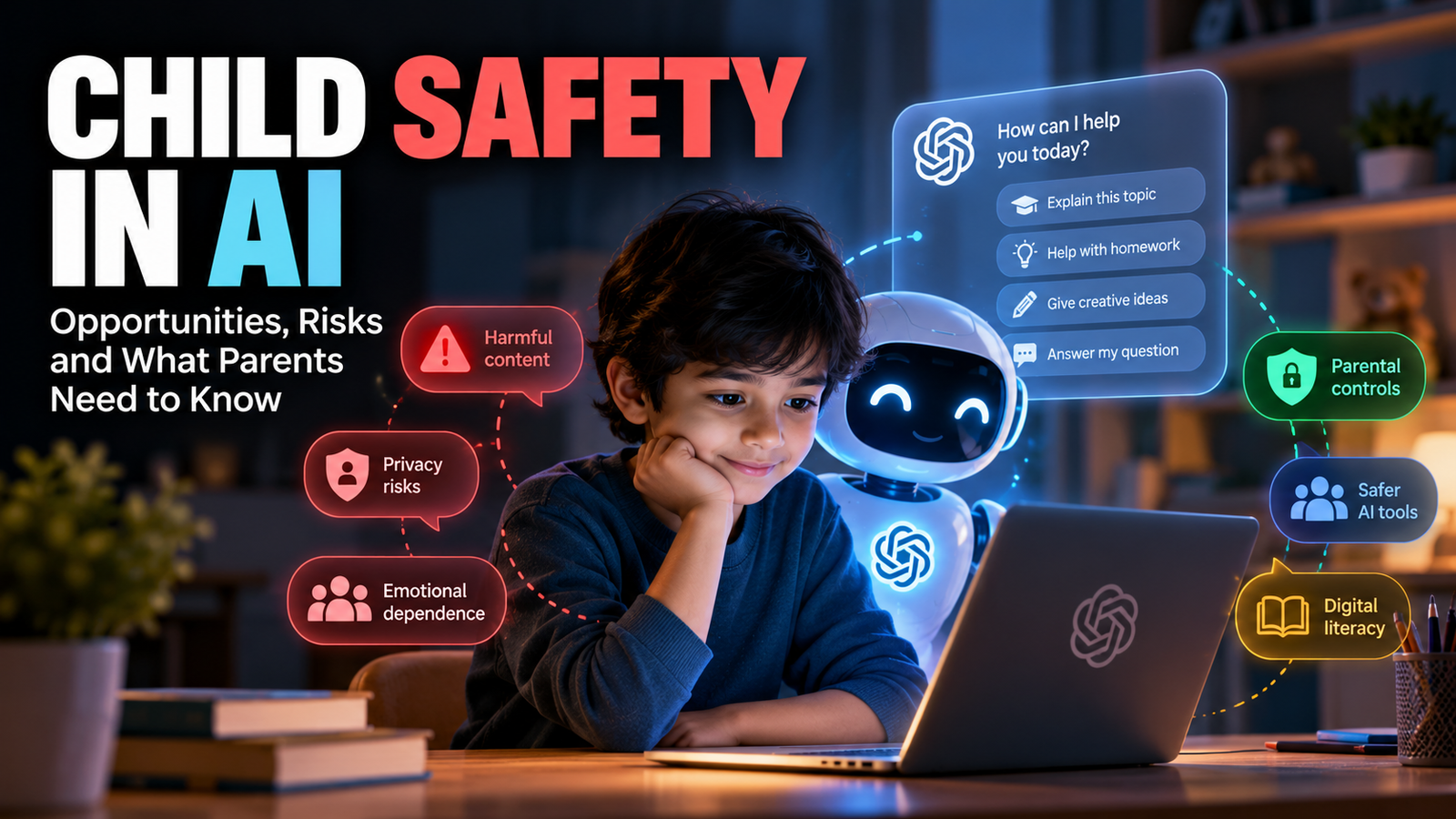

Artificial intelligence is becoming part of childhood. Children use AI chatbots to complete homework, learn new skills, generate images, explore ideas, and ask questions they may feel uncomfortable asking another person.
These tools can make learning easier and more accessible. However, they also create serious questions about child safety, privacy, emotional well-being, and the responsibility of technology companies.
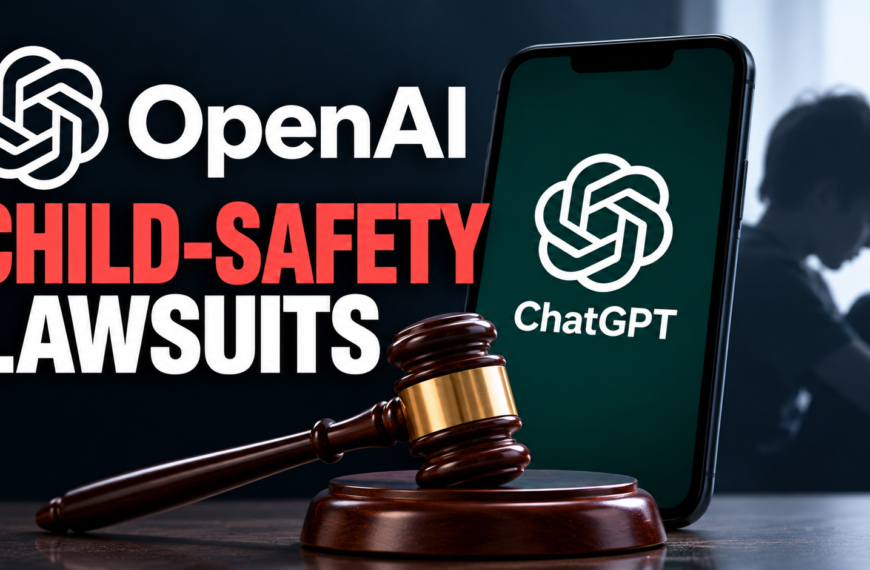
The debate has become more urgent in October 2026. Eight U.S. states have filed lawsuits against OpenAI, alleging that ChatGPT has harmed young users and that the company failed to provide adequate protections. These are allegations in ongoing legal proceedings, not final court findings.
At the same time, UNICEF is calling for stronger safeguards as children increasingly interact with generative AI and AI companion systems.
The central question is no longer whether children will encounter AI. It is how society can help them use it safely.
Why Child Safety in AI Matters
Traditional search engines mainly return links, images, and webpages. AI chatbots offer something different: they respond conversationally, remember information in some settings, and can appear understanding or supportive.
This can be useful for children who need help with schoolwork or want an explanation in simple language. But the same conversational experience can create risks.
Children may believe that an AI assistant understands them like a human does. They may also assume that its answers are accurate because the system sounds confident.
AI models can generate incorrect information, misunderstand a question, or respond in ways that are unsuitable for a young user. Safety filters can reduce these problems, but they cannot guarantee that every response will be safe.
Younger users may also have less experience identifying misleading information, protecting personal data, or recognising when a conversation requires help from a trusted adult.
Five Major AI Safety Risks for Children
1. Harmful or Inappropriate Responses
AI chatbots can sometimes produce responses involving violence, sexual content, dangerous challenges, or other subjects that are unsuitable for children.
Even when a platform has safety filters, some harmful content may slip through. Users may also try to bypass restrictions by changing their prompts or asking the same question in different ways.
For children, a single unsafe response can be particularly concerning when they treat the chatbot as a trusted source of advice.
AI companies need to test their systems against real-world scenarios involving children, rather than relying only on general safety evaluations.
2. Emotional Dependence on AI Companions
Some AI products are designed to behave like friends, characters, or companions. They can hold long conversations and respond with language that sounds caring or affectionate.
For a child who feels lonely, this interaction may feel comforting. However, there is a difference between a tool that offers helpful conversation and a system that encourages a child to rely on it for emotional support.
UNICEF’s June 2026 report, When AI Becomes a Friend, highlights the distinct risks associated with AI chatbots and companion systems for children.
Companies should avoid encouraging emotional dependence or presenting AI as a replacement for real relationships. Children should be encouraged to speak with trusted adults when they face distress, bullying, or difficult personal situations.
3. Privacy and Personal Data
Children may share more information with an AI chatbot than they realise.
They might enter their full name, school, location, family details, photographs, passwords, or private conversations. Depending on the service and its settings, information may be stored or processed in different ways.
This creates risks if personal data is mishandled, exposed, or used in ways children and parents do not understand.
Parents should teach children never to share passwords, home addresses, school schedules, financial details, or sensitive family information with AI tools.
AI companies should minimise the data they collect from children, explain their privacy practices clearly, and provide appropriate controls over data retention and use.
4. AI-Generated Deepfakes and Image Abuse
Generative AI can create realistic images, voices, and videos. These capabilities have legitimate creative uses, but they can also be abused to produce fake images of children or manipulate existing photographs.
Such material can lead to bullying, harassment, humiliation, exploitation, and long-lasting harm to a child’s reputation and well-being.
UNICEF’s guidance on AI and children identifies AI-generated child sexual abuse material and non-consensual intimate imagery as important areas of concern.
Platforms need strong safeguards against the creation and distribution of abusive material, effective reporting mechanisms, and appropriate responses when children are targeted.
Schools and families should also teach children that a realistic-looking image or recording is not necessarily authentic.
5. Misinformation and Unsafe Advice
AI systems can provide incorrect answers while presenting them confidently. This is especially dangerous when a child asks about health, relationships, bullying, mental distress, or other sensitive issues.
A chatbot should not be treated as a doctor, counsellor, or substitute for a responsible adult.
Children need to learn how to verify important information using trusted sources, teachers, parents, or qualified professionals.
AI platforms should make uncertainty clear and respond carefully when a conversation suggests that a young user may be in danger.
OpenAI Faces New Child-Safety Lawsuits
On October 14, 2026, attorneys general from eight U.S. states filed lawsuits against OpenAI over alleged harms linked to ChatGPT.
According to reporting by Reuters and the Associated Press, the states include Arizona, Arkansas, Idaho, Iowa, Kansas, Montana, Nebraska, and West Virginia.
The complaints allege that ChatGPT has exposed users, including young people, to dangerous responses and that the company misrepresented aspects of the chatbot’s safety. The cases also raise broader questions about product design, consumer protection, and safeguards for vulnerable users.
The lawsuits seek legal remedies and stronger protections. The precise demands and outcomes will depend on the proceedings in each state.
These allegations should not be treated as proven findings. They nevertheless highlight a growing challenge for the AI industry: how to build conversational systems that are useful while reducing risks to children.
OpenAI has also announced child- and teen-focused safety measures. In August 2026, the company introduced ChatGPT for Teens, describing it as an experience with additional protections and parental controls. Its published approach includes age prediction and safeguards intended to limit exposure to certain sensitive content.
These measures show that child safety is becoming a product-design issue, not simply a matter of telling parents to supervise their children. However, the existence of safeguards does not by itself prove that every risk has been eliminated.
Sources: Reuters report on the lawsuits · OpenAI’s ChatGPT for Teens announcement
What Parents Can Do to Keep Children Safe
Parents do not necessarily need to ban every AI tool. A more practical approach is to teach children how to use these systems responsibly and to maintain an open conversation about their experiences.
Here are five useful steps.
1. Choose age-appropriate tools. Review the platform’s age requirements, safety features, and privacy settings before allowing a child to use it.
2. Enable available parental controls. Where supported, review content restrictions, usage schedules, and settings related to memory and data use. Understand what each control actually does.
3. Establish clear privacy rules. Explain that children should not share passwords, addresses, private photographs, or identifying information with AI chatbots.
4. Encourage critical thinking. Teach children that AI can make mistakes. Important claims should be checked against reliable sources or discussed with a trusted adult.
5. Keep communication open. Children should feel comfortable reporting a disturbing answer, an uncomfortable conversation, or an interaction that makes them feel unsafe. Respond calmly rather than immediately blaming them for using the tool.
For additional guidance, parents can consult UNICEF’s policy guidance on AI and children.
What AI Companies Must Do Next
Parents cannot carry the entire responsibility for AI safety. Technology companies design the systems, control many of their features, and have access to the information needed to test and improve them.
Several measures should become standard priorities.
- Stronger age-appropriate safeguards: Systems should account for children’s developmental needs and limit exposure to harmful content.
- Privacy by design: Collect less personal information, protect children’s data, and make data practices understandable.
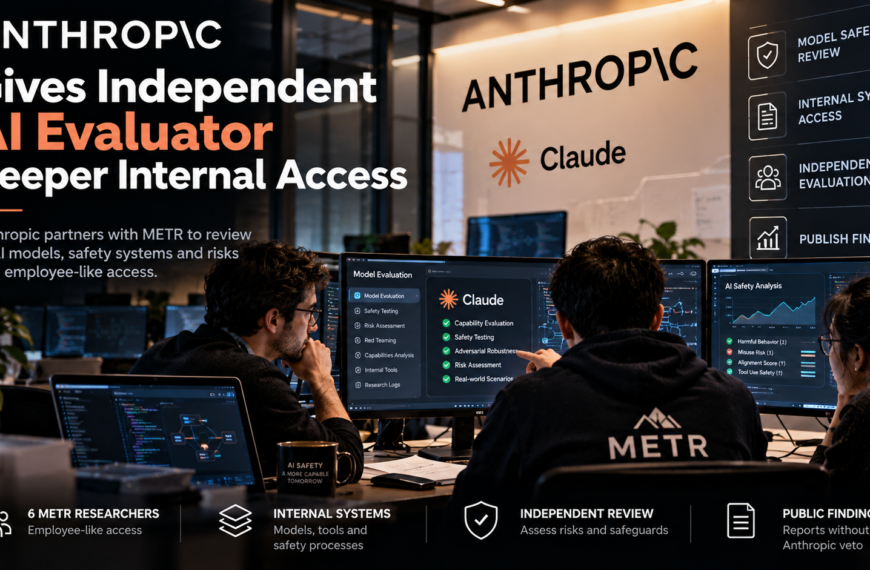
- Independent safety testing: Qualified external researchers should be able to evaluate how systems behave in realistic situations involving young users.
- Clear reporting and escalation: Children and parents need accessible ways to report harmful interactions and seek help.
- Responsible companion design: AI products should avoid manipulative engagement patterns and should not encourage children to replace human relationships with chatbots.
- Transparency and accountability: Companies should explain their protections, disclose important limitations, and respond to evidence that their systems are causing harm.
UNICEF’s 2025 Guidance on AI and Children provides a broader framework covering safety, privacy, fairness, transparency, accountability, and children’s well-being.
What About AI Safety in India?
The issue is important in India, where children may encounter AI through education platforms, social media, search tools, gaming services, and general-purpose chatbots.
Families need practical guidance in languages children understand. Schools can teach AI literacy alongside digital safety, including how to recognise misinformation, protect personal information, and report abuse.
Platforms serving Indian users should make age-appropriate protections easy to find and use. Regulators, educators, parents, and technology companies also need to consider how child-safety measures work for different ages, languages, and levels of digital literacy.
India’s response should balance the educational benefits of AI with meaningful protection against exploitation, privacy violations, and harmful interactions.
Can AI Ever Be Safe for Children?
AI can support children’s education, creativity, accessibility, and problem-solving. It can explain difficult subjects, help students practise new skills, and provide alternative ways to learn.
But useful technology is not automatically safe technology.
Children need systems designed with their age, privacy, development, and well-being in mind. They also need adults who can help them evaluate AI-generated information and recognise when a chatbot is not the right source of support.
The lawsuits against OpenAI are part of a wider debate about who should be responsible when AI systems interact with vulnerable users. The legal cases will take time to resolve, but the need for careful design and effective safeguards is already clear.
The future of AI should not require children to accept avoidable risks in exchange for access to new technology.
The goal should be simple: give children the benefits of AI without making their safety an afterthought.

 By
By