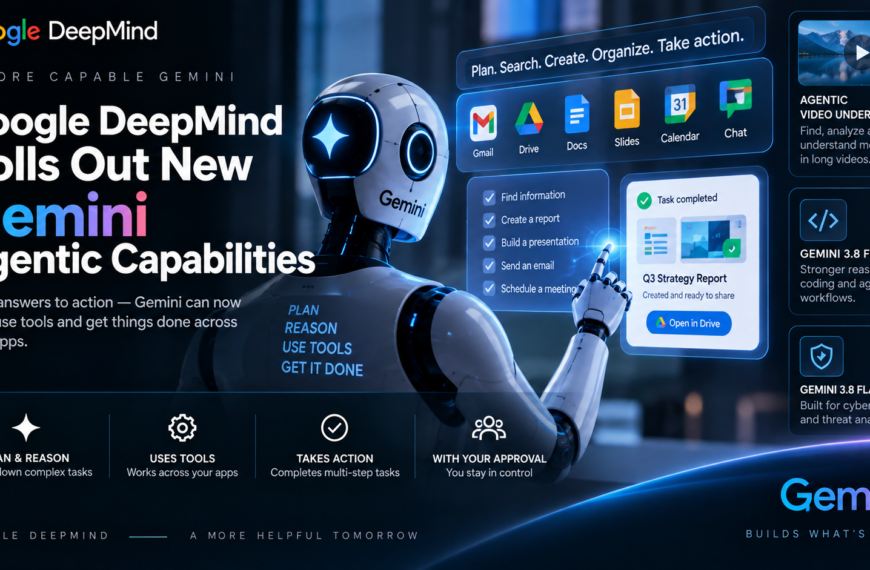
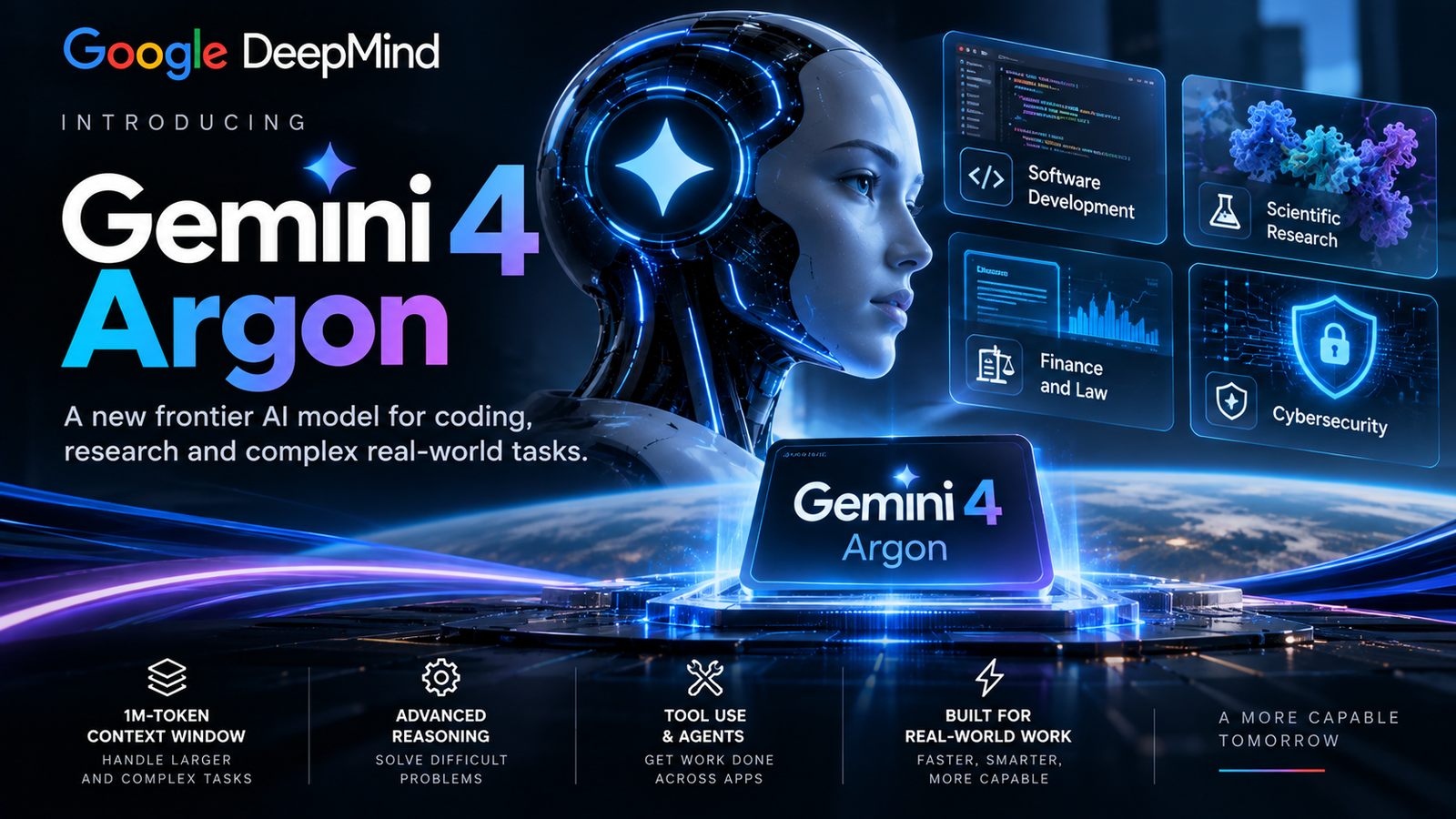

Google DeepMind has officially launched Gemini 4 Argon, its latest frontier AI model designed to solve complex problems in software engineering, scientific research, finance, law and cybersecurity.
Announced on October 13, 2026, the model is now rolling out globally to developers, businesses and eligible Google AI subscribers. Google says Argon is built to handle long, complicated tasks that require deep reasoning, multiple steps and the ability to work with different types of information.
Unlike a chatbot designed mainly to answer questions, Gemini 4 Argon focuses on completing demanding work. It can help developers understand large codebases, support researchers who analyze scientific data, and assist businesses with complex workflows.
The launch also puts Google back into the spotlight in the competition with OpenAI and Anthropic, as leading AI companies race to build models that can do more than generate text.
What Is Gemini 4 Argon?
Gemini 4 Argon is Google’s new flagship reasoning model. It is designed to work through difficult problems, maintain context across long tasks and use tools to complete multi-step workflows.
According to Google, the model combines advanced reasoning, visual understanding, coding skills and knowledge across professional fields.
Its main focus areas include:
- Software development: Understanding large projects, refactoring code and finding bugs.
- Scientific research: Analyzing experimental data and helping researchers investigate difficult questions.
- Finance and law: Supporting document analysis, financial research and complex professional workflows.
- Cybersecurity: Helping identify vulnerabilities and support defensive security work.
- AI agents: Using tools and maintaining progress across tasks that require multiple steps.
Google says Argon is designed for work that requires more depth and precision than a simple question-and-answer interaction.
Gemini 4 Argon Can Handle Longer, More Complex Tasks
One of the model’s most important technical features is its 1-million-token unified input-and-output limit through the Gemini API.
This gives developers room to work with large amounts of information in a single workflow.
For example, a developer could provide substantial portions of a software project, ask Argon to identify architectural problems, propose changes and help implement a solution.
A researcher could use it to examine lengthy documents, scientific papers, datasets and experimental findings.
A business could use it to review contracts, compare financial reports or coordinate a workflow involving several documents.
However, a large context window does not guarantee that a model will understand every detail perfectly. Results still depend on the task, the quality of the information and the tools available.
What Makes It Different From a Regular Chatbot?
A regular chatbot often produces an answer and waits for the next prompt.
An agentic model can work through a longer process:
- Understand the goal.
- Break the task into smaller steps.
- Examine the available information.
- Use tools or execute code when needed.
- Check results and continue working.
- Return a completed result or explain what remains.
Gemini 4 Argon supports capabilities such as function calling, code execution, file search and computer use in preview. These features allow developers to build systems that connect the model to external tools and applications.
The important distinction is that the model provides the reasoning, while the surrounding software determines which actions it can actually perform.
Google Reports Improvements in Software Engineering
Software engineering is one of the main areas Google is targeting with Gemini 4 Argon.
The company says its engineers have used Argon to solve difficult problems across Google’s own software systems. In one example, the model helped the Chrome team separate core webpage-handling code from a legacy folder containing browser features within the Chromium codebase.
Google also reported that teams using Argon through its Antigravity development platform achieved:
- More than 35% growth in agentic code submissions
- Nearly one-third fewer code rollbacks
These are results reported by Google from its internal use of the model. They should not be interpreted as guaranteed improvements for every developer or organization.
For developers, the potential benefit is significant. Instead of using AI only to generate individual functions, teams can use it to investigate larger codebases, plan changes, test solutions and support more complicated engineering work.
Gemini 4 Argon Targets Scientific Research
Google is also positioning Argon as a tool for scientific discovery.
The model is designed to help researchers interpret complex data and explore problems across fields such as biology, physics and chemistry.
Google says its early-access partners have used Argon to investigate experimental data, including cellular imaging and mass spectrometry. The company also highlighted work connected to quantum computing, nuclear fusion and life sciences.
Potential applications include:
- Analyzing scientific papers and research documents
- Identifying patterns in experimental data
- Comparing possible explanations for a result
- Helping researchers develop and test hypotheses
- Supporting complex mathematical and scientific reasoning
Argon does not replace the need for scientific validation. Researchers must still check its conclusions against evidence, repeat experiments where appropriate and use expert judgment.
Nevertheless, models that can handle complex reasoning and large amounts of information could become useful assistants for research teams.
Gemini 4 Argon Expands Google’s Cybersecurity Strategy
Cybersecurity is another major part of the launch.
Google says Argon can help identify and patch critical software vulnerabilities. It has also expanded access through its Fairwind Program, which provides selected cybersecurity defenders with access to advanced models under special conditions.
The goal is to help security teams find weaknesses faster and respond to threats more efficiently.
However, powerful AI models can also create security risks. A model capable of understanding complex software and finding vulnerabilities could potentially be misused by attackers.
Google says it has worked on protections against indirect prompt injection, a technique in which malicious instructions hidden in webpages, emails or other content attempt to manipulate an AI agent.
On its published Gray Swan Indirect Prompt Injection benchmark, Google reported an attack success rate of 0.7% across 15 adaptive attempts. This is a vendor-reported result for a specific evaluation, not proof that Argon is immune to prompt injection in real-world environments.
The company is taking a phased approach to access for advanced cybersecurity capabilities, reflecting the need to balance useful defensive tools with misuse prevention.
Gemini 4 Argon Pricing and Availability
Google announced a global rollout on October 13, 2026. Availability depends on the product and subscription tier.
Gemini 4 Argon: Access and Pricing
Availability
| User Type | Access |
|---|---|
| Developers | Gemini API, Google AI Studio and supported developer platforms |
| Businesses | Google Cloud and supported Gemini business products |
| Individual Users | Google AI Pro and Ultra subscriptions, Gemini app and AI Mode in Search |
API Pricing
| Pricing Type | Introductory Price | Standard Price After November 30, 2026 |
|---|---|---|
| Input Tokens | $2 per 1 million tokens | $4 per 1 million tokens |
| Output Tokens | $10 per 1 million tokens | $20 per 1 million tokens |
| Cached Input Tokens | 95% discount | Check official pricing |
Note: The introductory rates reportedly apply through November 30, 2026. Prices are for API usage, not monthly subscriptions. Check Google’s official documentation for the latest pricing, availability and usage limits.
Official Resources:
- Gemini API Documentation: https://ai.google.dev/gemini-api/docs/models/gemini-4-argon
- Google AI Blog: https://blog.google/
These prices are for API usage, not a monthly Gemini subscription. Developers should check the official documentation for billing details, usage limits and supported features before deploying Argon in production.
Can Gemini 4 Argon Beat OpenAI and Anthropic?
The launch intensifies competition between Google, OpenAI and Anthropic.
OpenAI is developing increasingly capable reasoning and agentic systems, while Anthropic continues to focus on coding, enterprise work and advanced AI safety. Google is competing across many of the same areas.
Google claims that Argon performs at the frontier across several professional benchmarks and ranks first on its cited Vals Index, which measures performance in areas such as finance, coding, legal work and tax-related tasks.
However, benchmark results alone cannot establish which AI model is best overall.
Performance can vary by programming language, reasoning task, context size, tool access, cost and response speed. Independent testing will be important to determine how Argon compares with competing models in everyday use.
Google’s existing ecosystem is another advantage. By connecting its model with Search, developer tools, cloud services and business applications, Google can make advanced AI capabilities available where people already work.
What Gemini 4 Argon Means for the AI Industry
Gemini 4 Argon reflects a broader shift in AI development.
The competition is moving beyond chatbots that answer questions toward systems that can perform longer workflows, operate software and assist with complex professional tasks.
For businesses, that could mean less time spent on repetitive document work, coding and data analysis. For developers, it could mean AI systems that contribute to larger engineering projects. For scientists, it could mean faster exploration of complex research questions.
But greater capability also brings new challenges. Companies will need to manage permissions, verify AI-generated work and monitor actions taken by agents. Sensitive decisions will still require appropriate human oversight.
The bottom line: Gemini 4 Argon is Google’s latest effort to compete at the frontier of AI reasoning and agentic work. Its long context window, coding capabilities and focus on professional workflows make it an important release. Its real value, however, will depend on independent performance testing, practical reliability and how safely organizations can use it.
 By
By