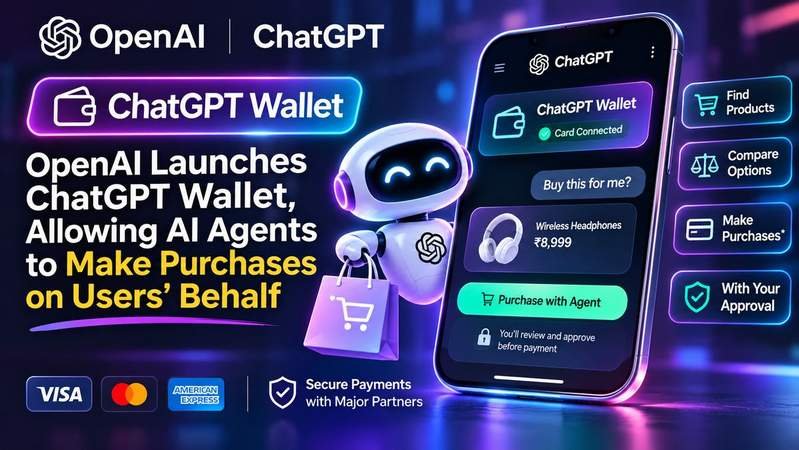

OpenAI is taking another major step towards agentic AI with the launch of ChatGPT Wallet, a new payment feature that allows AI agents to complete purchases using a user’s saved payment method.
Announced on November 13, 2026, ChatGPT Wallet is designed to make online shopping and digital transactions easier. Instead of manually entering payment details every time, users can allow their AI agents to handle the purchasing process.
The launch introduces a new possibility for AI assistants. They will not simply recommend products or compare prices. They will also be able to help users complete transactions.
However, OpenAI is not giving AI agents unrestricted access to users’ money. Every transaction currently requires a security check and user approval.
The company developed the wallet in partnership with American Express, Mastercard and Visa. Initially, the feature is rolling out to eligible ChatGPT Pro subscribers in the United States.
What Is ChatGPT Wallet?
ChatGPT Wallet is a payment feature that allows users to connect eligible debit or credit cards to ChatGPT.
Once a payment method is added, supported AI agents can use it to help complete purchases without requiring users to enter their card information repeatedly.
The feature is connected to OpenAI’s Dots, its always-on AI agents designed to perform tasks on a user’s behalf.
For example, imagine asking an AI agent to find a pair of running shoes within a specific budget.
The agent could:
- Search for suitable products.
- Compare prices and available options.
- Select a product based on your instructions.
- Prepare the purchase.
- Show you the item, total cost and selected payment method.
- Request your approval before completing the transaction.
This creates a more direct shopping experience, where users can move from product discovery to payment through an AI assistant.
How Does ChatGPT Wallet Work?
The wallet is designed to keep payment information protected while allowing AI agents to initiate transactions.
According to Reuters, the payment process uses tokens instead of exposing the user’s actual card details.
Here is how the process works:
1. Add a Payment Card
Users add an eligible debit or credit card to ChatGPT Wallet.
The wallet stores the payment method so users do not need to repeatedly enter their card details when making supported purchases.
2. Give Instructions to an AI Agent
Users can ask an AI agent to find and purchase something.
For example:
- Find a laptop under $1,000.
- Order groceries for the week.
- Buy a birthday gift for a friend.
- Find the cheapest available flight for a selected route.
The agent can then work towards completing the requested task.
3. Review the Purchase
Before payment, users can review important details, including:
- Selected product or service.
- Total purchase amount.
- Selected payment card.
- Transaction details.
This gives users an opportunity to check the purchase before approving it.
4. Approve With a Security Check
Every transaction currently requires user approval.
Users can confirm purchases through security checks such as Face ID or fingerprint authentication.
This prevents the agent from independently completing payments without the required authorisation.
5. Secure Payment Token Is Used
One important part of the system is payment tokenisation.
Instead of sharing the actual card number with the AI agent or merchant, the payment network provides a payment token.
This token is used to support the transaction without exposing the underlying card details.
The approach adds another layer of protection to agent-powered purchases.
Visa, Mastercard and American Express Are Supporting the Launch
OpenAI is not building this payment infrastructure alone.
ChatGPT Wallet was developed in partnership with three major payment networks:
- Visa: Provides payment network infrastructure and security capabilities.
- Mastercard: Supports secure card-based transactions.
- American Express: Participates in the wallet’s payment infrastructure partnership.
These partnerships are important because AI-powered payments need more than an intelligent chatbot.
They require payment processing, authentication, fraud prevention and transaction security.
Working with established payment networks could help OpenAI build trust in a new category of digital transactions.
ChatGPT Wallet Will Initially Be Limited to US Pro Users
The initial rollout is limited.
According to Reuters, ChatGPT Wallet is initially available to:
- ChatGPT Pro subscribers.
- Users aged 18 or older.
- Customers with eligible US-issued payment cards.
The feature is accessible through OpenAI’s Dots AI agents.
OpenAI has not announced a confirmed rollout date for India or other international markets.
This means users outside the initial supported group should not assume that they can already use ChatGPT Wallet.
The company may expand availability as its payment infrastructure and supported markets develop.
OpenAI Plans to Allow More Autonomous AI Purchases
The current version requires users to approve every transaction.
However, OpenAI has indicated that it expects users to eventually delegate purchases within predefined limits.
For example, users could potentially configure rules such as:
- Maximum spending limits.
- Approved product categories.
- Permitted purchase periods.
- Specific conditions for transactions.
Imagine setting a monthly budget for household supplies.
Instead of manually approving every small purchase, an AI agent could eventually handle eligible orders within the limits you establish.
This could make AI assistants more useful for repetitive tasks.
However, these future capabilities should not be confused with the current launch. Per-transaction approval remains a requirement in the initial version.
Why ChatGPT Wallet Matters for the Future of AI Agents
The launch is significant because it moves AI agents closer to performing complete real-world tasks.
Until now, many AI assistants have focused on answering questions, generating content, writing code and researching information.
Agentic AI takes this further by allowing systems to interact with tools and services to accomplish specific goals.
Payments are an important missing piece.
Consider a few possible examples:
Personal Shopping
An AI agent could compare products, check availability and prepare purchases based on your preferences and budget.
Travel Planning
A future shopping agent could help arrange flights, hotels and other travel services, subject to payment permissions and merchant support.
Business Operations
Companies could eventually use AI agents to purchase software subscriptions, cloud services, office supplies and other approved business resources.
Automated Reordering
AI agents could monitor frequently purchased products and help reorder them when supplies run low.
These examples represent potential applications. They are not all confirmed features of the current ChatGPT Wallet launch.
Security and Privacy: Can AI Agents Be Trusted With Money?
Allowing AI agents to make purchases introduces important security questions.
A system that can spend money must be carefully controlled.
Some major concerns include:
Unauthorised purchases: An agent might misunderstand instructions or select the wrong product.
Prompt injection: Malicious instructions hidden in websites or other content could attempt to manipulate an AI agent.
Payment fraud: Attackers could try to exploit weaknesses in payment systems or user authentication.
Privacy: Users need to understand how their payment information is stored, processed and shared.
Refunds and disputes: Clear responsibility is necessary when an agent makes an incorrect purchase.
Tokenisation and transaction approval help reduce some risks, but they do not eliminate every possible security problem.
Users should review purchases carefully and avoid granting unnecessary permissions to automated systems.
How ChatGPT Wallet Connects to OpenAI’s Agentic Commerce Strategy
ChatGPT Wallet is part of a wider shift towards agentic commerce.
OpenAI has already introduced the Agentic Commerce Protocol, developed with Stripe, to help AI agents and businesses work together during shopping and checkout.
The protocol allows merchants to provide product information, manage checkout sessions and process payments through their existing systems.
Importantly, merchants remain responsible for accepting orders, processing payments and fulfilling purchases.
ChatGPT Wallet adds another important part of this ecosystem: a reusable payment experience for AI-driven transactions.
Together, these developments point towards a future in which users can delegate more shopping and purchasing tasks to AI assistants.

What Happens Next?
The next important step will be expanding the wallet’s availability and introducing stronger controls for delegated purchases.
Several questions remain:
- When will ChatGPT Wallet launch outside the United States?
- Which merchants and payment providers will support it?
- Will users be able to set automatic spending limits?
- How will OpenAI handle refunds and disputed purchases?
- What additional security controls will be introduced?
- Will businesses be able to use AI agents for recurring payments?
The answers will determine how quickly AI-powered commerce becomes part of everyday life.
Conclusion
OpenAI’s ChatGPT Wallet launch represents an important development in the evolution of AI assistants.
By connecting payment methods with AI agents, OpenAI is moving towards a model in which users can delegate not only research and planning but also purchasing tasks.
The initial version still requires user approval for every transaction. However, OpenAI’s longer-term direction suggests that users may eventually allow agents to make certain purchases within predefined limits.
If this approach succeeds, AI assistants could become more than digital helpers. They could become personal shopping and purchasing agents.
The next major competition in AI may not only be about which chatbot answers questions best. It could also be about which AI agent can safely and reliably get things done.
Frequently Asked Questions
1. What is ChatGPT Wallet?
ChatGPT Wallet is OpenAI’s payment feature that allows users to connect eligible debit or credit cards and let supported AI agents help complete purchases.
2. Can ChatGPT make purchases without user approval?
Not in the initial version. Every transaction currently requires a security check and user approval.
3. Which companies are partnering with OpenAI?
OpenAI developed ChatGPT Wallet in partnership with American Express, Mastercard and Visa.
4. Who can use ChatGPT Wallet?
The initial rollout is for eligible US-based ChatGPT Pro subscribers aged 18 or older with supported US-issued payment cards.
5. Is ChatGPT Wallet available in India?
OpenAI has not announced a confirmed launch date for India.
6. Are users’ actual card details shared with AI agents?
According to OpenAI’s reported payment design, payment tokens are used instead of exposing actual card details to the agent or merchant.
7. Can AI agents eventually make automatic purchases?
OpenAI expects to support delegated purchases within user-defined rules, such as spending limits and approved categories. These capabilities are a future direction, not unrestricted spending in the initial release.
8. Is ChatGPT Wallet a cryptocurrency wallet?
No. The announced feature is designed to use eligible debit and credit cards through established payment networks. It is not presented as a cryptocurrency wallet.

 By