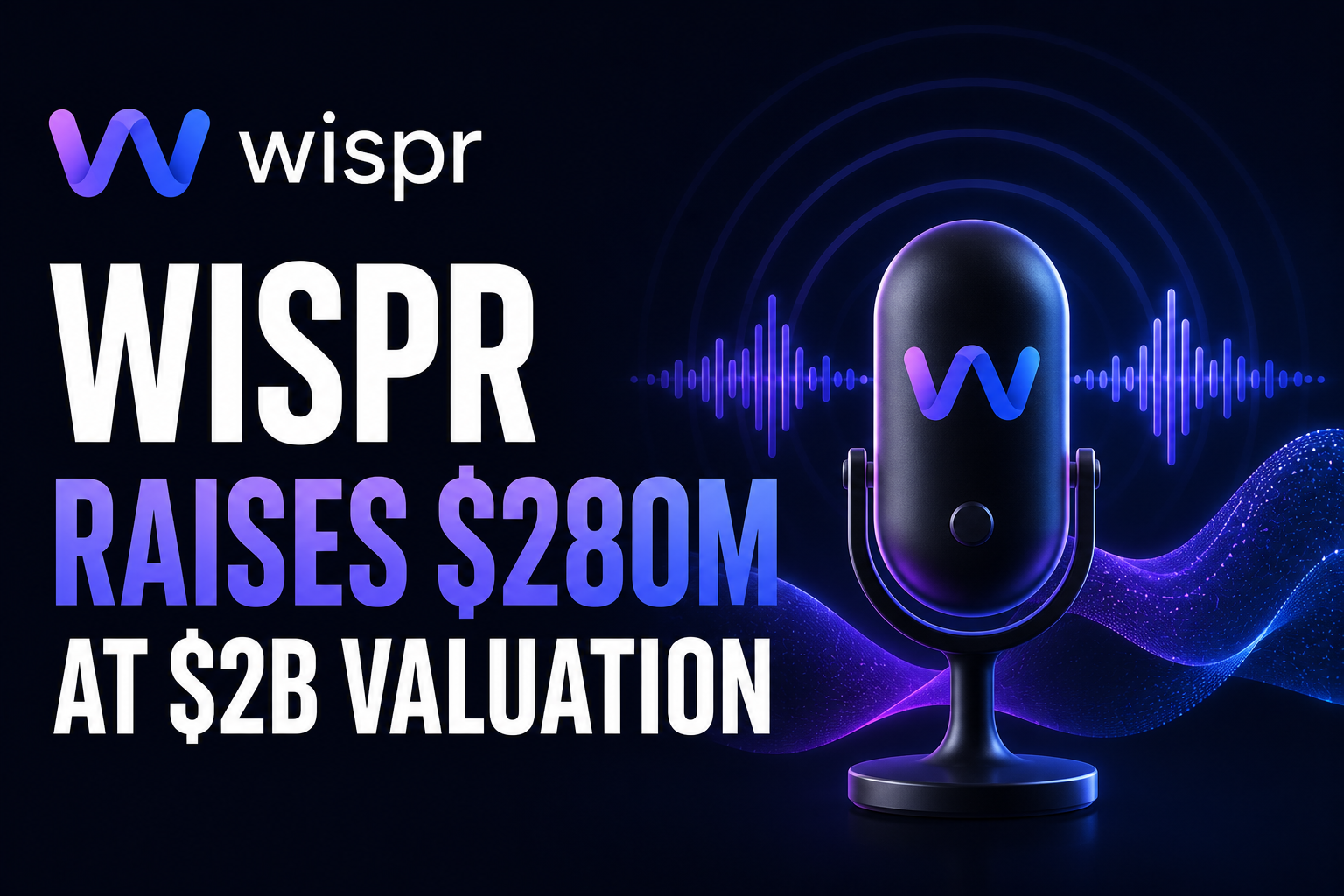

AI voice startup Wispr, the company behind Wispr Flow, has raised roughly $280 million at a $2 billion valuation, marking a major bet on voice as the next important interface for working with AI.
Wispr Flow lets users speak naturally and turns their speech into polished text inside apps and workflows. The company has attracted particular attention from software developers, who use voice to communicate with AI coding agents and other tools.
The funding makes Wispr one of the most valuable startups focused on AI-powered voice input and highlights a broader shift: people may increasingly talk to AI instead of typing to it.
Wispr’s Valuation Has Jumped Rapidly
Wispr’s latest financing values the company at approximately $2 billion, a huge increase from its previous valuation of around $700 million in November 2025.
Earlier reports put the new financing at around $260 million, led by Menlo Ventures. Later company-related discussions and reporting have referred to the round as approximately $280 million.
The exact final amount can vary depending on how the financing is counted, but the important figure is the same: Wispr is now valued at about $2 billion.
What Is Wispr Flow?
Wispr Flow is an AI-powered voice dictation tool.
Instead of typing a long message, email or AI prompt, users can simply speak.
The system then converts the speech into clean, structured text.
But Wispr is trying to do more than traditional speech-to-text software.
The company uses AI to understand how people naturally speak and turn that speech into text that is easier to read and use.
For example, a user can speak naturally while creating an email or writing instructions for an AI coding agent.
This makes voice a more practical input method for everyday computer work.
Why Developers Are Using It
One of Wispr’s biggest areas of growth is software development.
Developers are increasingly using AI coding agents to write and modify software.
That creates a new problem:
Typing instructions to AI can itself become slow.
A developer may need to explain a complex coding task, describe a bug or provide detailed instructions.
Speaking can be much faster than typing.
Wispr Flow is designed to take advantage of this.
Instead of spending several minutes typing a detailed prompt, developers can simply explain what they want to the AI.
This creates a new workflow:
Think → Speak → AI understands → AI acts
Voice Could Become the New AI Interface
The investment is important because it points to a bigger change in how people interact with computers.
For decades, the keyboard and mouse have been the primary tools for interacting with software.
Smartphones added touchscreens.
AI is now introducing another possibility:
Voice.
Talking to an AI system can feel much more natural than writing detailed instructions.
This could be especially useful when working with AI agents.
Instead of writing:
“Review this codebase, identify the authentication problem and explain which files need to be changed.”
A user could simply say the same thing naturally.
The AI handles the complexity.
Wispr Is Not Building Another AI Model
One interesting part of Wispr’s strategy is that the company isn’t trying to compete directly with OpenAI, Anthropic or Google by building the world’s biggest foundation model.
Instead, it is building an interface layer on top of AI.
Wispr uses a combination of its own technology and models from major AI companies to create its voice experience.
This is important because there could be a huge market for companies that make AI easier to use.
The future AI stack could look something like:
Foundation models → AI agents → applications → human interface
Wispr is focusing on the final part: how humans communicate with AI.
Big Technology Companies Are Already Using Wispr
Wispr has attracted users inside major technology companies.
Reports have identified employees at companies including Nvidia and Amazon among its users.
The startup has also been gaining attention among engineers and other professionals who spend large amounts of time communicating with computers.
That is an important market because professionals often write thousands of words every day.
Even a small improvement in typing speed can translate into significant productivity gains.
Investors See a Bigger Opportunity
The funding round is being led by Menlo Ventures, while other investors have also shown interest in the company.
Peak XV Partners and Activate were reportedly considering investments in the round as the company moved toward the $2 billion valuation.
The interest from investors reflects a broader trend.
AI investment is moving beyond just chatbots and foundation models.
Investors are now looking at companies building:
- AI agents
- AI interfaces
- Voice AI
- AI coding tools
- AI productivity software
- AI-powered enterprise applications
Wispr sits directly in the middle of several of these trends.
Voice + AI Agents Could Be a Powerful Combination
The most interesting opportunity for Wispr may be the rise of AI agents.
AI agents are designed to complete tasks rather than simply answer questions.
As these systems become more capable, users may need better ways to communicate with them.
Voice could become one of the easiest options.
Imagine telling your AI agent:
“Check my project, find the three biggest problems, fix the simple ones and prepare a summary for me.”
Instead of typing a long prompt, you simply say it.
The AI agent then handles the work.
This could make voice particularly valuable for professional users.
Wispr Is Also Expanding Beyond Simple Dictation
Traditional voice dictation converts speech directly into words.
Wispr Flow tries to go further by understanding the user’s intent and producing cleaner text.
That can make it useful for:
- Emails
- Documents
- AI prompts
- Coding
- Messages
- Research
- Business communication
- Productivity workflows
This distinction is important.
Wispr isn’t simply trying to replace a keyboard.
It wants to make speaking to computers feel as useful as typing.
Competition Is Coming
Wispr also faces significant competition.
Big technology companies can add advanced voice capabilities directly into their operating systems and AI assistants.
Google, Apple, Microsoft, OpenAI and other companies are all investing heavily in speech and voice interfaces.
AI models themselves are also becoming increasingly good at understanding natural speech.
That creates a major challenge for Wispr.
If voice becomes a standard feature inside every major AI assistant, standalone voice products could face pressure.
Wispr’s advantage will therefore need to come from its workflow, accuracy, user experience and deep integration with professional tools.
Why the $2 Billion Valuation Is Significant
A $2 billion valuation for an AI voice company shows how much investor expectations have changed.
Voice interfaces have existed for years.
But previous voice products often struggled to become essential tools.
Generative AI changes the equation.
AI can now understand more complex speech and turn it into useful actions.
That means voice is no longer simply about:
“Convert my speech to text.”
It can increasingly become:
“Understand what I want and help me get it done.”
That is a much bigger opportunity.
The Future Could Be Voice-First
The next generation of AI applications may not look like today’s chatbots.
Instead of opening an app, typing a prompt and waiting for a response, users could simply speak.
For example:
“Create a report from this data.”
“Fix this bug.”
“Write a reply to this customer.”
“Summarize today’s meetings.”
“Build a landing page based on this idea.”
AI agents could then complete these tasks.
In that world, the keyboard becomes less important for many types of work.
The Bigger Picture
Wispr’s approximately $280 million funding round at a $2 billion valuation shows that investors believe voice could become an important part of the AI economy.
The company has identified an interesting problem: AI is becoming more powerful, but interacting with AI can still require a lot of typing.
Wispr Flow attempts to solve that problem by turning natural speech into a fast interface for AI and everyday software.
The opportunity could become even larger as AI agents become more capable.
If agents can handle increasingly complex tasks, people will need simple ways to tell them what to do.
Voice could become one of the most natural interfaces for that future.
Wispr is betting that the next generation of computing won’t just be powered by AI.
It will be spoken to.

 By
By