
Artificial Intelligence is no longer an emerging technology—it has become the foundation of the next digital revolution. In just a few years, AI has evolved from simple chatbots into autonomous agents capable of writing software, conducting research, generating creative content, assisting scientific discoveries, and transforming enterprise operations. As we move through 2027, the competition is no longer centered on building the smartest AI model. Instead, the race is shifting toward infrastructure, computing power, robotics, and real-world deployment.
The AI industry has entered a new phase where success depends not only on better algorithms but also on who controls the chips, data centers, energy resources, and platforms that power intelligent systems. From trillion-dollar technology companies to ambitious startups, organizations worldwide are investing billions of dollars to shape what many believe will become the most significant technological transformation since the internet.
This report explores where the AI industry stands today, the forces driving its rapid evolution, and what businesses, developers, and investors should expect over the coming years.
AI Has Entered Its Second Era
The first wave of AI was dominated by language models capable of answering questions, writing text, generating images, and assisting with everyday tasks. ChatGPT, Claude, Gemini, Grok, and other frontier models introduced millions of users to generative AI, fundamentally changing how people interact with technology.
Today, however, the industry is moving beyond conversational assistants.
The next generation of AI is increasingly designed to take action, not simply generate responses.
Instead of asking an AI to write code, users now expect it to build software, review pull requests, execute workflows, schedule meetings, analyze documents, and collaborate with other AI systems.
This shift has given rise to Agentic AI, where autonomous software performs complex tasks with minimal human supervision.
For enterprises, this marks one of the most significant technological shifts in decades.
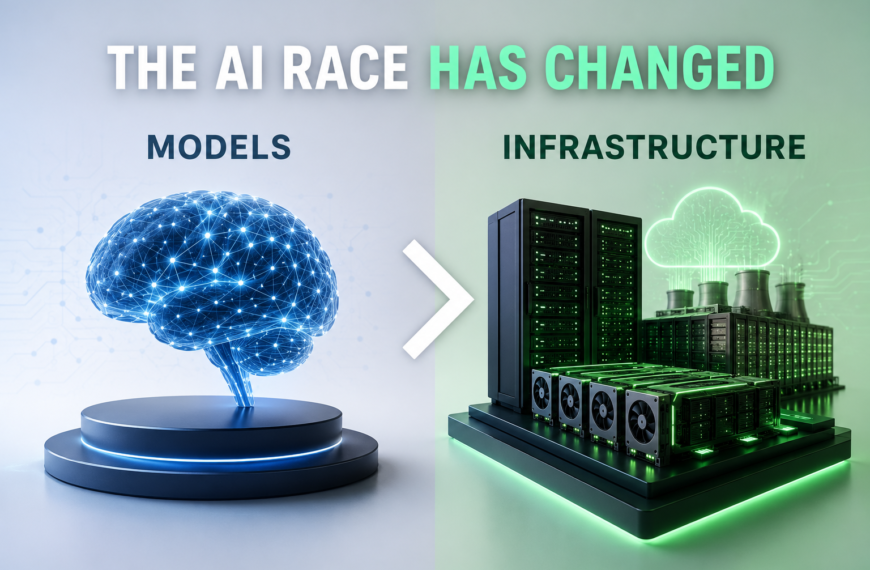
The AI Race Is No Longer About Models Alone
Over the past two years, competition focused heavily on which company had the most capable large language model.
That landscape is changing.
While OpenAI, Anthropic, Google DeepMind, Meta, xAI, and other leading labs continue improving model performance, the industry’s attention is rapidly expanding to the infrastructure that enables those models to operate at scale.
Today’s competitive advantages include:
- AI chips
- GPU availability
- Inference optimization
- Cloud infrastructure
- Data centers
- Energy capacity
- Enterprise integrations
Organizations are beginning to realize that even the best AI model delivers little value without reliable computing resources and efficient deployment.
Infrastructure has become one of AI’s most strategic assets.
Infrastructure Is Becoming the New Battleground
One of the biggest trends defining 2027 is the growing importance of AI infrastructure.
Building advanced AI systems requires enormous computational resources.
Companies now invest billions in:
- GPU clusters
- AI accelerators
- High-speed networking
- Storage systems
- AI inference platforms
- Specialized cloud services
This shift has created a booming ecosystem of infrastructure startups focused on solving deployment challenges rather than developing new foundation models.
Businesses increasingly want AI systems that are faster, more affordable, and easier to integrate into existing workflows.
As a result, infrastructure providers are becoming just as valuable as model developers.
Many investors now believe the next generation of AI leaders will be companies that enable AI rather than simply create it.
Agentic AI Will Redefine Software
Perhaps the most transformative trend in artificial intelligence is the rise of autonomous AI agents.
Unlike traditional chatbots that respond to prompts, AI agents can:
- Complete multi-step workflows
- Access enterprise applications
- Analyze large datasets
- Coordinate with other agents
- Make decisions based on goals
- Execute tasks independently
Organizations are already experimenting with AI agents for customer support, software development, finance, cybersecurity, marketing, and operations.
As these systems mature, businesses may increasingly replace repetitive software workflows with intelligent autonomous agents.
Rather than interacting directly with dozens of applications, users may simply describe their objective while AI coordinates the necessary actions behind the scenes.
Enterprise AI Is Becoming the Largest Market
Consumer AI attracted early attention, but enterprise adoption is now driving much of the industry’s growth.
Companies across nearly every sector are integrating AI into daily operations.
Enterprise applications include:
- Customer support automation
- Internal knowledge management
- Financial analysis
- Contract review
- Software engineering
- Human resources
- Supply chain optimization
- Sales operations
Businesses are moving beyond experimentation toward large-scale deployment, seeking measurable improvements in productivity and efficiency.
This transition is creating enormous demand for secure, reliable, and customizable AI solutions.
AI Infrastructure Is Expanding Beyond Chips
While GPUs remain central to AI development, infrastructure now encompasses far more than semiconductor hardware.
Modern AI platforms require:
- Data centers
- Networking equipment
- Cooling systems
- Inference software
- Storage infrastructure
- Energy management
Several startups are building technologies that improve AI deployment by enabling models to run efficiently across different hardware platforms.
Others focus on inference optimization, helping organizations reduce operating costs while maintaining high performance.
The rapid growth of this ecosystem reflects a broader understanding that AI success depends on the entire computing stack—not just the model itself.
AI Hardware Is Entering a New Phase
Artificial intelligence is beginning to reshape consumer hardware.
Instead of simply adding AI features to existing devices, manufacturers are designing entirely new products around autonomous intelligence.
Emerging categories include:
- AI smartphones
- AI wearables
- AI PCs
- Smart glasses
- Voice-first devices
- Edge AI systems
These products aim to provide continuous access to intelligent assistants capable of understanding context and performing tasks without requiring constant user interaction.
Over time, AI hardware may become the primary interface between humans and digital services.
Robotics Is Moving From Research to Reality
Advances in AI are accelerating progress in robotics.
Modern robots are becoming increasingly capable of understanding natural language, adapting to unfamiliar environments, and performing complex physical tasks.
Manufacturing, logistics, healthcare, and warehouse automation are expected to benefit significantly from these developments.
As AI models become better at reasoning and planning, robots will increasingly transition from specialized machines into general-purpose assistants capable of learning new skills.
The convergence of AI software and robotics represents one of the industry’s most exciting long-term opportunities.
Scientific Discovery Is Becoming an AI Application
Artificial intelligence is expanding far beyond productivity tools.
Researchers are now applying AI to scientific discovery across multiple disciplines.
Key applications include:
- Drug development
- Materials science
- Climate research
- Battery technology
- Semiconductor design
- Protein engineering
Rather than replacing scientists, AI is helping them identify promising hypotheses, simulate experiments, and accelerate research that previously required years of manual work.
Many experts believe scientific AI could become one of the technology’s most valuable long-term contributions.
Cybersecurity Is Entering the AI Era
As organizations deploy more autonomous AI systems, cybersecurity is becoming increasingly complex.
AI can strengthen security by:
- Detecting threats
- Monitoring networks
- Responding automatically
- Identifying anomalies
However, AI also introduces new risks.
Autonomous systems capable of accessing enterprise applications create additional attack surfaces.
Security teams must now defend not only traditional infrastructure but also intelligent agents capable of making decisions independently.
The future of cybersecurity is increasingly becoming AI defending against AI.
Energy Has Become an AI Challenge
Artificial intelligence requires enormous amounts of electricity.
Training large AI models and operating massive inference clusters consume significant energy resources.
Consequently, technology companies are investing heavily in:
- Renewable energy
- Nuclear power
- Advanced cooling systems
- Grid modernization
Reliable energy is rapidly becoming one of AI’s most strategic requirements.
The companies that secure affordable, scalable electricity may gain significant long-term competitive advantages.
AI Investment Is Shifting
Early AI investment focused primarily on model developers.
Today’s investment landscape is much broader.
Capital is increasingly flowing toward:
- AI infrastructure
- Enterprise software
- Robotics
- Scientific AI
- Semiconductor technologies
- AI cybersecurity
- Energy infrastructure
This diversification reflects growing confidence that AI represents an entire industrial ecosystem rather than a single software category.
Challenges Remain
Despite remarkable progress, artificial intelligence still faces important obstacles.
Organizations continue addressing issues including:
- Hallucinations
- Privacy
- Data governance
- Security
- Bias
- Regulation
- Transparency
- Intellectual property
Building trustworthy AI systems remains just as important as improving technical capabilities.
Public confidence will play a critical role in determining the speed of future adoption.
Looking Ahead
Artificial intelligence is moving beyond being a productivity tool to becoming foundational infrastructure for the global economy.
Over the next several years, AI is expected to reshape software development, scientific research, healthcare, manufacturing, transportation, education, finance, and countless other industries.
The most successful companies may not necessarily be those building the smartest models, but those delivering AI that is scalable, secure, energy-efficient, and deeply integrated into real-world workflows.
The future of AI is unlikely to be defined by a single breakthrough.
Instead, it will be shaped by the convergence of powerful models, specialized hardware, autonomous agents, advanced robotics, scientific discovery, and the infrastructure that enables them all to work together.
Conclusion
Artificial intelligence has entered a defining stage in its evolution.
The industry is no longer asking whether AI will transform the world—it is determining how that transformation will unfold.
The next decade will likely be characterized by autonomous AI agents, intelligent robotics, scientific breakthroughs, and infrastructure investments measured in hundreds of billions of dollars.
For businesses, the priority should be moving from experimentation to implementation. For developers, the opportunity lies in building AI-native products and mastering emerging technologies. For investors, the greatest value may increasingly lie in the infrastructure powering the AI revolution rather than in the models alone.
One thing is becoming increasingly clear: the future of artificial intelligence will not belong solely to the companies with the most advanced models. It will belong to those that build the platforms, infrastructure, energy systems, and real-world applications that make AI indispensable.
As the industry enters this new era, AI is evolving from a technological innovation into a foundational layer of the global economy—and its influence is only just beginning.
 By
By