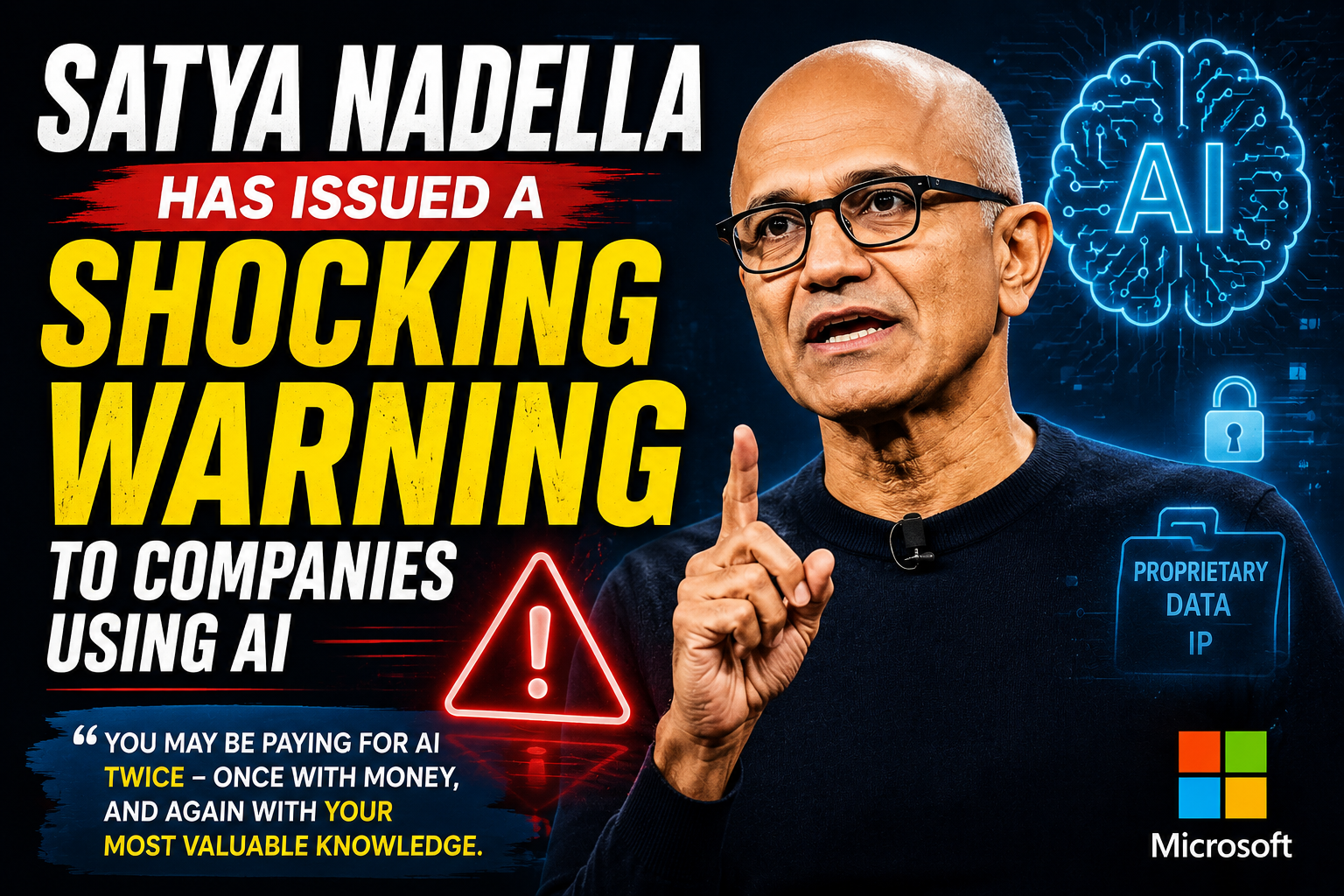

Microsoft CEO Satya Nadella has delivered one of the strongest warnings yet to businesses rushing to adopt artificial intelligence. His message is simple: companies may be paying for AI twice — once with money and again with their most valuable knowledge.
The warning comes as businesses around the world integrate AI tools into daily workflows, customer support systems, software development, and internal operations.
However, Nadella believes many organizations are overlooking a hidden cost.
The Hidden Price of AI
According to Nadella, companies pay directly for AI services through subscriptions, API usage, and token costs.
At the same time, they may unknowingly provide something even more valuable: their own intellectual property, business processes, customer insights, and operational knowledge.
Every prompt, workflow, correction, and interaction can help improve AI systems.
Nadella describes this information leakage as “AI exhaust.” Unlike financial costs, companies rarely track how much knowledge leaves their organization through AI usage.
The Reverse Information Paradox
Nadella introduced a concept called the “Reverse Information Paradox.”
Traditionally, businesses protected their knowledge because sharing it reduced their competitive advantage.
Today, AI changes that equation.
Companies actively feed internal knowledge into external AI systems to receive better answers and improved performance. As a result, organizations may strengthen the very platforms they depend on while weakening their own competitive edge.
Why This Matters for Businesses
For many companies, proprietary knowledge is their biggest asset.
This includes:
- Customer relationships
- Internal workflows
- Industry expertise
- Operational processes
- Historical business data
- Strategic planning information
If businesses rely entirely on external AI providers, they risk turning their unique expertise into a commodity.
Nadella’s Advice: Own Your AI Learning Loop
Rather than depending solely on third-party AI services, Nadella encourages businesses to build their own AI learning loops.
The idea is simple: organizations should ensure that the knowledge generated through AI usage stays within their own systems whenever possible.
He argues that companies should own:
- Their data
- Their workflows
- Their AI memory
- Their institutional knowledge
This approach allows businesses to benefit from AI while protecting long-term value creation.
A Growing Debate in the AI Industry
Nadella’s comments arrive at a time when concerns about AI concentration continue to grow.
Many industry leaders worry that a small number of AI companies could control the majority of future knowledge infrastructure.
If that happens, businesses may become dependent on a handful of providers for intelligence, automation, and decision-making tools.
What This Means for the Future
Nadella’s warning highlights an important shift in the AI economy.
In the past, companies protected factories, software, and patents.
In the AI era, organizations may need to protect prompts, workflows, and institutional knowledge with the same level of care.
The companies that succeed may not be the ones using the most AI tools.
Instead, they may be the businesses that learn how to keep their knowledge while using AI to amplify it.

 By
By