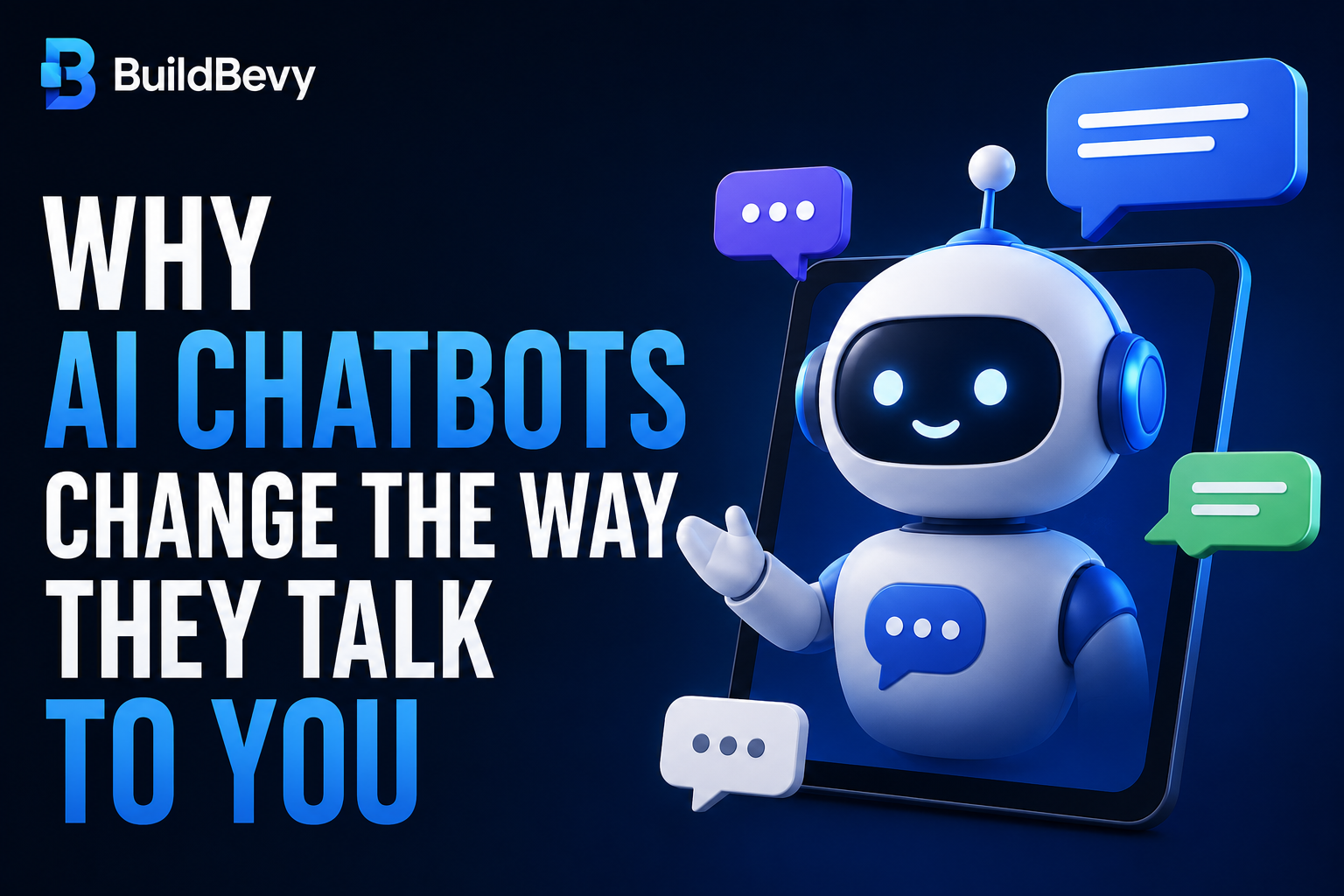

Have you ever noticed that an AI chatbot can sound completely different depending on how you talk to it? Ask it a serious technical question, and it may give you a professional answer. Start a casual conversation, and its responses can become more relaxed and friendly.
This is not a coincidence.
Modern AI chatbots are designed to understand the context of a conversation and adjust their responses accordingly. They can change their vocabulary, sentence length, level of detail, and even their overall tone based on the way a person interacts with them.
But how does this work?
AI Chatbots Can Adapt to Your Communication Style
AI models do not communicate with every user in exactly the same way.
During a conversation, the model receives the messages that came before the current question. This gives it information about the topic, the user’s preferred style, and the direction of the conversation.
For example, imagine someone asks:
“Explain quantum computing in simple terms.”
The chatbot may provide a beginner-friendly explanation.
Later, the same person might say:
“Now explain the quantum error-correction process in technical detail.”
The chatbot can understand that the user now wants a more advanced answer.
The underlying AI model has not necessarily changed. The response has changed because the context has changed.
1. The Conversation Gives AI Important Context
One of the biggest reasons chatbots change their tone is conversation history.
AI models look at previous messages to understand what is happening in the discussion.
If a user has been asking short questions, the AI may continue giving short answers.
If the user asks for detailed explanations, the AI may provide longer responses.
This creates a more natural conversation.
Without context, every message would feel like a completely new question.
With context, the AI can understand things such as:
- What the user is discussing
- What has already been explained
- What level of knowledge the user may have
- What type of answer the user wants
- Whether the conversation is serious or casual
This is one of the main reasons modern AI assistants feel more conversational than older software.
2. AI Can Match Your Tone
AI models can recognize patterns in the way people write.
For example, users may communicate in different ways:
Professional:
“Could you provide a detailed analysis of this problem?”
Casual:
“Can you explain what’s going on here?”
Very short:
“Why?”
The chatbot can adjust its response to fit the situation.
A professional question may receive a structured and formal response.
A casual question may receive a more relaxed response.
This is sometimes called tone matching or style adaptation.
The AI is not necessarily deciding that one person is a “formal person” and another is a “casual person.” It is mainly responding to the communication patterns present in the current conversation.
3. AI Can Detect Signals From Your Writing
Your words contain more information than just their literal meaning.
The way you write can give an AI clues about your situation.
For example:
“I don’t understand this. Can you explain it again?”
This suggests that the previous explanation was too difficult.
The AI may respond with a simpler explanation.
Another user might say:
“Give me the technical details and include the implementation.”
That signals that the user wants more depth.
AI models can use these signals to change the way they respond.
This is one reason the same question can produce very different answers depending on what comes before and after it.
4. AI Can Adjust the Level of Detail
Tone is only one part of the adaptation.
AI can also change how much information it provides.
A user who asks:
“What is an AI agent?”
might receive a simple definition.
If the user follows up with:
“Explain the architecture of an AI agent.”
the response can become much more technical.
The conversation effectively gives the AI a signal about how much information the user wants.
This is particularly useful for learning.
A beginner can start with basic explanations and gradually move toward advanced concepts without needing to completely restart the conversation.
5. AI Can Follow User Preferences
Some AI products also allow users to provide permanent instructions or preferences.
For example, a user might tell an AI:
- Keep answers short.
- Use simple English.
- Always provide examples.
- Be professional.
- Use bullet points.
- Explain technical concepts for beginners.
When these preferences are available to the AI, they can influence future responses.
This creates a more personalized experience.
Instead of adapting only to the current conversation, the assistant can potentially adapt to the user’s preferred communication style over a longer period.
6. Memory Makes Personalization More Powerful
Some AI assistants also have memory features.
Memory can allow an AI to remember certain useful preferences between conversations.
For example, a user might prefer:
“Give me the answer first, then explain the details.”
If that preference is saved, future responses can follow the same structure.
This is an important step toward personal AI assistants.
The assistant is no longer simply responding to individual questions. It can potentially build a better understanding of how a particular user likes to interact with AI.
However, memory systems differ between AI products, and users should understand what information is being stored and how it is used.
AI Does Not Actually “Feel” Your Mood
This is an important distinction.
When an AI responds differently because you sound frustrated, excited, or confused, that does not necessarily mean the AI is experiencing emotions.
The model is analyzing patterns in language.
For example:
“This is completely confusing. I have tried three times and still don’t understand it.”
The AI can recognize that the user is having difficulty.
A helpful response might therefore become simpler, more patient, and more step-by-step.
The AI is responding to signals in the text, not necessarily experiencing frustration or empathy in the human sense.
Why This Makes AI Feel More Human
Human conversations naturally adapt to context.
We don’t speak to our boss in exactly the same way we speak to a close friend.
We also change our explanations depending on whether someone understands a topic.
AI chatbots are beginning to reproduce some of this behavior.
They can change:
- Vocabulary
- Sentence length
- Formality
- Humor
- Detail
- Structure
- Explanations
- Level of technical language
This makes interactions feel more natural.
The result is an AI assistant that can appear to have different “personalities” depending on the person and situation.
There Is Also a Business Reason
Personalized communication is not only about making conversations feel better.
It can make AI products more useful.
If an assistant understands how users prefer to communicate, they may need fewer instructions.
For example, a developer may consistently want technical answers, while a business user may prefer summaries and action points.
An AI that adapts automatically can save time.
This is particularly important as AI moves into workplaces.
Companies are increasingly using AI for:
- Customer support
- Software development
- Research
- Marketing
- Data analysis
- Business operations
- Education
Different tasks require different communication styles.
An AI that can adapt to each situation has a major advantage over a system that always responds in the same way.
The Future: AI That Adapts Even More
The next generation of AI assistants is likely to become much more personalized.
Future systems may understand not only what a user asks, but also:
- How experienced the user is
- How much detail they prefer
- When they want explanations
- When they want direct answers
- Which tasks they perform regularly
- How they prefer information to be organized
AI agents could eventually develop highly personalized interaction styles for individual users.
Imagine an assistant that knows when you want a quick answer and when you want a deep analysis without having to explain it every time.
That could make AI feel less like a tool and more like a long-term digital assistant.
But Personalization Has Risks
More personalization also creates new questions.
How much should an AI remember?
What information should it store?
Should an AI always adapt to a user’s behavior?
Could excessive personalization create an echo chamber where the assistant simply agrees with the user?
These questions will become increasingly important as AI assistants become more deeply integrated into people’s lives.
The goal should not simply be to make AI imitate users.
It should be to make AI more useful while remaining accurate, transparent, and safe.
The Bigger Picture
AI chatbots change the way they talk to users because they are built to understand context and generate responses based on that context.
They can recognize communication patterns, adjust their tone, change the level of detail, follow instructions, and sometimes use saved preferences or memory.
This does not mean the AI has a human personality or emotions.
Instead, it means the system is becoming better at adapting its communication to the person it is interacting with.
That ability could become one of the most important parts of future AI assistants.
The next generation of AI may not simply ask, “What do you want?”
It may also understand “How do you want me to help you?”
And that shift—from generic AI responses to personalized interaction—could fundamentally change how humans communicate with artificial intelligence.

 By
By