
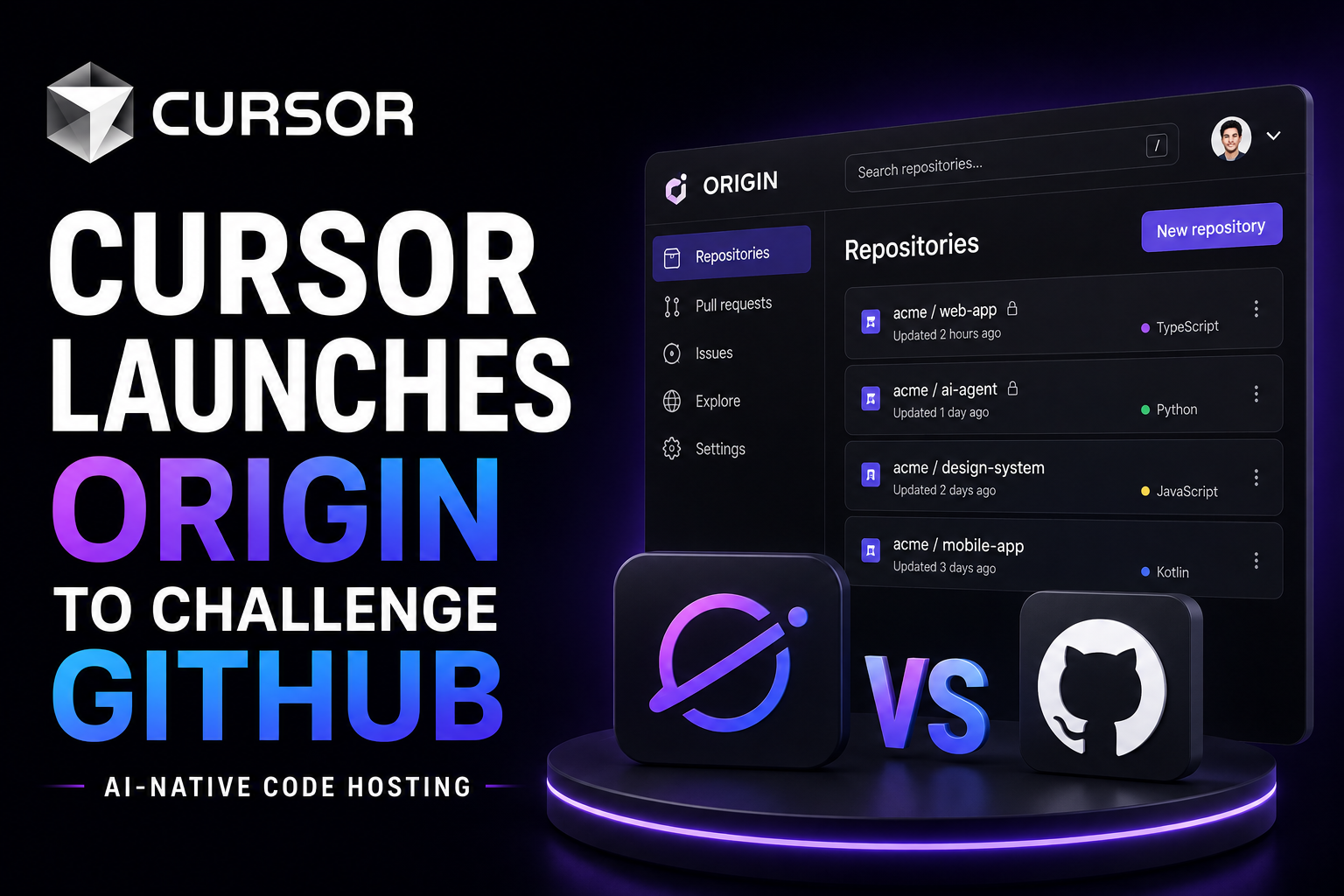

Cursor has launched Origin, a new code-hosting platform designed to compete with GitHub and reshape how developers manage software in the age of AI coding agents.
The platform is rolling out in early beta to paid Cursor users and combines repositories, pull requests, code browsing and GitHub synchronization with Cursor’s AI coding tools.
The launch represents an important change for Cursor. The company started as an AI-powered code editor, but Origin takes it deeper into the software development stack.
What Is Cursor Origin?
Origin is a Git-compatible code-hosting platform where developers can store, manage and collaborate on software projects.
The basic functions will feel familiar to GitHub users.
Developers can:
- Create repositories
- Push and pull code
- Browse projects
- Create pull requests
- Review code changes
- Manage branches
- Work with Git
- Connect existing GitHub repositories
Origin is designed to work directly with Cursor, meaning developers can move between their code, AI agents and source control without constantly switching between different platforms.
Cursor Is Not Simply Copying GitHub
At first glance, Origin may look like another GitHub alternative.
But Cursor’s bigger idea is different.
GitHub was originally designed around human developers writing code, creating commits and reviewing pull requests.
AI agents are changing that workflow.
An AI agent can create multiple branches, modify large parts of a project, run tests and generate pull requests much faster than a human developer.
Cursor believes code-hosting infrastructure needs to evolve around this new workflow.
That is why the company describes Origin as a platform built for the agentic era.
AI Agents Are at the Center
The most important difference between Origin and traditional code hosting could be its connection to AI agents.
With Origin, Cursor wants developers to have AI agents working directly with hosted repositories.
An agent can understand the codebase, make changes and work with pull requests as part of the same development environment.
This creates a much tighter workflow:
Repository → AI agent → Code changes → Review → Pull request → Deployment
Instead of treating AI as an assistant sitting beside the developer, Origin puts AI much closer to the actual software-development infrastructure.
GitHub Isn’t Being Completely Replaced
Cursor is also making it possible for developers to continue using GitHub.
Origin supports GitHub synchronization, allowing existing GitHub repositories to connect with the new platform.
This is an important strategy.
Cursor does not need developers to abandon GitHub immediately.
A team can experiment with Origin while continuing to use GitHub for existing projects.
That makes it easier for developers to test the platform without making a complete switch.
Why Cursor Wants to Compete With GitHub
GitHub controls a huge part of the software-development workflow.
Developers use it for:
- Source-code hosting
- Collaboration
- Pull requests
- Code reviews
- Issue tracking
- Automation
- CI/CD
- Open-source projects
By launching Origin, Cursor is moving into one of the most important parts of the developer ecosystem.
The company can now potentially control more of the journey:
Write code → Ask AI for help → Run agents → Store code → Review changes → Merge code
That is a much bigger opportunity than simply selling an AI code editor.
Cursor Is Becoming a Development Platform
This launch continues Cursor’s rapid expansion.
The company started by improving the traditional code editor with AI.
It then expanded into increasingly autonomous coding agents.
Now it is adding code hosting.
That creates a broader platform:
Cursor Editor
Where developers write and modify code.
Cursor Agents
AI systems that can perform coding tasks.
Origin
Where code and pull requests are hosted and managed.
Together, these products could create a complete AI-native software-development environment.
Why This Matters for AI Coding
AI coding is moving quickly from autocomplete toward autonomous development.
Traditional AI coding assistants might suggest a few lines of code.
Modern coding agents can potentially handle much larger tasks.
For example:
Developer: “Add user authentication to this application.”
The agent could:
- Inspect the existing project.
- Create the required files.
- Modify the database.
- Add authentication logic.
- Run tests.
- Fix errors.
- Create a branch.
- Prepare a pull request.
The more capable agents become, the more important the underlying code-hosting infrastructure becomes.
That is the market Cursor is targeting with Origin.
Origin Could Change Pull Requests
Pull requests were designed mainly around humans reviewing code written by other humans.
AI agents could create many more changes than human developers traditionally do.
That creates a new challenge:
How do humans efficiently review thousands of AI-generated changes?
AI-native code hosting could potentially help by allowing agents to summarize changes, answer questions about code and assist with reviews.
Cursor has already positioned AI agents as a central part of its development workflow, and Origin provides the infrastructure where these interactions can happen around repositories and pull requests.
The Timing Is Interesting
Origin’s launch also came during a period of renewed attention on GitHub’s reliability.
A major GitHub outage around the launch highlighted how heavily modern software teams depend on centralized development infrastructure.
The timing does not necessarily mean Cursor launched Origin because of the outage—the product had been announced months earlier.
But the outage gave Origin an interesting moment to demonstrate why alternative infrastructure could matter.
Cursor Has Big Competition
GitHub is obviously the biggest competitor.
But Cursor will also compete with other development platforms and AI coding companies.
Microsoft has the advantage of owning GitHub and operating GitHub Copilot.
Other companies are also building AI-powered development environments.
The competition could eventually become:
GitHub + Copilot
vs.
Cursor + Origin
with other AI-native development platforms joining the race.
Why Developers May Care
For developers, the biggest advantage could be convenience.
Instead of constantly moving between:
IDE → AI assistant → GitHub → pull request → CI → deployment
more of the workflow could happen inside one AI-focused environment.
That could save time.
It could also make AI agents much more useful because they can operate closer to the repository and development workflow.
But There Are Still Questions
Origin is still in early beta, so it is too early to say whether it can seriously challenge GitHub at scale.
Developers will want answers to important questions around:
- Pricing
- Security
- Enterprise controls
- Reliability
- Performance
- Open-source support
- Data privacy
- Migration from GitHub
- CI/CD compatibility
- Long-term GitHub interoperability
GitHub has spent years building a massive ecosystem around its platform.
Replacing that ecosystem will be difficult.
Cursor’s advantage is that it does not necessarily need to replace GitHub immediately.
It can start by making AI-native development workflows better.
The Bigger Picture
Cursor’s Origin launch is important because it shows that the AI coding race is moving beyond the editor.
The first phase was about making developers faster.
The next phase is about letting AI agents perform increasingly large parts of software development.
That requires new infrastructure.
AI agents need repositories. They need branches. They need pull requests. They need code reviews. They need testing and deployment.
Origin is Cursor’s attempt to build that infrastructure around AI from the beginning.
GitHub remains the dominant platform, and Origin is still in its early stages.
But the direction is clear:
Cursor doesn’t just want to help developers write code. It wants to become part of the infrastructure where AI-written code is created, reviewed and shipped.
If AI agents become the primary way software is built, that could make Origin one of Cursor’s most strategically important products.
And that is why this isn’t simply another GitHub competitor.
It is a bet that the future of software development will be built around AI agents—and the infrastructure supporting them will need to change too.
 By
By