
The future of data centers may not be powered only by GPUs and silicon chips.
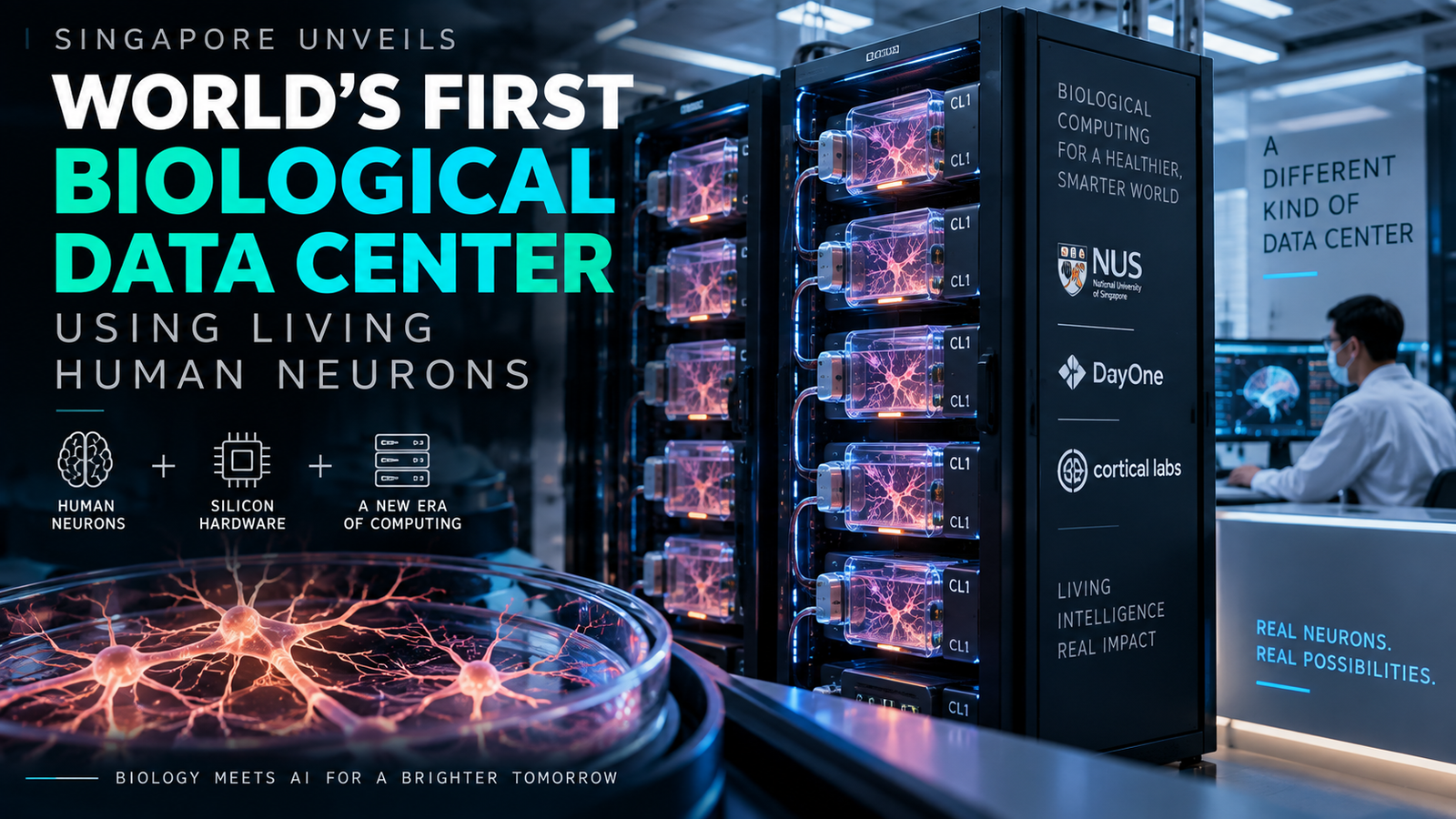
In Singapore, researchers and technology companies have built a biological data center prototype that uses living human neurons as part of its computing system.
The project brings together the National University of Singapore (NUS) Medicine, data center company DayOne, and biological computing startup Cortical Labs.
The system uses living neurons grown from stem cells and connected to silicon hardware. The goal is to explore whether biological systems can perform certain computing and AI tasks while using far less energy than traditional computing systems.
This does not mean a human brain has been placed inside a data center.
Instead, scientists are growing human neurons in controlled laboratory conditions and connecting them to computer hardware.
The idea could eventually create a completely new type of computing infrastructure.
What Is a Biological Data Center?
A traditional data center contains thousands of servers powered by silicon chips.
A biological data center works differently.
Instead of using only electronic processors, it uses living biological neurons, often described as “wetware.”
The neurons can receive electrical signals from a computer and send electrical activity back to the computer. Software can then interact with this activity.
In Singapore, the prototype uses 20 CL1 biological computing units developed by Cortical Labs. NUS describes the installation as the world’s first independently operated biologically integrated server rack.
The neurons are grown from stem cells and maintained inside the CL1 system.
According to NUS, each unit contains at least 200,000 lab-grown neurons, meaning the 20-unit rack contains at least several million living neurons.
The important point is that these are lab-grown human neurons, not pieces of a human brain.
How Does It Work?
Cortical Labs’ CL1 combines biological neurons with a silicon chip.
The neurons are grown directly over a chip containing a microelectrode array.
The computer can send electrical signals to the neurons.
The neurons respond with their own electrical activity.
That activity is then recorded and translated back into information that a computer can use.
This creates a closed loop:
Computer → electrical signals → living neurons → neural activity → computer
Cortical Labs describes the CL1 as a code-deployable biological computer that allows researchers to interact with real neurons through software.
The company has also developed a biological computing platform called Cortical Cloud, which allows researchers to access CL1 systems remotely without operating their own biological laboratory.
Why Use Human Neurons?
The main reason is efficiency.
The human brain is extremely good at processing information while using very little energy compared with modern computing infrastructure.
Today’s AI systems require huge amounts of computing power.
Training and running advanced AI models can require large GPU clusters, significant electricity and cooling infrastructure.
Biological neural networks work differently.
They naturally learn and adapt through biological processes.
Researchers therefore want to understand whether some of these properties can be used to build more efficient computing systems.
NUS says biological computing has the potential to provide greater efficiency because biological systems can operate using only a fraction of the power required by conventional digital computers.
However, this should be viewed as a research goal, not proof that biological computers are already more powerful than GPUs for general AI.
The Neurons Can Actually Learn
This is one of the most interesting parts of the technology.
Cortical Labs has previously demonstrated biological neurons interacting with a computer game.
In 2021, the company connected approximately 800,000 living neurons to a computer system and trained them to play Pong.
The neurons received information about the game and learned to control the paddle through electrical signals.
The experiment demonstrated that living neural networks can interact with digital environments and change their behavior based on feedback.
The Singapore project takes that idea much further.
Instead of one laboratory experiment, researchers are now testing multiple biological computing units together inside a data center environment.
What Could Biological Computers Be Used For?
The technology is still experimental, but researchers see several possible applications.
AI Research
Biological computers could provide another way to study learning and intelligence.
Instead of trying to perfectly simulate neurons using software, researchers can work with actual neurons.
This could help scientists understand how biological systems learn and adapt.
Drug Discovery
One of the most promising areas is medicine.
Researchers can expose biological neural networks to different compounds and observe how the networks respond.
This could potentially help scientists study neurological diseases and test drug effects.
NUS says the platform could help accelerate drug discovery and neurological disease research.
Robotics
Biological neural networks could eventually be connected to robots.
A robot could receive information from sensors and use a biological neural network to help process that information.
Cortical Labs specifically lists humanoid robotics among the areas it wants to explore.
Cybersecurity
Biological computing could also be tested for security applications.
Cortical Labs says potential applications include cybersecurity and fraud detection.
The advantage could come from biological systems’ ability to adapt to changing patterns.
Fraud Detection
Financial systems constantly deal with new types of suspicious activity.
A biological computing system could potentially be used to investigate whether adaptive neural networks can identify unusual patterns with less training data.
Again, this remains an area of research rather than a proven replacement for existing fraud systems.
Why Singapore?
Singapore is already one of the world’s major data center markets.
But the country faces an important problem.
Data centers require large amounts of electricity and water, while Singapore has limited land and resources.
That makes energy-efficient computing particularly interesting for the country.
The Singapore government has also introduced tighter sustainability requirements for new data center capacity.
The biological data center project is therefore being positioned as an experiment in what future computing infrastructure could look like.
DayOne, NUS Medicine and Cortical Labs want to explore whether biological computing can help Singapore increase computing capacity without simply increasing traditional energy-intensive infrastructure.
This Is Not a GPU Replacement Yet
Despite the exciting headline, biological computers are not replacing Nvidia GPUs.
There is still a huge difference between an experimental biological computing system and a modern AI data center.
GPUs can run massive AI models at extremely high speeds and are already supported by mature software ecosystems.
Biological computers have many limitations.
The neurons are living cells.
They need to be maintained in controlled conditions.
They need nutrients and environmental support.
Their behavior can also vary from one biological network to another.
Cortical Labs says its CL1 system can keep neurons alive for up to six months under its controlled life-support system.
Scaling the technology is another major challenge.
Putting 20 biological computers into a rack is very different from operating thousands or millions of them.
The Biggest Difference From Normal AI
Traditional AI attempts to simulate intelligence using mathematics and silicon.
Biological computing takes another approach.
It uses the biological system itself.
That means researchers are not simply creating another AI model.
They are creating a hybrid system where:
Biology + silicon + software = biological computing
This could eventually lead to computers that learn differently from today’s AI systems.
Instead of requiring enormous datasets and massive training runs, biological neural networks may be able to learn certain tasks from much smaller amounts of information.
Cortical Labs says its biological systems can learn with less training data and lower energy use than traditional approaches, although these are still areas being explored and demonstrated.
The Future Could Be Hybrid
The most realistic future may not be biological computers replacing traditional computers.
Instead, they could work alongside them.
A future AI system might use GPUs for large-scale mathematical computation while biological processors handle specific tasks involving adaptation, pattern recognition or learning.
This could create a hybrid data center containing:
GPUs + CPUs + specialized AI chips + biological processors
Each system could handle the type of work it is best suited for.
That is potentially much more interesting than simply replacing one technology with another.
The Ethical Questions Are Also Important
Using living human neurons for computing creates questions that traditional chips do not.
Scientists need to understand how biological neural networks behave and what ethical limits should apply to them.
Researchers also need to establish clear standards around the use of human-derived cells.
Cortical Labs says its research operates within established ethical frameworks and is exploring biological computing for medical and scientific applications.
These questions will become even more important if biological computing becomes more advanced.
Singapore’s Prototype Is Only the Beginning
The current system is still a prototype.
But its importance is not necessarily about how powerful the 20-unit rack is today.
It is about proving that biological computing can move beyond a laboratory experiment and into something resembling real computing infrastructure.
NUS, DayOne and Cortical Labs say their long-term goal is to develop a larger biological data center in Singapore and eventually explore applications across AI, healthcare, robotics, cybersecurity and other fields.
The project represents a very different vision of the future of computing.
For decades, computers became more powerful by putting more transistors onto chips.
Now researchers are asking another question:
What if the next big improvement in computing comes from using the same biological technology that created intelligence in the first place?
The answer is still unknown.
But Singapore’s biological data center shows that this idea is no longer purely theoretical.
Living human neurons are now being connected to computing infrastructure, and researchers are beginning to explore what happens when biology becomes part of the computer itself.

 By
By