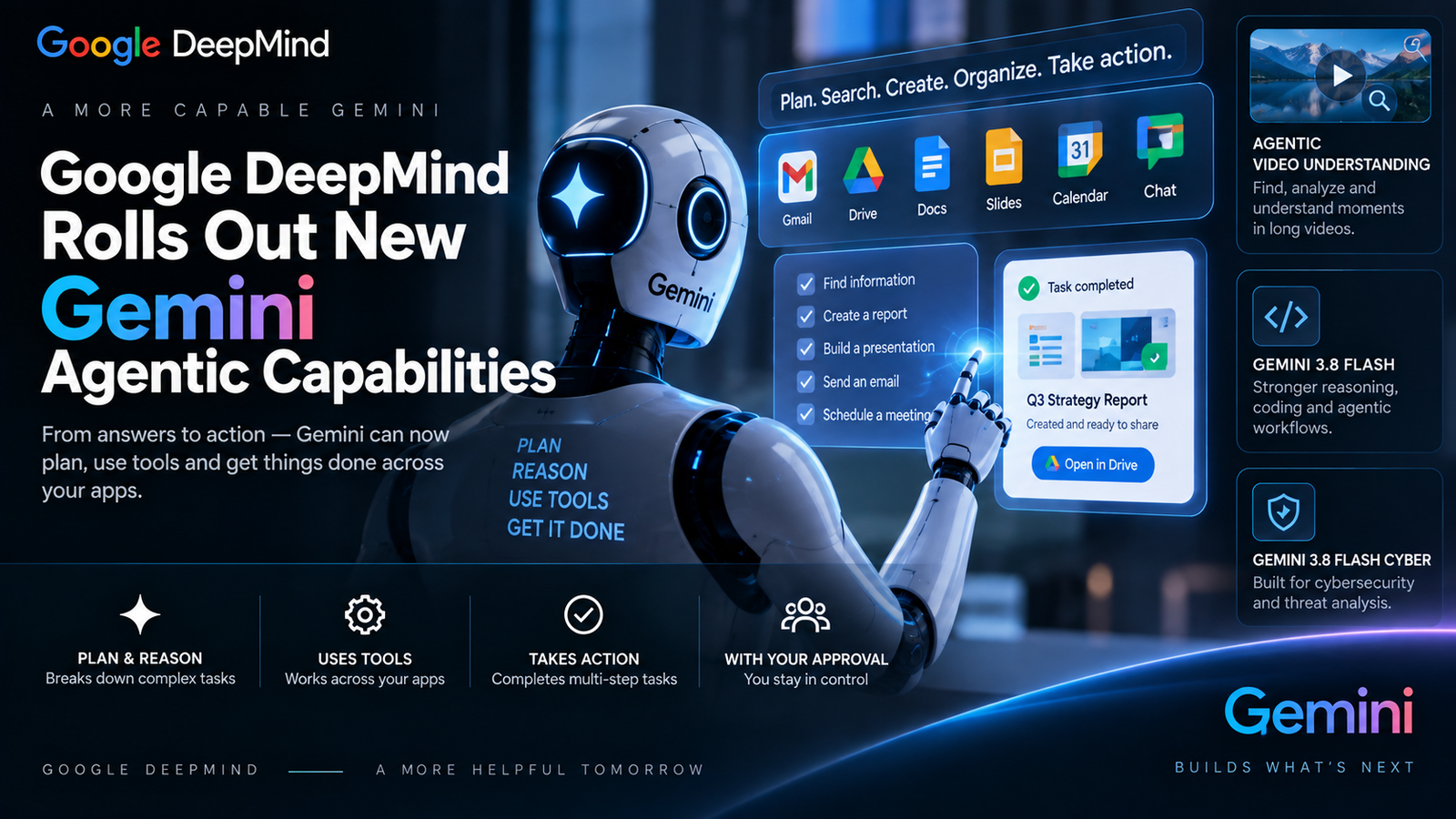

Google DeepMind is expanding Gemini from an AI that mainly responds to prompts into a system that can reason through tasks, use tools, work across applications and act on a user’s behalf.
The latest updates include new agentic capabilities for Google Workspace, advanced video understanding, and the new Gemini 3.8 Flash models. Together, these updates show Google’s growing focus on AI agents that can handle longer and more complex tasks instead of simply generating an answer.
Gemini Can Now Work Across Google Workspace
One of the newest updates is coming to Google Workspace.
Google says Gemini can now act as an intelligent orchestrator across Gmail, Drive, Docs, Slides and Chat. Instead of opening each application separately, users can ask Gemini to complete parts of a larger task from the app they are already using.
For example, a user could ask Gemini to:
- Create a document using information from emails
- Build a structured spreadsheet
- Create a presentation
- Draft emails
- Create and manage to-do items
- Schedule meetings
- Coordinate information across different Workspace apps
Gemini can work in the background while the user continues working.
Google describes this as a move from individual AI features toward cross-application agents that can coordinate multiple steps.
Gemini Can Take Action, Not Just Generate Text
The biggest change is how Gemini handles tasks.
Traditional AI assistants usually follow a simple pattern:
Prompt → Answer
Agentic AI is designed for a different workflow:
Goal → Plan → Use tools → Complete multiple steps → Return result
This means Gemini can decide what information it needs, retrieve it from connected sources and perform actions using available tools.
Google has also added human approval for certain actions. For example, when Gemini wants to send an external communication or make a calendar commitment, users receive a preview and can review or confirm the action before it happens.
This is important because giving AI more control also creates a need for stronger safeguards.
Gemini Gets Agentic Video Understanding
Google DeepMind also introduced agentic video understanding in September.
The feature is available across Gemini 3.7 Flash, Gemini 3.6 Flash and Gemini 3.5 Flash-Lite through the Gemini API and Google AI Studio.
Instead of processing a video at a fixed frame rate, Gemini can actively decide which parts of a video it needs to inspect.
It can search through different sections, examine frames more closely, use audio and transcripts, and return to specific moments when necessary.
This makes Gemini more useful for long videos.
Google Reports Major Efficiency Gains
According to Google DeepMind’s internal testing, agentic video understanding can:
- Reduce token consumption by up to 88%
- Reduce analysis costs by up to 66%
- Improve accuracy by up to 7%
These are Google’s reported benchmark results, so real-world performance can vary depending on the video and task.
The technology could be useful for:
- Finding specific moments in long videos
- Detecting unusual events
- Counting objects or actions
- Analyzing lectures
- Searching through long recordings
- Video editing
- Reviewing security footage
For example, instead of watching an entire two-hour recording, an agent could search for the exact section related to a user’s question.
Gemini 3.8 Flash Pushes Agentic Workflows Further
Google DeepMind also launched Gemini 3.8 Flash and Gemini 3.8 Flash Cyber on September 2.
Google describes Gemini 3.8 Flash as its most intelligent workhorse model at the time of launch, with improvements in coding, reasoning and agentic tasks.
The company says the model is designed for long-horizon coding and autonomous agents.
That means the model is intended to handle workflows that require multiple reasoning and execution steps rather than completing everything in one response.
Gemini 3.8 Flash Cyber is focused specifically on cybersecurity. Google says it can help trusted defenders find vulnerabilities and automate parts of the remediation process through its Fairwind program.
Google Is Building an Entire Agent Ecosystem
These launches are part of a larger strategy.
At Google I/O 2026, Google introduced several agent-focused products, including Gemini Spark, information agents in Search and updates to Google Antigravity.
Gemini Spark was designed as a personal AI agent that could operate in the background, use tools and work on longer tasks. Google also introduced Managed Agents through the Gemini API, allowing developers to create agents capable of reasoning, using tools and executing code inside isolated environments.
Google has continued expanding this system throughout 2026.
The result is a broader Gemini ecosystem where the same underlying AI capabilities can be used for:
Search + Workspace + Coding + Research + Video + Cybersecurity + Personal Agents
What This Means for AI Users
The latest Gemini updates show an important change in the AI industry.
The competition is no longer only about which model can produce the best answer.
Companies are increasingly trying to build AI that can complete the entire task.
For example, instead of asking:
“Write a marketing report.”
An agent could potentially gather information, analyze documents, create the report, build charts, prepare a presentation and organize the related files.
That is a much more powerful use of AI.
Google’s approach is also different from standalone AI assistants because Gemini can connect directly to Google’s large ecosystem of products and services.
The Agentic AI Race Is Accelerating
Google DeepMind’s latest releases come as OpenAI, Anthropic and other AI companies are also investing heavily in autonomous agents.
Google is now pushing Gemini deeper into everyday software while simultaneously improving the underlying models and tools that power those agents.
The company’s recent releases suggest that the next stage of Gemini is not simply about making the chatbot smarter.
It is about making Gemini more capable of seeing, reasoning, using tools and completing real-world tasks.
As these systems become more autonomous, security, permissions and human approval will become increasingly important. Google’s Workspace implementation already shows this direction by keeping users involved when an agent wants to take actions such as sending messages or making calendar commitments.
For Google, the goal is becoming clear: Gemini is moving from an AI assistant toward an AI agent that can actually get work done.

 By
By