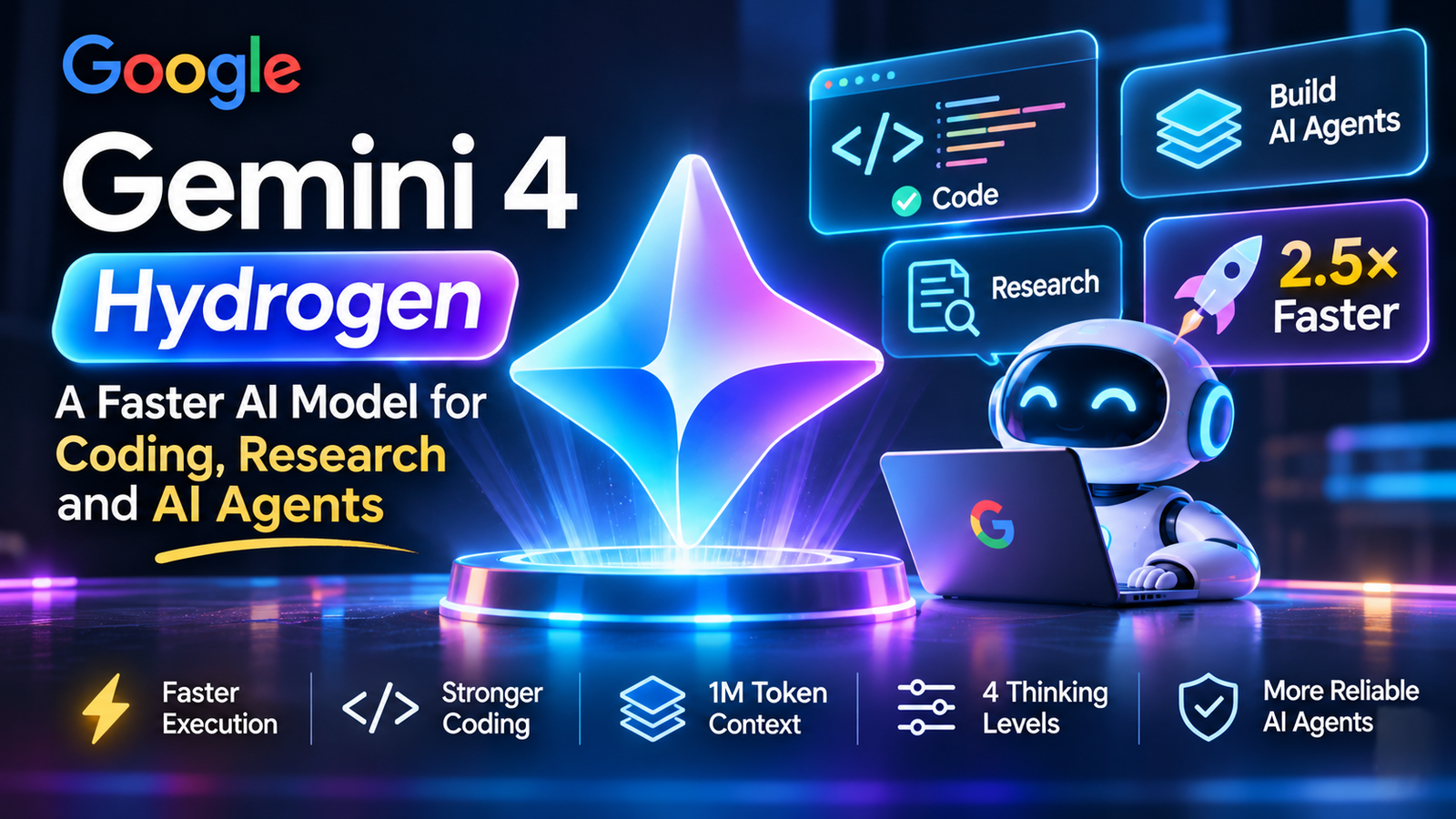

Google has launched Gemini 4 Hydrogen, a new AI model designed to make coding, research, and autonomous AI agents faster and more efficient. The model brings advanced reasoning capabilities to Google’s developer tools, Gemini app, Search, and enterprise products.
The AI race is no longer just about building the most powerful model. Speed, cost, reliability, and the ability to complete tasks independently are becoming equally important.
Google is addressing this shift with its latest release: Gemini 4 Hydrogen.
Announced on November 12, 2026, Hydrogen is designed for everyday coding, debugging, multi-step tasks, and agentic workflows. Unlike Google’s frontier models, Gemini 4 Carbon and Gemini 4 Argon, which focus on complex reasoning, Hydrogen prioritizes fast execution.
Google says the model can complete certain tasks significantly faster than its predecessor while improving coding performance, instruction following, and tool usage.
The launch also introduces a new direction for AI development: using multiple specialized models together, allowing one model to plan while another executes and verifies the work.
Here is everything you need to know about Gemini 4 Hydrogen, its features, benchmarks, pricing, availability, and what it means for the future of AI agents.
What Is Gemini 4 Hydrogen?
<text color=”secondary” size=”sm”>Google’s latest model for fast AI execution and agentic workflows</text>
<AsyncImage query=”Google Gemini 4 Hydrogen official model announcement abstract blue purple Gemini four branding” aspectRatio=”16:9″ width=”100%”/>
Gemini 4 Hydrogen is Google’s latest AI model, built for speed and efficiency across everyday tasks.
It is part of Google’s Gemini 4 model family, which also includes:
- Gemini 4 Carbon: Designed for advanced reasoning and complex tasks.
- Gemini 4 Argon: Focused on deep reasoning and long-horizon problem-solving.
- Gemini 4 Hydrogen: Built for rapid execution, coding, research, and AI agents.
The difference is in how Google expects developers and users to work with these models.
A complex software architecture problem might require a powerful reasoning model. But writing code, running tests, fixing smaller bugs, and checking results can often be handled by a faster model.
Hydrogen is designed for those execution-heavy tasks.
Google says it can operate independently or work alongside Carbon and Argon in multi-model workflows.
This approach could help developers build more capable AI agents without using their most expensive model for every step.
Source: Google DeepMind – Introducing Gemini 4 Hydrogen
Gemini 4 Hydrogen: Key Features
Google has introduced several improvements focused on speed, coding, reasoning, and agentic execution.
1. Faster Coding and Debugging
One of Hydrogen’s biggest strengths is software development.
The model is designed to work with existing codebases, understand project structures, identify bugs, and make focused changes.
Instead of rewriting large sections of code, it aims to make targeted edits while preserving existing functionality.
Google highlights several developer use cases:
- Debugging existing applications.
- Resolving repository issues.
- Writing and improving code.
- Running tests and verifying changes.
- Understanding large codebases.
- Building interactive web applications.
- Working with multiple files simultaneously.
Google reports that Hydrogen completes tasks 2.5 times faster than Gemini 3.8 Flash at its default high thinking setting.
It also reports a Terminal-Bench 4.1 score of 57%, compared with 18.2% for Gemini 3.8 Flash.
These are Google’s published evaluation results, not a guarantee that every real-world coding task will be 2.5 times faster.
2. Built for Autonomous AI Agents
<AsyncImage query=”AI agent orchestration multiple autonomous software agents connected nodes futuristic technology visualization” aspectRatio=”16:9″ width=”100%”/>
The most interesting part of Gemini 4 Hydrogen is its focus on agentic workflows.
Traditional chatbots mainly respond to questions. AI agents can work toward a goal by planning tasks, using tools, executing actions, and checking results.
For example, a software development agent could:
- Understand a development requirement.
- Inspect the existing repository.
- Identify the files that need changes.
- Write or modify code.
- Run tests.
- Analyze errors.
- Fix problems.
- Verify the final result.
Hydrogen is designed to handle these repeated execution steps efficiently.
Google also says the model performs well on multi-step research, data analysis, and broad codebase navigation.
This is important because agentic applications often make many model calls. Reducing the time and token usage of individual steps can improve the overall cost and speed of an application.
3. One Million-Token Context Window
Gemini 4 Hydrogen supports a large context window of approximately one million tokens.
This allows developers to work with substantial amounts of information in a single workflow.
Possible applications include:
- Analyzing large software repositories.
- Processing long technical documents.
- Reviewing business reports.
- Understanding complex spreadsheets.
- Analyzing audio and recorded video.
- Researching multiple documents together.
Google also describes support for long output generation through its API.
For developers working with large applications, this can reduce the need to split information into many smaller requests.
The exact input and output limits depend on the API surface and generation configuration.
4. Four Thinking Levels
Google has introduced four configurable thinking levels for Hydrogen:
| Thinking level | Purpose |
|---|---|
| Low | Faster responses for simpler tasks |
| Medium | Balanced speed and reasoning |
| High | Default setting for more capable execution |
| Xhigh | Deeper reasoning for demanding tasks |
This gives developers more control over how much reasoning a task requires.
For example, a simple code formatting request may not need extensive reasoning.
But debugging a complex application or analyzing a large dataset may benefit from a higher thinking level.
The goal is to balance performance, response time, and cost.

5. Better Tool Usage and Reliability
AI agents depend on tools to perform real work.
They may need to search the web, read files, access APIs, run commands, or interact with software.
However, tool calls can fail. A search may return no results, an API may respond with an error, or a command may produce unexpected output.
Google says Hydrogen is better at adapting when a tool call fails or a search returns empty results.
It also reports improvements in instruction following and fewer fabricated claims compared with Gemini 3.8 Flash.
For developers building autonomous systems, this matters because a reliable agent must know how to recover from errors instead of repeatedly executing failed actions.
Google Introduces Orchestrator for Multi-Model AI Agents
<AsyncImage query=”Google Antigravity AI coding agent orchestration interface multiple AI models workflow futuristic developer workspace” aspectRatio=”16:9″ width=”100%”/>
Alongside Hydrogen, Google is introducing Orchestrator in Google Antigravity.
This feature is particularly interesting for developers building complex AI-powered applications.
Instead of relying on one model throughout an entire task, Orchestrator can dynamically switch between models such as Gemini 4 Carbon and Hydrogen.
The idea is simple:
- Carbon can handle complex planning and coordination.
- Hydrogen can perform execution-heavy tasks.
- Worker agents can build and test different parts of a project.
- Verification agents can check the results.
For example, imagine asking an AI coding system to build an ecommerce application.
The system could use a more advanced model to understand the architecture and divide the work into smaller tasks.
Hydrogen-powered agents could then build individual components, write code, run tests, and verify changes in separate workspaces.
This allows multiple agents to work on different parts of a project simultaneously.
Google’s Orchestrator Benchmark Results
Google reported the following results on Terminal-Bench 4.0:
- Near-Carbon task success rates.
- 24% less quota consumption on average.
- 19% faster completion.
These results suggest that combining different models could provide a better balance between intelligence, speed, and resource usage.
However, the results come from Google’s published testing and should be evaluated against independent real-world performance.
Gemini 4 Hydrogen Benchmark Results
Google has published several benchmark results showing how Hydrogen performs across coding, reasoning, and knowledge-work tasks.
Here are some of the highlighted results.
| Benchmark | Gemini 4 Hydrogen result |
|---|---|
| Terminal-Bench 4.1 | 57% |
| HLE-Diamond | 58.8% |
| Agents’ Last Exam v1.1 | 71.6% |
| Multimodal Knowledge Agent | 53.4% |
| AutomationBench-AA | 76.1% |
| Terminal-Bench Science 0.1 | 51.4% |
One particularly interesting result is the Artificial Analysis Intelligence Index.
Google says Gemini 4 Hydrogen scores:
- 51 at its default high thinking level.
- 54 at its highest xhigh thinking setting.
- Gemini 4 Argon scores 50 in the comparison highlighted by Google.
This means Hydrogen can score higher than Argon on this particular index under the stated configurations.
It does not mean Hydrogen is universally more capable than Argon. Different models have different strengths, and benchmark results depend on the tasks and evaluation methods used.
Source: Gemini 4 Hydrogen Model Card
Gemini 4 Hydrogen Pricing
Google has positioned Hydrogen as a model for high-volume everyday workloads.
Its published API pricing is:
| Usage | Price |
|---|---|
| Input tokens | $1.50 per million |
| Output tokens | $7.50 per million |
| Context window | Approximately 1 million tokens |
Google says the pricing is flat across the supported context window.
This could make Hydrogen attractive for developers building applications that generate many model requests.
For example, an AI coding agent may need to inspect files, generate code, analyze test results, and repeat the process several times.
Using a faster model for those repetitive steps could help control the total cost.
Actual application costs will still depend on the number of requests, input and output tokens, and the thinking level used.
Where Can You Use Gemini 4 Hydrogen?
Google announced a global rollout across its developer, consumer, and enterprise products beginning November 12, 2026.
Here are the main availability options.
For Developers
Developers can access Hydrogen through:
- Google AI Studio.
- Gemini API.
- Android Studio paid tier.
- Google Antigravity for eligible Google AI Pro and Ultra subscribers.
This makes it possible to integrate Hydrogen into custom applications and AI agent systems.
For Everyday Users
Hydrogen is also rolling out to:
- Gemini app.
- Google Search.
In the Gemini app, free users can receive Hydrogen through automatic model selection when Google determines it is appropriate for their request.
For Businesses
Enterprise users can access Hydrogen through eligible Gemini business products, Gemini Enterprise Agent Platform, and Google Antigravity.
Google also says Hydrogen is being introduced in Gemini in Google Sheets for eligible Google AI Pro and Ultra subscribers.
Source: Google’s official launch announcement
How Gemini 4 Hydrogen Could Change AI Development
The launch reflects a broader shift in AI development.
Until recently, companies focused heavily on building increasingly powerful general-purpose models.
Now, developers are exploring systems where multiple specialized models work together.
This approach has several potential advantages.
Lower operating costs: Faster models can handle repetitive tasks instead of using expensive frontier models for every request.
Faster execution: Multiple agents can work on separate tasks simultaneously.
Better specialization: Different models can handle planning, coding, research, and verification.
More practical automation: Developers can build systems that complete longer workflows with fewer manual steps.
For example, a business could build an AI agent that reads customer requests, checks its internal database, prepares reports, and sends the results for human approval.
A software company could build an agent that reviews code, fixes bugs, runs tests, and prepares a pull request.
These are the types of workflows that could benefit from models like Hydrogen.
What About AI Safety?
More capable AI agents also create new security challenges.
An AI agent that can access files, execute commands, and interact with external systems needs carefully controlled permissions.
Google says Hydrogen includes improvements to agent safety and security.
According to its published evaluation results, the model:
- Reduces overreach in agentic tasks by up to 81%.
- Is up to twice as unlikely to bypass permission boundaries when facing blocked tasks.
- Shows improved resilience against indirect prompt-injection attacks.
- Achieves a 96.7% honesty rate on Google’s internal agent-honesty evaluation.
These are company-reported results from Google’s own evaluations.
They should not be interpreted as proof that the model cannot make mistakes or that every AI agent built with it will be safe.
Developers still need permission controls, monitoring, human approval for sensitive actions, and secure execution environments.
Gemini 4 Hydrogen vs Gemini 4 Argon vs Carbon
Google’s three Gemini 4 models are designed for different roles.
| Model | Main purpose |
|---|---|
| Gemini 4 Carbon | Advanced reasoning and complex problem-solving |
| Gemini 4 Argon | Deep reasoning and long-horizon tasks |
| Gemini 4 Hydrogen | Fast execution, coding, and AI agents |
This is not necessarily a competition between three models.
Google’s strategy is to make them work together.
A developer may use Carbon to plan a complex application, Argon for difficult reasoning, and Hydrogen for implementation and verification.
That approach could become increasingly important as AI applications move from answering questions to completing entire workflows.
Final Thoughts: Google Is Building AI for Execution, Not Just Intelligence
Gemini 4 Hydrogen is an important release because it focuses on a practical problem facing the AI industry.
Powerful models can reason through difficult problems, but real-world applications also need speed, predictable costs, and reliable execution.
Google is addressing this through a model designed for everyday coding and agentic workflows, alongside an orchestration system that allows different models to cooperate.
The biggest opportunity may not be Hydrogen working alone. It may be the combination of Carbon, Argon, and Hydrogen in a coordinated AI system.
For developers, this could make complex AI agents more affordable and practical to build.
For businesses, it could enable faster automation across software development, research, data analysis, and daily operations.
The next stage of AI competition may not be about which model is smartest. It may be about which AI system can complete real work faster, more reliably, and at a lower cost.
Gemini 4 Hydrogen is Google’s latest move in that direction.

 By