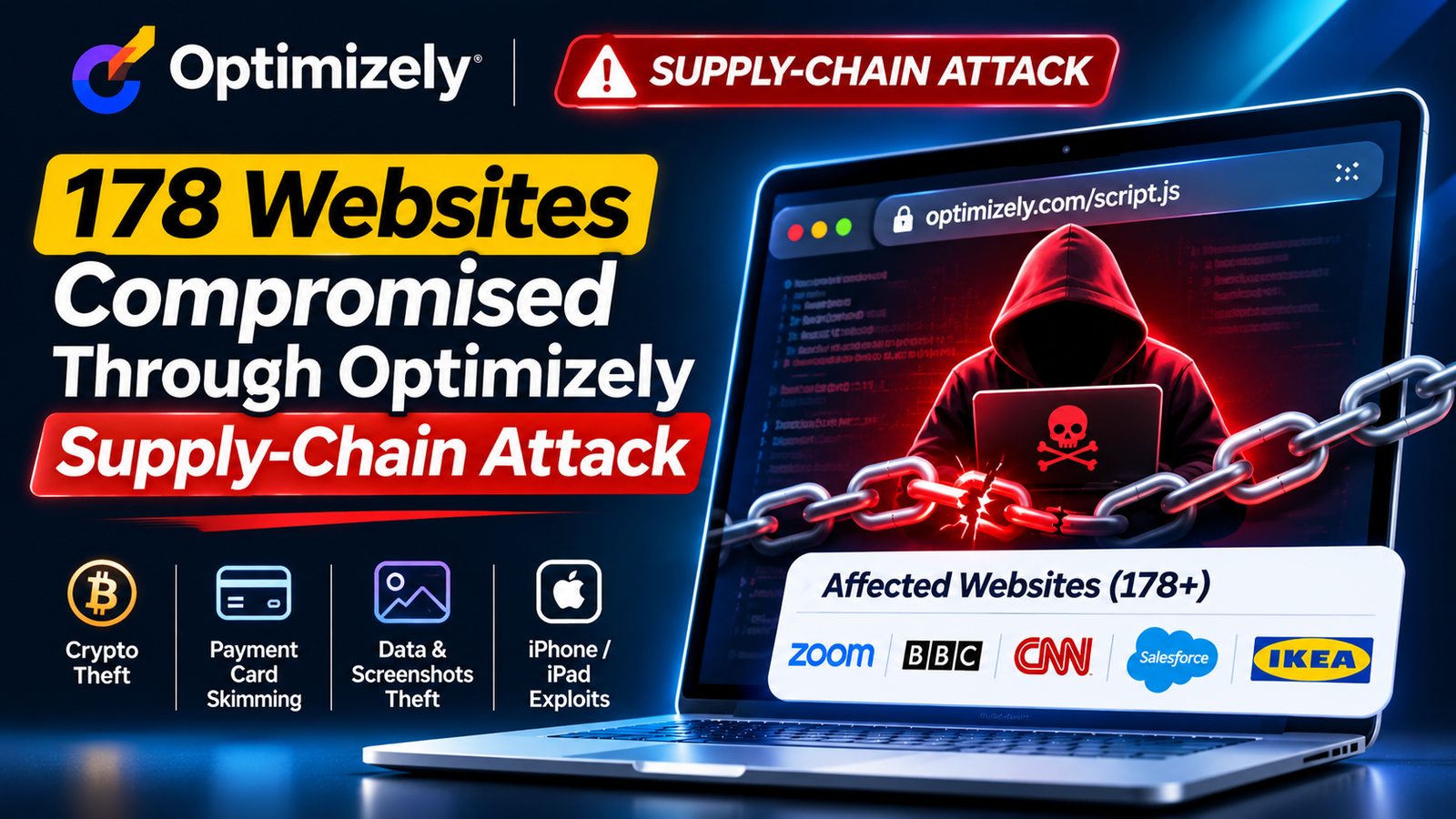

A major software supply-chain attack involving Optimizely has exposed visitors to malicious code across websites belonging to 178 organisations, including Zoom, BBC, CNN, Salesforce, GitLab, HSBC and IKEA.
The attack was discovered on November 16, 2026, after security researcher Scott Helme identified malicious JavaScript injected into Optimizely’s website experimentation scripts.
The compromised scripts were designed to steal cryptocurrency, capture payment-card information, collect browser cookies and screenshots, and deliver exploit code targeting iPhones and iPads.
What makes this incident particularly concerning is that the malicious code was delivered through Optimizely’s legitimate content delivery network (CDN). Visitors were therefore loading scripts from a service that the affected websites already trusted.
Optimizely confirmed that an attacker exploited a vulnerability in its Experimentation platform to inject malicious JavaScript into customer projects. The company says it has fixed the vulnerability and removed the malicious code.
The incident highlights a growing cybersecurity problem: attackers do not always need to hack a company’s own servers. Sometimes, compromising one trusted third-party provider is enough to reach visitors across hundreds of websites.
What Happened in the Optimizely Supply-Chain Attack?
Optimizely provides tools that businesses use to experiment with website designs, test different content and personalise customer experiences.
Websites using Optimizely typically load a JavaScript snippet from the company’s CDN. This script runs inside visitors’ browsers and provides the functionality needed for website experimentation.
Attackers exploited a vulnerability in Optimizely’s Experimentation account signup flow and used it to add malicious JavaScript to customer projects.
The injected code then became part of the scripts delivered to visitors.
According to Scott Helme’s investigation, researchers examined 1,611 Optimizely JavaScript snippets and identified 188 infected files belonging to 178 organisations.
The affected organisations included companies from several industries:
- Technology and software
- Banking and financial services
- Retail and e-commerce
- News and media
- Airlines and travel
- Healthcare
- Telecommunications
- Cryptocurrency and trading
The important distinction is that the attackers compromised third-party scripts used by these organisations. This does not mean that all 178 organisations’ internal networks or databases were breached.
The malicious code was delivered to website visitors through a trusted external dependency. <Cite refs={[“turn796385view0″,”turn829514view1″,”turn829514view0”]}/>
Which Major Websites Were Affected?
The incident involved several internationally recognised brands.
Some of the organisations identified by researchers included:
| Industry | Affected organisations |
|---|---|
| Technology | Zoom, Salesforce, GitLab, Bitly |
| News and media | BBC, CNN, Fox News, NPR |
| Banking and finance | HSBC, Equifax, Paychex |
| Retail | IKEA, ASOS, American Eagle |
| Airlines | Air France-KLM, Alaska Airlines, Transavia |
| Cryptocurrency | Ledger, IG, OANDA |
| Telecommunications | Vodafone Australia, Virgin Media, O2 |
| Healthcare | Takeda, Invisalign, Covetrus |
This list is not exhaustive. Report URI identified affected organisations across 20 industry categories.
Some companies responded by disabling Optimizely scripts while investigating the incident.
Zoom said it had disabled Optimizely across its production environments as a precaution and had not identified an impact on customer data at the time of Reuters’ reporting.
Equifax also said it had stopped using the platform and had found no evidence of compromise to its systems. Salesforce confirmed that it was investigating the malicious script modifications. <Cite refs={[“turn796385view0″,”turn829514view0″,”turn829514view1”]}/>
What Did the Malicious JavaScript Actually Do?
The injected JavaScript was not ordinary tracking code. It contained several malicious capabilities designed to steal financial information and compromise visitors’ privacy.
Researchers identified four major functions.
1. Cryptocurrency Wallet Address Hijacking
One of the most concerning features was a cryptocurrency address replacement mechanism.
The malicious script searched webpages for cryptocurrency wallet addresses. When it found a valid address, it could replace it with an address controlled by the attackers.
The malware targeted several cryptocurrency networks, including:
- Bitcoin
- Ethereum
- TRON
- Solana
- Litecoin
- Bitcoin Cash
- Dogecoin
- TON
The attack could affect wallet addresses displayed on webpages, entered into forms or copied through the browser clipboard.
Imagine visiting a cryptocurrency platform and copying a wallet address to make a deposit.
You might see the correct address on the screen, but the malicious script could replace it when you copied it. If you then pasted the altered address into your wallet application and approved the transfer, your cryptocurrency could go directly to the attackers.
This is particularly dangerous because cryptocurrency transactions are generally difficult or impossible to reverse.
2. Payment Card Information Theft
The malicious JavaScript also included a payment-card skimming component.
It searched website forms and network requests for information such as:
- Credit and debit card numbers
- Card expiration dates
- CVV security codes
When it identified the required information, it attempted to send the captured details to an attacker-controlled server.
However, there was an important limitation.
According to Report URI, the malicious script could not access card information entered into separately hosted payment frames from providers such as Stripe and Adyen.
This means payment forms implemented through isolated, cross-origin payment frames had an additional layer of protection against this particular technique.
Cards entered directly into a website’s own form fields were potentially exposed. <Cite refs={[“turn796385view0″,”turn829514view1”]}/>
3. Browser Cookies and Screenshots Stolen
The malware also attempted to collect browser information.
This included:
- Website URLs.
- Cookies that were accessible to JavaScript.
- Original cryptocurrency addresses before replacement.
- Screenshots of affected webpages.
Cookies can contain information associated with a user’s browsing session. Depending on the website and cookie configuration, exposed information could create additional privacy and security risks.
Cookies protected with the HttpOnly attribute are not directly accessible through ordinary JavaScript, which limits what this particular method can collect.
The screenshots also gave attackers additional context about the pages users were visiting.
4. iPhone and iPad Exploit Delivery
Perhaps the most alarming capability was the delivery of iOS exploit kits.
Researchers identified two exploit kits:
- Coruna
- DarkSword
The malicious JavaScript checked visitors’ devices and attempted to load additional exploit code targeting certain iPhone and iPad software versions.
These exploit chains targeted vulnerabilities in older iOS versions. Apple told Reuters that the underlying vulnerabilities had been fixed previously and that users running up-to-date software would have been protected.
This means visiting an affected website did not automatically mean that every iPhone or iPad became infected. Successful exploitation depended on device compatibility and vulnerable software.
Nevertheless, the attempt to deliver mobile exploit code made the incident considerably more serious than an ordinary website compromise. <Cite refs={[“turn796385view0″,”turn829514view0″,”turn829514view1”]}/>
How Much Cryptocurrency Was Stolen?
Researchers identified cryptocurrency transactions associated with wallets included in the malicious JavaScript.
Report URI estimated that the attackers’ wallets had received approximately $7,040 by 19:25 UTC on November 16.
The observed transactions included:
- Approximately $5,380 in Bitcoin.
- Approximately $762 in Litecoin.
- Approximately $719 in TRON-related assets.
- Smaller amounts involving Ethereum and other networks.
However, there is an important limitation to these figures.
Some of the identified wallets had been active before the Optimizely incident. Researchers could not confidently attribute every transaction to this specific campaign.
Therefore, approximately $7,040 represents observed wallet activity, not a confirmed total of money stolen from victims of this attack.
Researchers also could not establish how many payment cards or browser cookies were successfully captured. <Cite refs={[“turn796385view0″,”turn829514view1”]}/>
How Did Optimizely Respond?
Optimizely confirmed that an unauthorised party had exploited a vulnerability in its Experimentation platform.
The company told BleepingComputer that it had taken several emergency steps:
- Blocked access to the vulnerable signup path.
- Deployed a security fix.
- Removed injected malicious code from affected customer projects.
- Ended active sessions.
- Revoked affected access tokens.
- Reset access for affected user accounts.
- Added protections to prevent unauthorised code from being delivered.
Optimizely also said it had notified affected customers and continued investigating the incident.
Scott Helme reported that the cleanup had reduced the number of infected scripts significantly. By 21:52 UTC on November 16, only one of the 188 previously infected snippets still contained the malicious code.
Palo Alto Networks’ Unit 42 later described the campaign as OPTIMJACK, highlighting how attackers used a trusted software provider to reach a large number of organisations. <Cite refs={[“turn829514view1″,”turn796385view0″,”turn829514view2”]}/>
Why This Is a Serious Software Supply-Chain Security Problem
Traditional cybersecurity strategies often focus on protecting an organisation’s own infrastructure.
Companies invest in firewalls, endpoint protection, access controls and network monitoring.
However, modern websites rarely operate using only their own code.
They frequently load external scripts for:
- Analytics and tracking.
- Advertising.
- Customer support.
- Payment processing.
- Personalisation.
- A/B testing.
- Marketing automation.
These third-party scripts often run inside the same browser environment as the website itself.
That creates a serious problem.
If attackers compromise a trusted provider, they may be able to deliver malicious code to every customer website that loads the affected script.
In the Optimizely incident, the malicious code was delivered through a legitimate Optimizely domain and certificate. This made the attack particularly difficult to identify using security controls that simply trust approved third-party providers.
The attack demonstrates why organisations must monitor not only their own JavaScript but also the behaviour and integrity of external scripts.
How Websites Can Protect Themselves
The incident provides several important lessons for website owners, developers and security teams.
1. Monitor Third-Party JavaScript
Organisations should maintain an inventory of external scripts running on their websites.
Unexpected changes to script content should trigger security alerts.
2. Use Strict Content Security Policies
A properly configured Content Security Policy (CSP) can restrict which domains are allowed to load scripts, send data and create embedded frames.
Report URI examined 256 affected organisation hostnames and found that only 24 blocked the attack completely under their CSP configurations.
This shows why simply allowing a trusted CDN is not enough. Security policies must also restrict what scripts can load and where information can be transmitted.
3. Isolate Payment Forms
Sensitive payment fields should use properly isolated, cross-origin payment frames wherever practical.
This reduces the ability of an unrelated third-party script to read card information entered into the payment interface.
4. Remove Unnecessary Scripts From Sensitive Pages
Marketing and experimentation scripts should not automatically run on login, authentication and checkout pages.
Reducing the number of scripts on sensitive pages limits the potential impact of a compromised dependency.
5. Audit Website Changes and Access
Website administrators should review changes made to third-party platform projects, check account permissions and investigate unexpected modifications.
Organisations that used Optimizely during the incident should review their project code and relevant logs.
Palo Alto Networks recommends auditing project modifications and treating payment information entered into affected forms as potentially compromised. <Cite refs={[“turn796385view0″,”turn829514view2”]}/>
What Should Visitors of Affected Websites Do?
Visitors who accessed affected websites during the incident should take precautions based on what they did.
If you copied a cryptocurrency wallet address:
Verify the destination address independently before making another transfer. If you made a transaction during the exposure period, review the transaction details and contact your wallet provider or exchange if anything looks suspicious.
If you entered payment-card details:
Review recent transactions and contact your bank or card issuer if you notice anything unusual. Consider asking the issuer whether the card should be replaced.
If you visited an affected website using an iPhone or iPad:
Install the latest available iOS or iPadOS security updates. Keeping devices updated is especially important because the campaign attempted to deliver exploit code targeting older software versions.
If you logged into an affected website:
Review account activity and consider changing credentials if you notice suspicious activity or receive a relevant security notification from the organisation.
Visiting an affected website alone does not establish that your device or account was compromised. The risk depends on the specific website, script behaviour, device and actions performed.
Conclusion
The Optimizely supply-chain attack is a powerful reminder that website security depends on more than protecting a company’s own servers.
By exploiting a vulnerability in a trusted third-party platform, attackers were able to inject malicious JavaScript into projects associated with 178 organisations.
The code attempted to steal cryptocurrency, capture payment-card details, collect browser information and deliver iOS exploit kits.
Optimizely has fixed the vulnerability and removed the injected code, but the incident raises important questions about third-party software security.
For developers and security teams, the message is clear: every external script running on a website should be treated as part of its security boundary.
A trusted vendor can become an attacker’s entry point, and hundreds of websites can expose their visitors through a single compromised dependency.
Frequently Asked Questions
1. What is the Optimizely supply-chain attack?
It was a cybersecurity incident in which attackers exploited a vulnerability in Optimizely’s Experimentation platform to inject malicious JavaScript into customer projects. The scripts were delivered to visitors of websites belonging to 178 organisations.
2. Which major companies were affected?
The organisations identified included Zoom, BBC, CNN, Salesforce, GitLab, HSBC, Equifax, IKEA, Ledger and Air France-KLM, among others.
3. What information did the malware attempt to steal?
The malicious code attempted to capture cryptocurrency wallet addresses, payment-card information, accessible browser cookies and webpage screenshots.
4. Did the attack infect 178 company networks?
Not necessarily. Researchers identified malicious scripts associated with 178 organisations. This does not mean that all those organisations’ internal networks or databases were breached.
5. Were iPhones affected?
The malicious scripts attempted to deliver Coruna and DarkSword exploit kits to certain iPhones and iPads running vulnerable software versions. Apple said the underlying vulnerabilities had been patched and updated devices were protected.
6. Has Optimizely fixed the vulnerability?
Yes. Optimizely said it blocked the vulnerable path, deployed a fix, removed injected code, revoked tokens, reset affected account access and introduced additional protections.
7. How much money did attackers steal?
Report URI identified approximately $7,040 in cryptocurrency transactions associated with the attackers’ wallets. However, some wallets were active before the incident, so the exact amount stolen during this campaign remains unknown.
8. How can website owners prevent similar attacks?
Website owners should monitor third-party scripts, enforce restrictive Content Security Policies, isolate payment forms, remove unnecessary scripts from sensitive pages and regularly audit access permissions.
 By