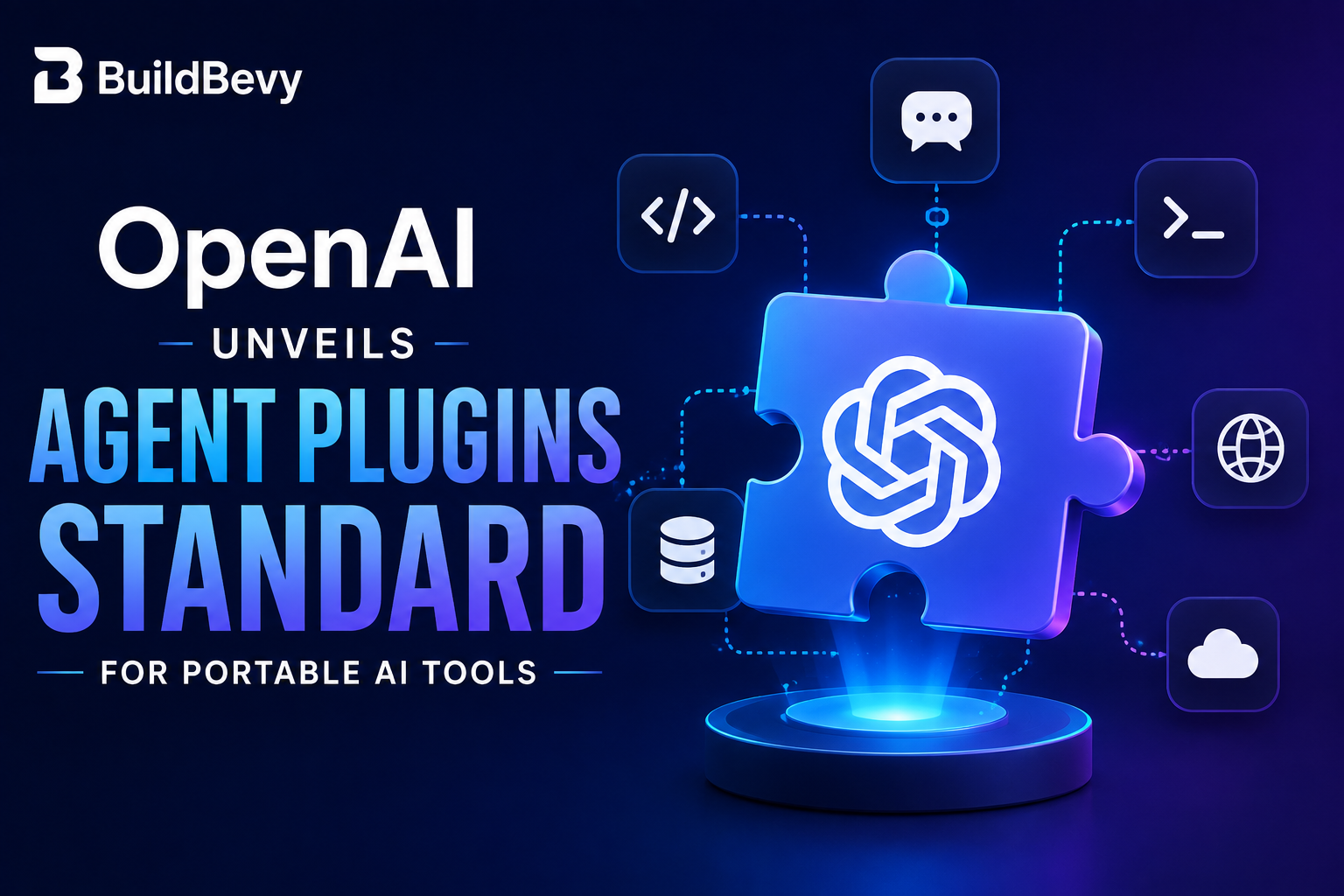

OpenAI, alongside GitHub, AWS, Microsoft, Vercel, Cursor, and other industry partners, has introduced the new Agent Plugins Standard, an open specification designed to make AI tools portable across different AI assistants and development platforms. The initiative aims to eliminate fragmentation in the rapidly growing AI agent ecosystem by allowing developers to build reusable agent components that work across multiple compatible clients.
The announcement marks an important step toward creating a common foundation for AI agents, similar to how web standards helped the internet grow into a universal platform.
Solving AI’s Fragmentation Problem
The AI industry has experienced explosive growth in agentic AI, with developers building tools for platforms such as ChatGPT, Codex, GitHub Copilot, Cursor, and enterprise AI systems.
However, one major challenge has emerged: every platform often requires its own implementation.
This means developers frequently have to rewrite the same tools for different AI environments.
The new Agent Plugins Standard addresses this problem by introducing a shared packaging format that enables AI tools to be reused across compatible platforms.
What Are Agent Plugins?
Agent Plugins are portable software packages that bundle everything an AI agent needs to perform a task.
A plugin can include:
- Agent skills and workflows
- Prompt logic
- Model Context Protocol (MCP) server configurations
- External API connections
- Supporting configuration files
Instead of distributing these components separately, developers package them into a single standardized plugin that can be installed across multiple AI clients.
Built Around Open Standards
The specification uses a simple filesystem-based structure with files such as:
plugin.jsonmcp.json
This standardized approach allows AI platforms to discover, load, and execute plugins consistently.
Because the format is vendor-neutral, developers can create plugins without being locked into a single ecosystem.
Why It Matters
The new standard introduces several important advantages.
Build Once, Use Everywhere
Developers can create an AI tool once and deploy it across multiple compatible platforms instead of maintaining separate versions.
Better Developer Experience
A common plugin format reduces development time while making AI applications easier to maintain.
Easier Enterprise Adoption
Organizations can reuse internal AI workflows across different products without rebuilding integrations for every AI assistant.
Reduced Vendor Lock-In
Since the specification is open and governed publicly, businesses gain greater flexibility when choosing AI platforms.
Industry Collaboration
One of the most significant aspects of the announcement is the number of companies supporting the initiative.
Contributors include:
- OpenAI
- GitHub
- Amazon Web Services (AWS)
- Microsoft
- Cursor
- Vercel
The collaboration suggests that leading AI companies recognize the need for shared standards as AI agents become a core part of software development and enterprise workflows.
The Connection to MCP
The Agent Plugins Standard complements the growing adoption of the Model Context Protocol (MCP).
MCP provides a standardized way for AI models to communicate with external tools and data sources.
Agent Plugins package these MCP configurations alongside reusable agent skills, making deployment significantly simpler.
Together, MCP and Agent Plugins could become foundational technologies for the next generation of AI applications.
A Step Toward an AI App Ecosystem
Many industry observers compare the announcement to the early days of smartphone app stores.
Just as developers could build one application for an operating system and distribute it widely, Agent Plugins aim to make AI capabilities portable across compatible AI platforms.
This could accelerate innovation by allowing developers to focus on building better tools rather than rewriting integrations for each platform.
Why This Matters
The AI industry is rapidly shifting from standalone chatbots to autonomous agents capable of completing real-world tasks.
As these agents become more common, interoperability will become increasingly important.
Without common standards, developers face higher costs, slower innovation, and fragmented ecosystems.
The Agent Plugins Standard represents an important move toward solving those challenges while encouraging broader collaboration across the AI industry.
The Bigger Picture
Artificial intelligence is entering a new phase where success depends not only on better models but also on a strong ecosystem of reusable tools and workflows.
Open standards such as Agent Plugins and MCP have the potential to become the infrastructure that enables AI agents to work seamlessly across different platforms and applications.
If widely adopted, the Agent Plugins Standard could do for AI agents what HTML and HTTP did for the web—providing a common language that makes innovation faster, more portable, and accessible to everyone.

 By
By