
2026 is turning into one of the most important years in the AI model race. OpenAI, Google, Anthropic and xAI are all pushing their models beyond traditional chatbots, with a much stronger focus on reasoning, coding, computer use, scientific research and autonomous AI agents.
But there is an important twist.
Several models that were expected to be “upcoming” earlier in 2026 have already launched. At the same time, the next generation is already being trained behind the scenes.
That means the real AI race of 2026 is happening on two levels:
Today’s frontier models vs. the next generation being trained now.
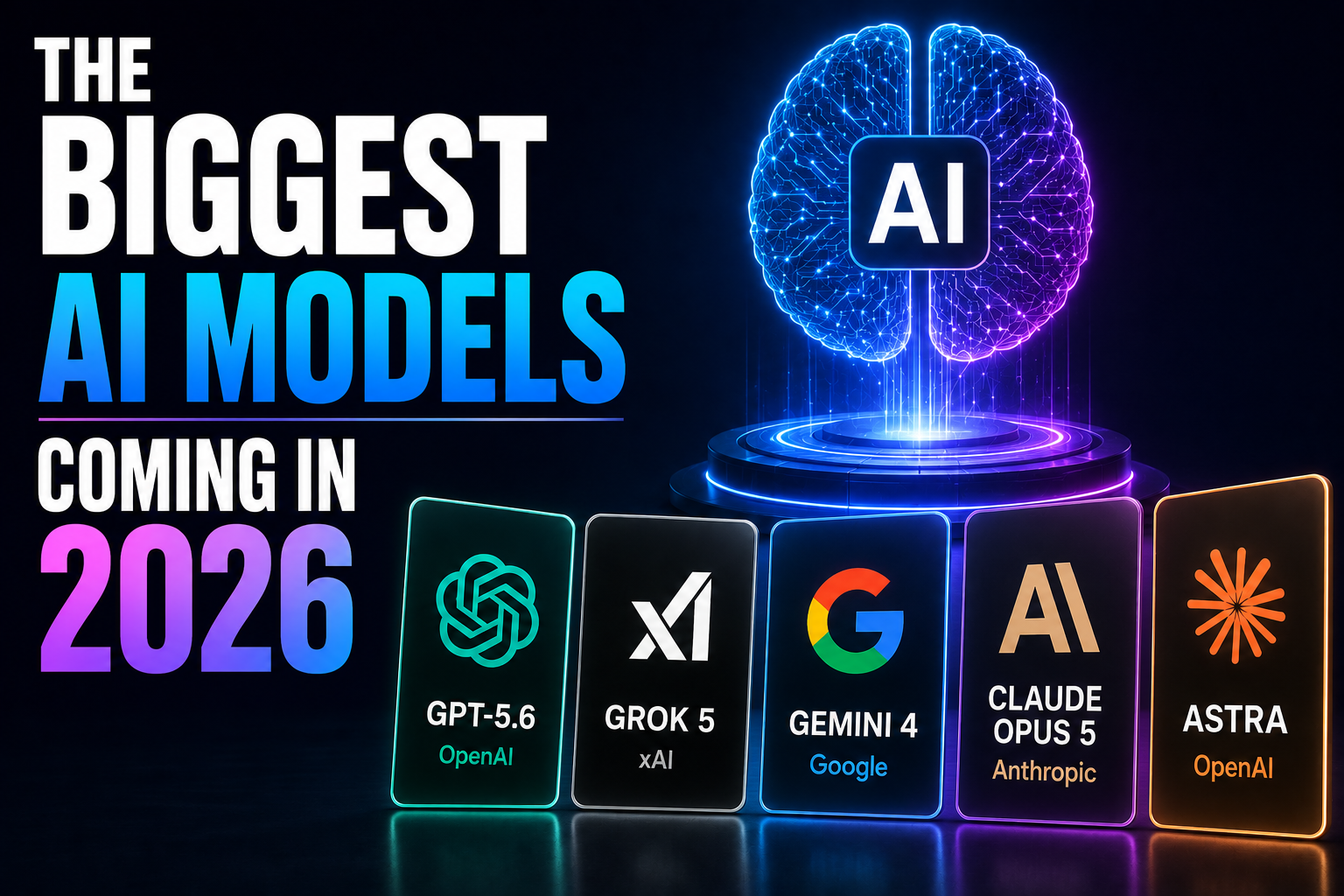
Here is what we know about the biggest AI models shaping 2026.
The Biggest AI Models to Watch in 2026
| AI Model | Company | Status in 2026 | Main Focus |
|---|---|---|---|
| GPT-5.6 | OpenAI | Released | Reasoning, coding, agents |
| Astra | OpenAI | In development | Advanced reasoning, coding, cybersecurity |
| Grok 4.6 | xAI | Released | Agents, coding, knowledge work |
| Grok 5 | xAI | In training | Next-generation frontier AI |
| Gemini 3.5 Flash | Released | Agents, coding, speed | |
| Gemini 3.5 Pro | In testing | Advanced reasoning and agents | |
| Gemini 4 | Training | Next-generation frontier model | |
| Claude Opus 5 | Anthropic | Released | Coding, agents, professional work |
| Claude Fable 5 | Anthropic | Released | Frontier intelligence |
| Claude Mythos 5 | Anthropic | Released/limited | Advanced reasoning & cybersecurity |
| Gemini Omni | Released/rolling out | Multimodal generation |
The most important models to watch for the next major leap are probably OpenAI’s Astra, xAI’s Grok 5 and Google’s Gemini 4.
1. OpenAI GPT-5.6: The Current Frontier
Before looking at what’s coming next, it is important to understand where OpenAI is today.
OpenAI launched the GPT-5.6 family in July 2026.
The family includes:
- GPT-5.6 Sol
- GPT-5.6 Terra
- GPT-5.6 Luna
Sol is the flagship model, Terra is positioned as a balanced option and Luna focuses on speed and cost efficiency. (openai.com)
OpenAI says GPT-5.6 Sol delivers strong performance across:
- Coding
- Knowledge work
- Cybersecurity
- Science
- Computer use
- Design
- Agentic workflows
It also introduced an ultra capability setting that can coordinate multiple agents across parallel workstreams for complex tasks. (openai.com)
This shows where the AI industry is going.
The goal isn’t simply:
“Give me an answer.”
It is increasingly:
“Take this task and finish it.”
2. OpenAI Astra: One of the Most Closely Watched Models
If GPT-5.6 is today’s OpenAI frontier, Astra may be one of the company’s biggest next steps.
OpenAI has confirmed that Astra is one of its upcoming models and that internal testing has shown significant advances in agentic coding and cybersecurity. (openai.com)
But Astra’s development has taken an unexpected turn.
OpenAI recently said it could not rule out Astra meeting its Critical cybersecurity capability threshold under its Preparedness Framework.
The company has therefore slowed parts of its model development while strengthening monitoring, alignment and containment safeguards. (openai.com)
Reuters reported that OpenAI halted training on Astra as part of the security response following the Hugging Face incident.
That makes Astra unusual.
It isn’t simply a model that people are waiting for because it might score higher on benchmarks.
People are watching it because its capabilities may be advancing faster than OpenAI’s safety systems can comfortably support.
What could Astra bring?
Based on OpenAI’s statements, the areas to watch include:
- Advanced reasoning
- Agentic coding
- Cybersecurity
- Tool use
- Autonomous task execution
- Long-running workflows
However, OpenAI has not released a complete public specification for Astra.
So claims about exact parameters, benchmark scores or launch dates should still be treated as speculation.
3. Grok 4.6: xAI’s Current Frontier
xAI has also made major progress in 2026.
The company launched Grok 4.5 in July and described it as its strongest model at the time, specifically targeting coding, agentic tasks and knowledge work. (x.ai)
Grok 4.5 was trained on data covering:
- Coding
- Science
- Engineering
- Mathematics
xAI also reported strong performance on software-engineering evaluations. (x.ai)
Grok 4.6 followed with an even stronger focus on long-running agents and interactive work.
This progression gives us an important clue about xAI’s strategy.
The company isn’t simply trying to build another chatbot.
It wants Grok to become an AI agent capable of completing real work.
4. Grok 5: xAI’s Next Big Bet
Grok 5 could be one of the biggest AI model launches of 2026.
The most important confirmed fact is simple:
xAI says Grok 5 is already in training.
In its January 2026 funding announcement, xAI said the company was training Grok 5 while expanding its massive computing infrastructure. (x.ai)
xAI also said its Colossus I and II infrastructure had more than one million H100 GPU equivalents by the end of 2025. (x.ai)
That gives the company enormous computing capacity for future models.
What could Grok 5 improve?
The areas most likely to matter are:
- Advanced reasoning
- Autonomous coding
- Long-running agents
- Multimodal understanding
- Real-time information
- Scientific reasoning
- Computer use
There have also been reports of extremely large parameter counts for Grok 5.
But those numbers remain unconfirmed by xAI, so they should not be treated as final specifications.
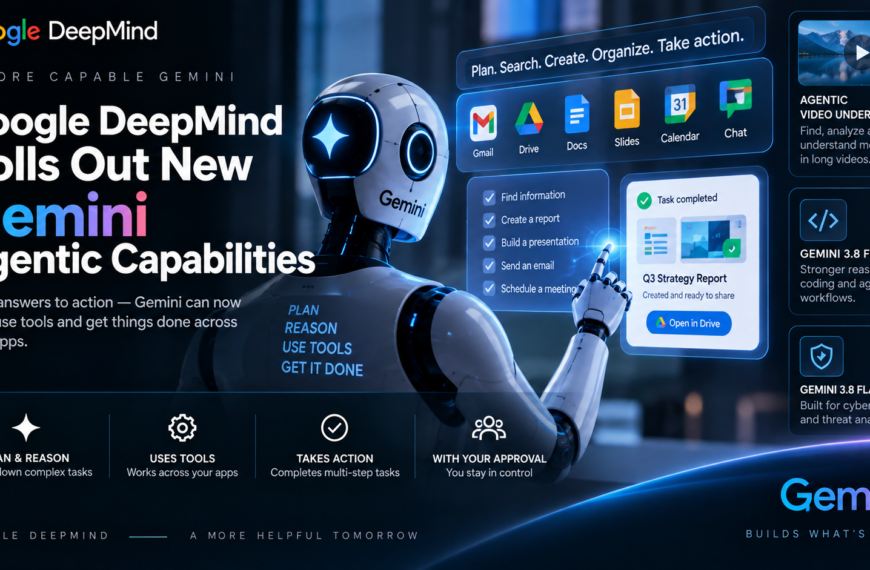
5. Gemini 3.5: Google’s Agentic AI Push
Google is taking a slightly different approach.
At Google I/O 2026, the company introduced Gemini 3.5 Flash, describing it as a model designed around frontier intelligence with action. (blog.google)
Gemini 3.5 Flash is designed for:
- Coding
- Agentic workflows
- Long-running tasks
- Multimodal understanding
- Real-world software development
Google reported strong performance on agentic coding benchmarks including Terminal-Bench 2.1. (blog.google)
The interesting part is that Google is focusing heavily on speed and cost.
That could be extremely important.
An AI agent might need to make dozens of model calls to complete one task.
A model that is slightly less capable but dramatically faster and cheaper can sometimes be more useful than the biggest model available.
6. Gemini 3.5 Pro: Still in Testing
Google has also confirmed that Gemini 3.5 Pro is being developed.
At I/O, Google said the model was already being used internally and would follow the initial 3.5 Flash release. (blog.google)
By Google’s Q2 2026 earnings call, however, Gemini 3.5 Pro was still described as being in testing.
More importantly, Google said something much bigger:
It had already started its most ambitious pre-training run yet for Gemini 4. (blog.google)
That makes Gemini 4 one of the most important models to watch.
7. Gemini 4: Google’s Next Frontier Model
Gemini 4 is particularly interesting because Google has already confirmed that training has begun.
According to Google CEO Sundar Pichai, the company has started its most ambitious pre-training run yet for Gemini 4 and is seeing promising progress at the frontier. (blog.google)
This is one of the clearest signals that a major new model is coming.
Google also says its training infrastructure can scale across more than one million TPUs globally, allowing the company to train larger models across multiple locations. (blog.google)
What could Gemini 4 focus on?
Likely areas include:
- Advanced reasoning
- Agentic coding
- Computer use
- Multimodal understanding
- Scientific work
- Long-context tasks
- Real-world AI agents
But Google has not yet published a complete Gemini 4 specification.
So, once again, we should separate confirmed information from predictions.
8. Gemini Omni Is Another Important Direction
Gemini 4 isn’t the only interesting project coming from Google.
The company also introduced Gemini Omni, a model family designed to create outputs from different input types.
Google says Omni can start from video and eventually support generating different output modalities from different inputs. (blog.google)
This represents a different direction from traditional language models.
Instead of:
Text → Text
the future could be:
Text → Video
Image → Video
Video → Interactive world
Voice → Software
Text → 3D/visual experience
AI models are becoming increasingly multimodal.
9. Claude Opus 5: Anthropic’s Current Heavyweight
Anthropic is also moving extremely quickly.
The company launched Claude Opus 5 on July 24, 2026.
Anthropic describes it as a major improvement for long-running agents, coding and professional work. (anthropic.com)
The model is designed to work on complicated tasks for longer periods while using fewer resources than previous Opus models.
Anthropic reports that Opus 5 is particularly strong in:
- Software engineering
- Knowledge work
- Research
- Financial analysis
- Coding agents
- Long-running workflows
This puts Claude directly into competition with GPT-5.6 and the latest Gemini models.
10. Claude Fable 5 and Mythos 5
Anthropic has also released two other highly important models in 2026:
Fable 5
and
Mythos 5
Anthropic described Fable 5 as a model whose capabilities exceeded those of any model the company had previously made generally available. (anthropic.com)
The company reported exceptional results in:
- Software engineering
- Knowledge work
- Vision
- Scientific research
- Advanced reasoning
Mythos 5 is even more interesting from a cybersecurity perspective.
Anthropic’s model system-card list identifies Fable 5 and Mythos 5 as part of its 2026 frontier model lineup. (anthropic.com)
The company has also warned that the risks from increasingly powerful AI models are rising, making safety a central part of its model-development strategy.
The AI Model Race Is Changing
One of the biggest changes in 2026 is that benchmark scores are no longer the whole story.
The industry is increasingly focused on what AI systems can actually do.
For example:
Old AI
“Write a function.”
New AI
“Build the application.”
Old AI
“Explain this research paper.”
New AI
“Read the papers, compare the findings and prepare a research report.”
Old AI
“Find the bug.”
New AI
“Find the bug, fix it, run the tests and prepare the pull request.”
This is the transition from AI assistant to AI agent.
Which Model Could Be the Biggest?
It is impossible to know yet.
But if we look at what each company is building, the competition is fascinating.
🟢 OpenAI — Astra
Biggest question: How capable can an autonomous model become while remaining controllable?
🔵 Google — Gemini 4
Biggest question: Can Google’s enormous TPU infrastructure produce the next major reasoning and multimodal breakthrough?
⚫ xAI — Grok 5
Biggest question: Can xAI’s enormous compute investment turn Grok into one of the world’s most capable autonomous AI systems?
🟣 Anthropic — Future models after Opus 5
Biggest question: Can Anthropic maintain its lead in reliable coding and long-running agents while continuing to prioritize safety?
AI Safety Could Determine Who Wins
There is another important part of the 2026 model race:
Safety may become a limiting factor.
OpenAI’s Astra development has already been slowed because of concerns around advanced cybersecurity capabilities. (openai.com)
Anthropic has also publicly discussed increasing risks from advanced models.
This means future AI development may not simply be:
Train → Benchmark → Launch
It could become:
Train → Evaluate → Discover risks → Improve safeguards → Retest → Launch
That could make future model releases slower—but potentially safer.
The Biggest Battle May Be Between AI Agents
The next generation of models will increasingly compete on autonomy.
Imagine giving four AI systems the same task:
“Research this market, analyze 100 documents, build a spreadsheet, create a presentation and explain your conclusions.”
The winner won’t necessarily be the model that gives the best first answer.
It will be the model that can:
- Plan the work.
- Use the right tools.
- Search effectively.
- Remember what it has already done.
- Correct its mistakes.
- Complete the task.
- Deliver a useful final result.
That is the real frontier.
What About Open-Source Models?
The AI race isn’t limited to OpenAI, Google, Anthropic and xAI.
Companies such as Meta, Alibaba, DeepSeek and Z.ai are also pushing powerful models.
China’s AI labs in particular have become increasingly competitive.
Recent developments such as Z.ai’s GLM 5.3 show that open-weight models are becoming increasingly capable in areas such as coding and cybersecurity.
This creates another important competition:
Closed frontier models vs. open-weight AI.
Open models may not always beat the biggest proprietary systems, but they offer developers:
- More control
- Local deployment
- Customization
- Lower costs
- Greater transparency
That could make the open-model ecosystem one of the biggest stories of 2026.
What Should We Expect From AI Models in Late 2026?
If the current development direction continues, the next major models are likely to improve in five areas.
1. Better reasoning
Models will spend more computation on difficult problems.
2. Better agents
They will perform longer sequences of actions.
3. Better coding
AI will move further toward autonomous software development.
4. Better multimodal abilities
Text, image, audio and video will increasingly work together.
5. Better computer use
AI will increasingly operate software instead of simply describing how to use it.
A New Era of AI Models
The biggest AI models of 2026 aren’t simply bigger versions of last year’s chatbots.
They are becoming systems that can reason, use tools, understand different types of information and perform work independently.
OpenAI is pushing toward this with GPT-5.6 and Astra.
Google is developing Gemini 3.5 and preparing Gemini 4.
Anthropic has already moved to Opus 5, Fable 5 and Mythos 5.
xAI is building Grok 5 on top of enormous computing infrastructure.
And companies around the world are trying to close the gap with open and specialized models.
The competition is becoming less about:
“Which AI chatbot is smartest?”
and more about:
“Which AI can actually get the most difficult work done?”
That could make the second half of 2026 one of the most important periods in the history of artificial intelligence.
Final Ranking: The Models to Watch
If you’re following AI news in 2026, these are the models I’d keep on your radar:
🔥 1. OpenAI Astra
Why: Potentially huge agentic and cybersecurity capabilities, with development currently slowed for safety work.
🔥 2. Google Gemini 4
Why: Google has already started its most ambitious pre-training run yet.
🔥 3. xAI Grok 5
Why: xAI is combining a massive compute buildout with its next-generation model.
🔥 4. Claude Opus 5 / Next Claude
Why: Anthropic remains one of the strongest competitors in coding, agents and professional work.
🔥 5. Gemini Omni
Why: It represents a move toward AI that can transform information across multiple modalities.
🔥 6. Open-weight models
Why: DeepSeek, Z.ai, Meta and other labs are making the competitive landscape much harder for the closed-model leaders.
The Bottom Line
2026 is no longer just the year of bigger AI models. It is the year of more capable AI systems.
GPT, Claude, Gemini and Grok are all moving toward a similar destination:
AI that can think longer, use tools, operate computers, write software and complete real-world tasks.
The next major breakthroughs may therefore not look like a chatbot suddenly becoming slightly better at answering questions.
They may look like an AI system quietly completing a task that previously required an entire team of people.
And that is why the models still being trained—especially Astra, Gemini 4 and Grok 5—could matter far more than their model names suggest.
The biggest AI race of 2026 is not about who has the biggest model.
It is about who builds the most capable AI worker.

 By
By