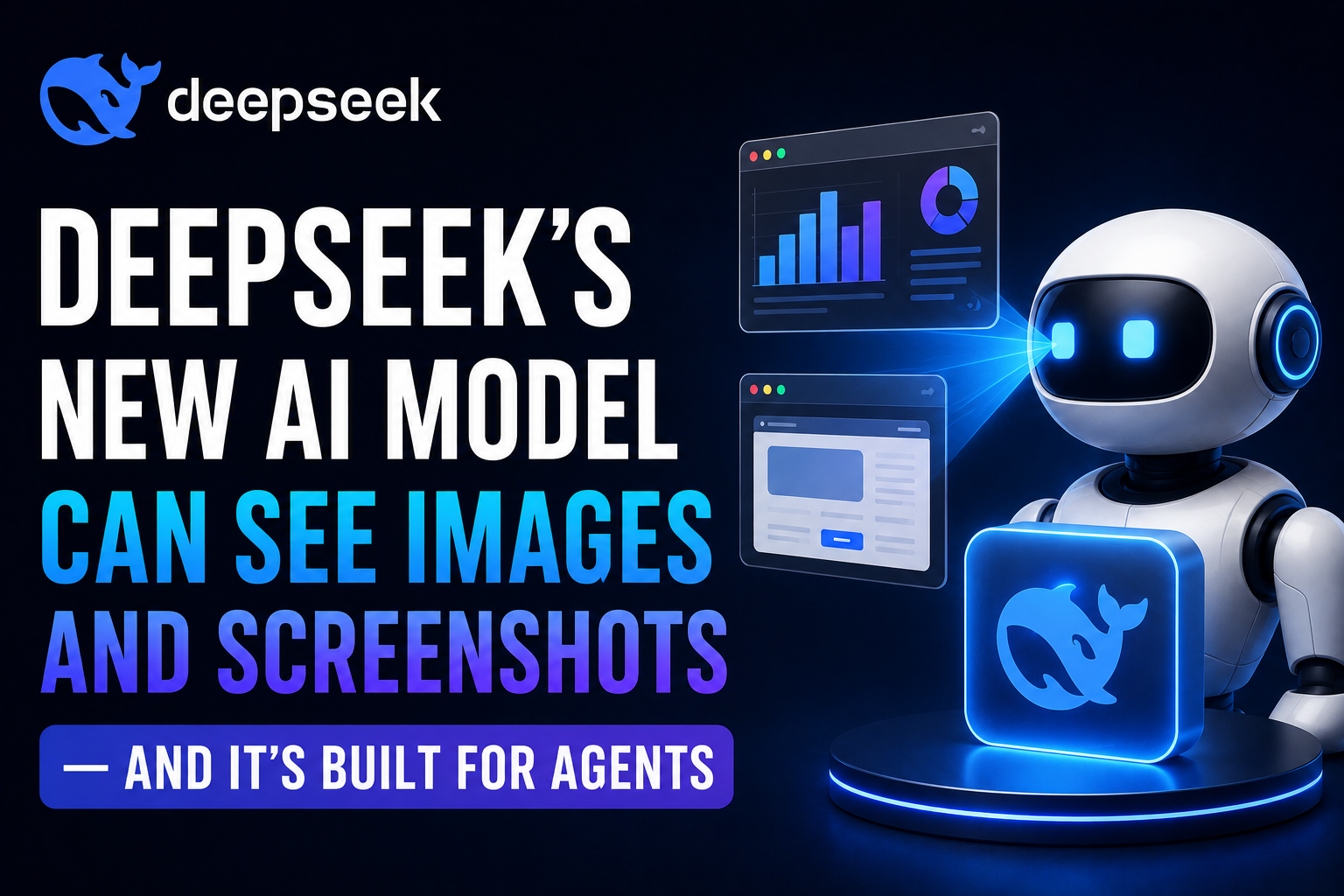

DeepSeek has introduced an experimental AI model that finally gives its V4 Flash family native vision capabilities. The new DeepSeek-V4-Flash-Vision-Exp can understand images and screenshots while keeping the agent, reasoning and tool-use capabilities of V4 Flash.
The model became available through the DeepSeek API on August 21, 2026, marking an important step for DeepSeek as AI systems increasingly move from simple chatbots toward agents that can understand their surroundings and take actions.
Unlike earlier DeepSeek V4 models, which were text-only, the new experimental model can receive text and images in the same interaction.
That means an AI agent can now potentially look at a screenshot, understand what is on the screen and use that information while completing a task.
What Is DeepSeek-V4-Flash-Vision-Exp?
The new model is called:
DeepSeek-V4-Flash-Vision-Exp
It is an experimental version of DeepSeek-V4-Flash with an important addition:
Native visual understanding.
The model can accept images alongside text and perform tasks such as:
- Understanding screenshots
- Reading text from images
- Analyzing charts
- Understanding documents
- Interpreting visual layouts
- Working with visual information inside agent workflows
DeepSeek’s documentation supports common formats including JPEG, PNG, GIF and WebP.
The model is currently available through the DeepSeek API, rather than being presented as a full replacement for the standard DeepSeek V4 models.
Why Vision Matters for AI Agents
This may sound like a simple upgrade.
It isn’t.
AI agents often need to understand what is happening on a computer screen.
A text-only AI can understand:
“Click the settings button.”
But it doesn’t necessarily know where that button actually is.
A vision-enabled agent can receive a screenshot and determine:
What is on the screen → Where is the button → What should I click → What changed after clicking
That creates a much more complete agent loop.
Without vision
Text → Reason → Tool
With vision
Screenshot → Understand → Reason → Tool → New screenshot → Check result
This is particularly useful for computer-use agents.
DeepSeek Says Its Agent Capabilities Remain Strong
DeepSeek says the new vision model maintains the text capabilities of V4 Flash, including:
- Agent tasks
- Reasoning
- World knowledge
The company says the major improvement appears when a task requires visual understanding. On its published multimodal-agent evaluations, DeepSeek reports a substantial improvement over V4 Flash and says performance approaches Anthropic’s Claude Opus 4.8 on multimodal agent tasks.
That comparison is a DeepSeek-reported result, rather than an independent benchmark conclusion, so it should be viewed accordingly.
Still, it shows exactly where DeepSeek wants this model to compete.
Not simply in image recognition.
In AI agents that can see and act.
Screenshots Are One of the Biggest Use Cases
One of the most interesting applications is screenshot understanding.
Imagine an AI coding agent working inside a browser.
It could encounter:
- A website error
- A broken UI
- A login screen
- A pop-up
- A visual design
- A dashboard
- A form
- A chart
A text-only model might need the user to describe what is happening.
A vision-enabled model can potentially look at the screenshot itself.
This can be particularly useful for:
Browser agents
AI can understand web pages and interfaces.
UI testing
Agents can compare expected and actual screens.
Software development
AI can inspect visual bugs in applications.
Automation
Agents can interact with graphical interfaces.
Data analysis
AI can interpret charts and visual reports.
DeepSeek Is Moving Toward Full Agent Systems
The timing of this release is particularly interesting.
DeepSeek recently introduced DeepSeek Harness, a developer platform designed to build and run AI agents.
DeepSeek describes the architecture as:
Agent = Model + Harness
The Harness provides components such as:
- Models
- Tools
- Skills
- Sessions
- Sandboxes
- Storage
- Scheduling
- Loops
- User interface
DeepSeek says these capabilities can be added or swapped as plugins.
Adding vision to V4 Flash therefore fits directly into the company’s broader strategy.
The model can provide the intelligence.
The Harness can provide the environment.
And vision gives the agent another way to understand that environment.
A Big Difference From Earlier DeepSeek Models
DeepSeek’s V4 models originally focused heavily on reasoning, coding, long context and agentic capabilities.
The April V4 preview introduced a 1-million-token context window and dedicated optimizations for agent capabilities. DeepSeek said V4 Pro achieved strong results on agentic coding benchmarks.
But there was a major limitation:
The models were text-only.
Developers wanting to build visual agents often had to use another vision model to describe an image before sending that information to DeepSeek.
DeepSeek’s own GitHub Copilot documentation previously explained that its V4 models were text-only and that images could be handled through a separate vision model acting as a proxy.
The new Vision model removes that extra step.
This Could Make Browser Agents Much Better
Browser automation is becoming one of the biggest areas of AI development.
A browser agent may need to:
- Open a website.
- Understand the page.
- Find a button.
- Enter information.
- Navigate to another page.
- Read the result.
- Fix an error.
- Continue the task.
Text alone isn’t always enough.
Websites contain:
- Images
- Icons
- Layouts
- Charts
- Visual states
- Pop-ups
- Dynamic elements
Vision allows an AI agent to understand those elements.
This means DeepSeek is moving closer to the type of AI system that can operate a computer rather than simply talk about it.
The Model Is Surprisingly Cheap on Images
One of the most interesting technical details is how DeepSeek handles image tokens.
According to the API documentation, an image can consume up to 384 input tokens after processing and resizing.
That matters because agents may need to process many screenshots during one task.
Consider a browser agent that takes:
1 screenshot → thinks → clicks → 1 screenshot → thinks → clicks
If every image consumed thousands of tokens, the cost could quickly become expensive.
DeepSeek’s relatively low image-token ceiling is designed to make visual agent loops more economical.
However, there is a trade-off.
Large images are resized, so the low token cost does not mean the model retains every pixel of the original image.
It Has a 1 Million Token Context Window
DeepSeek-V4-Flash-Vision-Exp also supports a 1-million-token context window, according to the published model specifications.
That could be useful for long-running agents.
An agent might need to remember:
- Previous screenshots
- User instructions
- Tool results
- Documents
- Code
- API responses
- Previous actions
A large context window gives the system more room to maintain information throughout a long task.
Combined with vision, this creates a powerful combination:
Long context + reasoning + tools + images
It Supports Tool Calling
Vision alone doesn’t make an agent.
The model also needs a way to act.
DeepSeek’s new model supports tool calls, allowing it to work inside agent workflows.
This creates a basic loop:
See → Think → Act → See → Think → Act
For example:
Screenshot shows a login page.
The model identifies the username field.
↓
Calls a tool to enter the username.
↓
Receives a new screenshot.
↓
Checks whether the login field was filled correctly.
↓
Moves to the password field.
That is much closer to autonomous computer operation than traditional chatbot interaction.
DeepSeek Published Strong Agent Benchmarks
DeepSeek’s published evaluation results include several agent and coding benchmarks.
Reported results include:
| Benchmark | Reported Score |
|---|---|
| Terminal-Bench 2.1 | 83.9 |
| NL2Repo | 57.7 |
| DeepSWE | 59.3 |
| DSBench-Hard | 63.6 |
| AutomationBench | 25.7 |
| ApexBench | 36.5 |
| Agents’ Last Exam | 27.3 |
| Chartography | 64.3 / 63.3 |
| ZeroBench | 35.0 |
These are figures reported by DeepSeek and should not automatically be treated as independent rankings. The company also notes different evaluation setups across the benchmarks.
The important takeaway isn’t one individual number.
It’s the combination of:
Coding + reasoning + tool use + vision + agent capabilities.
DeepSeek Is Now Competing on Multimodal Agents
The AI competition is changing.
Earlier competition looked like:
GPT vs Claude vs Gemini vs DeepSeek
based mainly on language and reasoning benchmarks.
Now the competition increasingly looks like:
Who can build the best AI agent?
An agent needs multiple abilities:
🧠 Reasoning
Understand the problem.
👁️ Vision
Understand what is happening visually.
🔧 Tools
Interact with external systems.
💻 Computer use
Operate software.
🧠 Memory
Remember previous steps.
🔄 Planning
Complete long sequences of actions.
DeepSeek is now combining many of these pieces.
Why This Matters for Developers
For developers, this release could be especially interesting because it makes it easier to build visual AI agents without having to use a separate vision model.
Potential applications include:
AI browser agents
Automate websites using screenshots.
Visual coding assistants
Understand UI problems directly from images.
Automated testing
Check whether an application’s interface looks correct.
Document processing
Read and analyze scanned documents.
Chart analysis
Extract information from visual reports.
Customer support
Understand screenshots sent by users.
E-commerce
Analyze product images and storefront interfaces.
DeepSeek Is Still Calling It Experimental
There is an important caveat.
The model is explicitly labeled experimental.
That means developers should not assume it has the same maturity or reliability as a fully established production model.
Vision models can still make mistakes.
For example, they may:
- Misread small text
- Misinterpret UI elements
- Miss visual details
- Misunderstand charts
- Choose the wrong button
- Misjudge spatial relationships
Those mistakes become more serious when an AI agent is allowed to take actions automatically.
So developers will need strong verification and safety controls.
The Bigger Competition With Anthropic
DeepSeek’s comparison with Claude Opus 4.8 is particularly interesting.
Anthropic has invested heavily in coding agents and computer-use capabilities.
DeepSeek is now trying to compete in a similar space, but with a different strategy:
Open ecosystem + low cost + long context + agent capabilities
If DeepSeek can deliver strong visual-agent performance at significantly lower cost, it could put additional pressure on the leading AI companies.
And because DeepSeek has historically released open models and technical research, developers may be particularly interested in what happens next.
What This Means for the AI Industry
The release represents a larger trend.
AI models are gaining eyes and hands.
The eyes are:
Vision
The brain is:
Reasoning
The hands are:
Tools and computer control
And the memory is:
Long context and persistent state
Put those together and you get something much closer to an autonomous digital worker.
That’s why DeepSeek’s new model is more significant than simply adding image understanding to another chatbot.
Final Thoughts
DeepSeek-V4-Flash-Vision-Exp is still an experimental release, but it marks an important step for the company.
For the first time in the V4 family, DeepSeek is giving its Flash model native visual input, allowing it to understand images and screenshots while retaining its text-based reasoning and agent capabilities.
The combination is particularly interesting for:
- Browser agents
- Computer-use AI
- Coding agents
- UI testing
- Document analysis
- Visual automation
And the timing couldn’t be more important.
The AI industry is moving away from systems that simply answer questions toward systems that can see a problem, understand it, use tools and complete the task.
DeepSeek is now clearly competing in that direction.
The next generation of AI agents won’t just read your instructions. They’ll be able to see the screen, understand what’s happening and act on it.
DeepSeek’s latest model is another sign that this future is arriving quickly.

 By
By