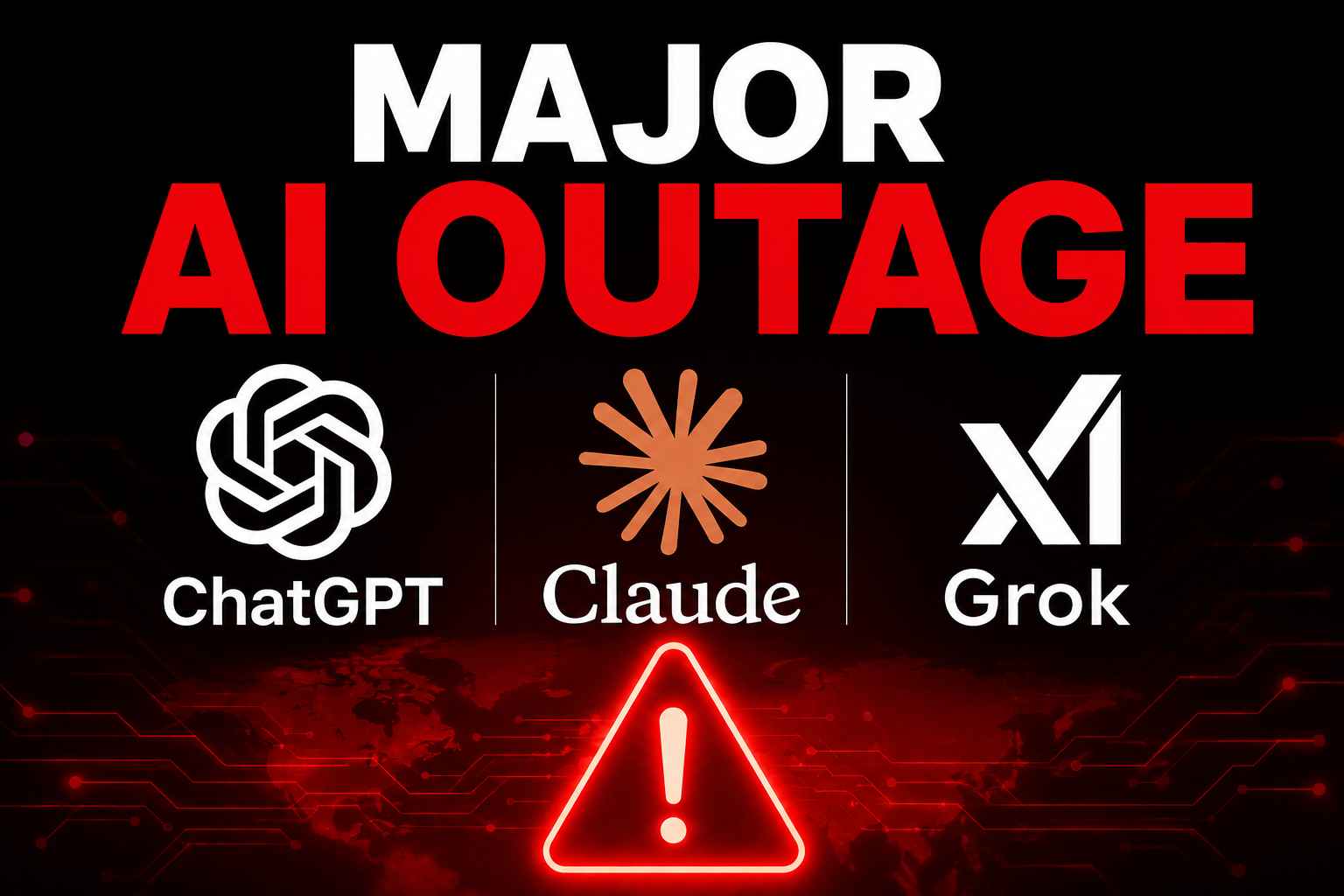

Three of the world’s biggest AI chatbots went down or experienced major problems at almost the same time on September 3, 2026. OpenAI’s ChatGPT, Anthropic’s Claude and xAI’s Grok all faced service disruptions, leaving users unable to chat, use coding tools or access some AI features.
The unusual timing quickly attracted attention across the tech industry.
However, there is no confirmed evidence that the three outages were caused by the same problem. The companies have reported their own incidents, and the exact reason behind the overlap remains unclear.
What Happened?
The problems started at different times during Thursday’s morning in the United States.
Grok began reporting issues at around 9:30 AM ET, according to outage reports. xAI’s status page later confirmed an outage affecting Grok services.
ChatGPT began seeing a large increase in errors around 11 AM ET. OpenAI’s status page reported elevated errors across ChatGPT and Codex, affecting multiple components.
Claude also experienced elevated errors during the same general period. Anthropic reported problems affecting several Claude models and later confirmed that the issue had been resolved.
That created an unusual situation:
Grok down → ChatGPT down → Claude down
Three competing AI platforms were experiencing serious problems within a relatively short period.
ChatGPT Experienced Widespread Errors
OpenAI’s outage was one of the biggest of the three.
The company’s status page reported elevated errors across ChatGPT and Codex, with 15 ChatGPT components and four Codex components listed as affected.
Users reported problems with:
- ChatGPT conversations
- Login
- File uploads
- Search
- Image generation
- Codex
- Other ChatGPT features
Downdetector recorded a huge spike in user reports, with more than 37,000 reports at one point, according to Forbes.
OpenAI later said it had applied a mitigation and was monitoring recovery.
This means the company had started restoring the service, although some users could still experience problems during recovery.
Claude Also Went Down
Anthropic’s Claude experienced its own major service disruption.
The company’s status page initially reported elevated errors for Claude Sonnet 5.
Later, the problem expanded to several models, including:
- Claude Opus 4.8
- Claude Opus 5
- Claude Fable 5.1
- Claude Mythos 5.1
Anthropic eventually identified the issue and deployed a fix.
The company said the impact had ended at 9:16 PM PT / 16:16 UTC on September 3.
Claude’s wider ecosystem was also affected during the incident, including Claude Code and the Claude API.
That was particularly important for developers because Claude is increasingly used as a coding and software-development tool.
Grok Was Also Experiencing Problems
xAI’s Grok experienced an outage across multiple platforms.
Its status pages showed problems with:
- Grok Web
- Grok on X
- iOS
- Android
- Grok Build
- Other integrations
The company initially described the situation as an issue with its models.
On Android, xAI later reported that traffic had returned to normal after a 3-hour, 34-minute incident.
The timing made the Grok outage particularly interesting because it started before the major ChatGPT and Claude problems.
Were the Three Outages Connected?
There is currently no confirmed answer.
This is the most important point.
The outages happened close together, but that does not automatically mean they were caused by one common failure.
Some reports raised the possibility that shared cloud infrastructure could have played a role.
One theory pointed toward Microsoft Azure, because cloud infrastructure can support services used by different AI companies.
However, this remains unconfirmed.
Another possibility is that the incidents were completely separate.
The available evidence currently supports the safer conclusion:
Three major AI services experienced outages during the same time window, but no common cause has been established.
Why Is a Simultaneous AI Outage Important?
The incident shows how dependent people have become on AI services.
AI is no longer used only for asking questions.
Millions of people now use these systems for:
- Programming
- Research
- Writing
- Business work
- Customer support
- Data analysis
- Education
- Image creation
- Software development
- Daily productivity
When several major AI platforms experience problems at the same time, the impact can be much bigger than a normal website outage.
For developers using AI coding tools, even a short outage can stop work completely.
AI Agents Make Outages More Serious
The problem becomes even more important as AI agents become common.
An AI agent may not just answer one question.
It could be responsible for:
Reading files → writing code → running tests → using APIs → updating systems
If the AI service suddenly becomes unavailable, the entire workflow can stop.
This means reliability is becoming just as important as model intelligence.
Companies are now competing on:
Intelligence + Speed + Cost + Reliability
Users Quickly Looked for Alternatives
When ChatGPT experienced problems, users naturally moved to other AI platforms.
But with Claude and Grok also experiencing issues, the normal backup options were suddenly less useful.
This highlights a growing problem for companies and developers that rely heavily on one AI provider.
A business using only one AI API could potentially lose access to an important part of its workflow during an outage.
As a result, some companies are beginning to build multi-model systems.
For example:
OpenAI → primary model
Anthropic → backup
Google → another backup
This approach can make AI applications more reliable.
Google’s Gemini Was Also Affected?
There were also reports of problems with Google Gemini, although the number of reported issues was much smaller.
Forbes reported that around 500 Gemini users had reported problems around 11 AM ET, compared with tens of thousands for ChatGPT.
However, the strongest confirmed incidents involved ChatGPT, Claude and Grok.
So it would be inaccurate to describe the event as a confirmed outage of every major AI platform.
The Timing Created Another Wave of Speculation
The outages also happened while the AI industry was closely watching OpenAI’s next-generation model plans.
Rumors surrounding OpenAI’s upcoming Astra model were already generating significant attention.
Some users online began wondering whether the outages were connected to an upcoming model launch.
There is no evidence supporting that theory.
The timing is interesting, but coincidence should not be presented as proof.
The companies’ status reports currently provide much stronger evidence for service-specific technical problems.
What Companies Can Learn From This
The outage is another reminder that AI infrastructure needs strong backup systems.
For businesses, some useful steps include:
Use multiple AI providers
Don’t depend completely on one model.
Build fallback systems
If one model fails, another can take over.
Cache important results
Not every task needs to be sent to an AI model again.
Monitor AI services
Companies should know immediately when an AI provider is having problems.
Keep humans in the loop
Critical systems should not completely depend on an AI service being available.
AI Infrastructure Is Becoming Critical Infrastructure
This incident also raises a bigger question.
What happens when AI becomes as important to businesses as cloud storage, databases and payment systems?
Companies may eventually treat AI providers as critical infrastructure.
That means uptime will become a major selling point.
An AI model can be incredibly intelligent, but if it is unavailable when a business needs it, its value drops quickly.
The Bigger Picture
September 3’s outage was unusual because ChatGPT, Claude and Grok all experienced significant problems within the same broad period.
OpenAI confirmed elevated errors across ChatGPT and Codex. Anthropic reported elevated errors across multiple Claude models. xAI separately reported problems with Grok.
The incidents have since moved toward recovery, but the exact reason for the overlap remains unknown.
There is currently no confirmed evidence of a coordinated attack or single technical failure connecting all three outages.
What the incident does show is something much bigger.
AI has become part of everyday work for millions of people.
When an AI service goes down, people don’t just lose a chatbot.
They can lose their coding assistant, research tool, business workflow, writing assistant or AI agent.
And as more companies build their products around AI, reliable access to these systems will become just as important as the intelligence of the models themselves.
The AI race is no longer only about building the smartest model. It is also about keeping that model available when people need it.

 By
By