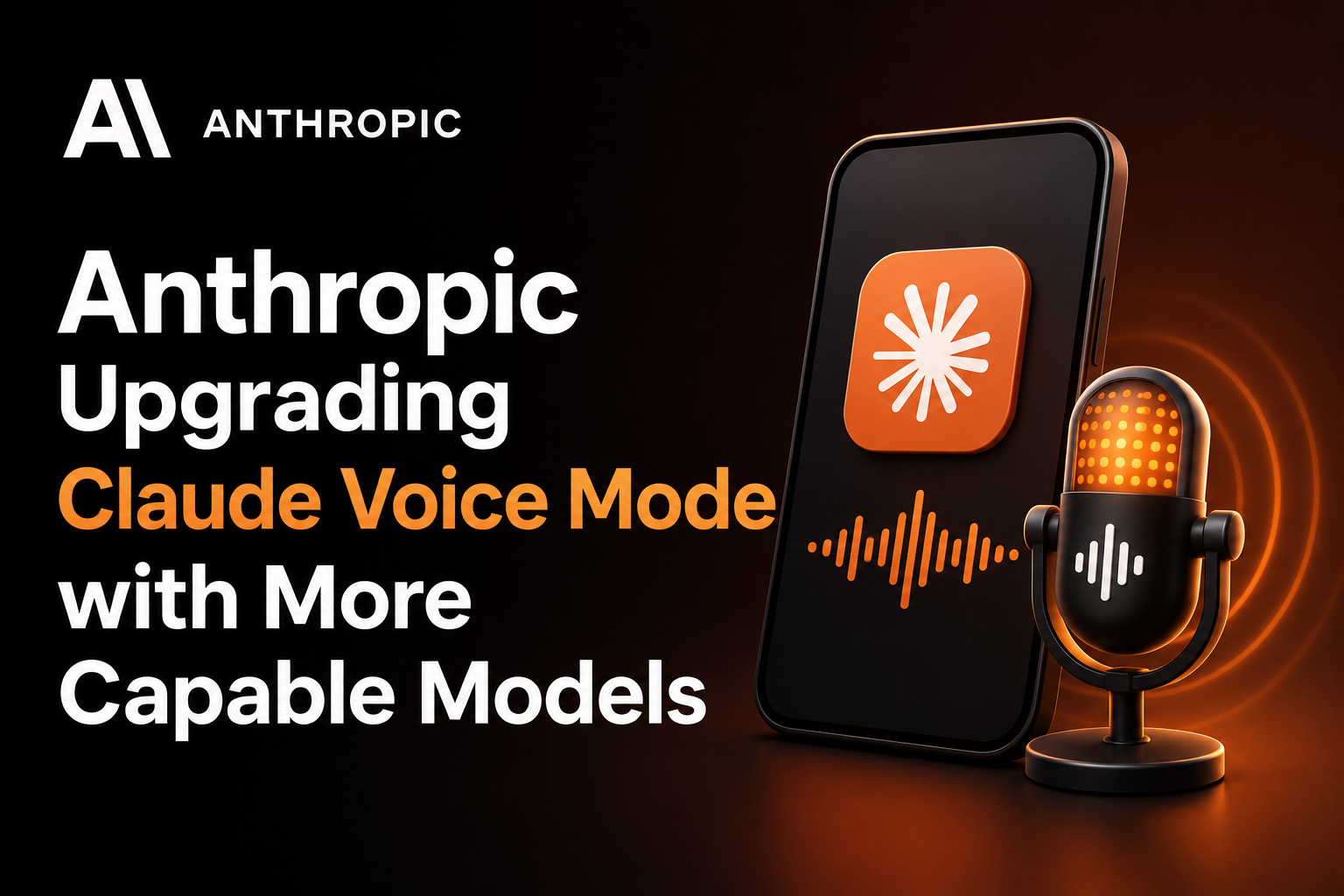

Anthropic has rolled out a major update to Claude Voice Mode, bringing support for its more capable Opus and Sonnet models. The upgrade enables deeper conversations, improved reasoning, and access to connected productivity apps, making Claude a more powerful voice assistant for both personal and professional use.
The update comes as competition in AI voice assistants continues to intensify, with companies racing to deliver more natural, capable, and productivity-focused conversational experiences.
Voice Mode Now Supports Opus and Sonnet
Previously, Claude Voice Mode relied primarily on the lightweight Haiku model, which was optimized for quick responses but less suitable for complex discussions.
With the latest update, users can now choose between:
- Claude Opus
- Claude Sonnet
- Claude Haiku
Voice conversations can now leverage the same advanced reasoning capabilities available in Claude’s text interface, allowing users to tackle more demanding tasks through speech.
Smarter Conversations for Real-World Work
The enhanced Voice Mode is designed for conversations that require more than simple question-and-answer interactions.
Users can now use Claude to:
- Practice presentations
- Brainstorm business ideas
- Prepare for client meetings
- Review communication style
- Discuss product strategy
- Solve technical problems
- Generate creative ideas
The improved reasoning offered by Opus and Sonnet makes longer conversations significantly more useful for professional workflows.
Connected Apps Make Claude More Useful
One of the biggest additions is support for connected workplace tools.
Claude Voice Mode can now interact with services such as:
- Gmail
- Google Calendar
- Google Docs
- Slack
- Canva
- Notion
Users can perform tasks like checking schedules, drafting emails, creating documents, or updating workspaces without leaving a voice conversation.
Seamless Switching Between Voice and Text
Anthropic has also improved continuity across conversations.
Users can:
- Switch between voice and text chats
- Change AI models during a conversation
- Continue discussions without losing context
This creates a more flexible experience, allowing users to move naturally between speaking and typing depending on the situation.
Expanded Language Support
Claude Voice Mode is no longer limited to English.
The feature now supports multiple languages, including:
- English
- French
- German
- Hindi
- Indonesian
- Italian
- Japanese
- Korean
- Portuguese (Brazilian)
- Spanish
This broader language support makes Voice Mode accessible to a much larger global audience.
Free vs Paid Access
The upgraded Voice Mode is available across Claude’s mobile, desktop, and web applications.
However, there are some differences between plans:
- Free users can access Voice Mode using the Haiku model with one connected app.
- Paid subscribers gain access to Opus and Sonnet models along with additional connected tools and advanced capabilities.
Why This Matters
Voice assistants are evolving from simple conversational tools into full-featured productivity platforms.
By combining advanced reasoning models with integrations for workplace apps, Anthropic is positioning Claude as more than just a chatbot—it is becoming an AI assistant capable of helping users complete meaningful work through natural conversation.
This update also brings Claude closer to competing AI assistants while emphasizing productivity and enterprise use cases over purely conversational experiences.
The Bigger Picture
The future of AI is increasingly multimodal, allowing users to switch seamlessly between text, voice, and connected applications.
Anthropic’s latest Voice Mode upgrade reflects this trend by making spoken interactions smarter, more context-aware, and capable of interacting with external tools.
As AI assistants become central to everyday workflows, enhancements like advanced reasoning, app integrations, and multilingual support are likely to become standard features across the industry.
 By
By