
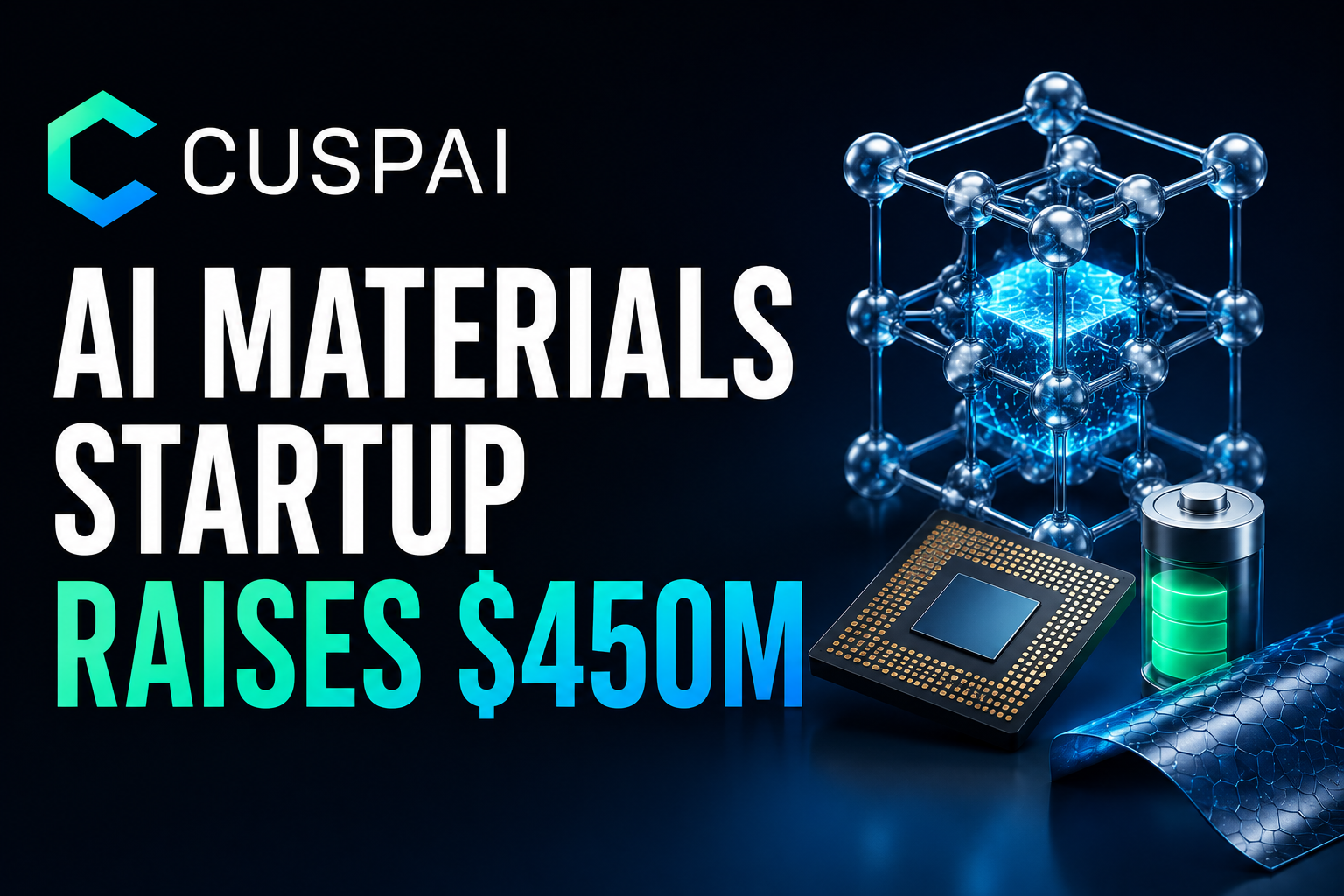

AI materials startup CuspAI has secured $450 million in a Series B funding round, pushing its valuation to approximately $2.6 billion. The round attracted high-profile backing from Jeff Bezos and the UK government’s sovereign AI fund, underscoring growing investor confidence in AI-driven scientific research and advanced materials discovery.
The funding positions CuspAI among the fastest-growing AI startups focused on applying artificial intelligence to solve complex challenges in manufacturing, energy, and semiconductor development.
AI for the Next Generation of Materials
Rather than building chatbots or generative AI applications, CuspAI is using artificial intelligence to discover entirely new materials.
Its AI-powered platform is designed to accelerate research by predicting the properties of materials before they are physically created in laboratories.
The company is targeting breakthroughs across several critical industries, including:
- Semiconductors
- Advanced batteries
- Clean energy infrastructure
- Industrial manufacturing
- Sustainable materials
By reducing the time needed for experimentation, CuspAI aims to dramatically shorten the materials discovery process.
$450 Million Series B Funding
CuspAI’s latest Series B funding round raised $450 million, valuing the company at around $2.6 billion.
The investment includes participation from:
- Jeff Bezos
- The UK Government’s Sovereign AI Fund
- Existing and new institutional investors
The fresh capital will support expanded research, larger AI infrastructure, recruitment of scientific talent, and faster commercialization of its platform.
Collaborating With Industry Leaders
Although still a relatively young company, CuspAI has already established collaborations with several major global technology and industrial companies.
Its reported partners include:
- Nvidia
- Meta
- Hyundai
These collaborations highlight increasing interest in AI-driven materials science as companies seek breakthroughs in computing performance, battery efficiency, and sustainable manufacturing.
Why Materials Discovery Matters
Developing new materials has traditionally taken years—or even decades—of laboratory research.
Scientists often test thousands of combinations before identifying one with the desired properties.
CuspAI believes artificial intelligence can dramatically reduce this timeline by predicting promising candidates before physical testing begins.
This approach could accelerate innovation in:
- Faster computer chips
- Longer-lasting batteries
- More efficient energy storage
- Lower-carbon industrial processes
AI Meets Scientific Research
Generative AI is increasingly moving beyond text and images into scientific discovery.
Companies are now applying large AI models to chemistry, biology, medicine, and materials science.
Instead of generating content, these systems generate scientific hypotheses that researchers can validate through experiments.
This emerging field has become one of the most promising areas for commercial AI.
Why This Matters
The funding demonstrates that investors are betting on AI’s ability to transform scientific research—not just software.
As global demand grows for better semiconductors, renewable energy technologies, and advanced manufacturing, AI-powered materials discovery could become a critical competitive advantage.
CuspAI is positioning itself at the center of that transformation.
The Bigger Picture
Artificial intelligence is rapidly becoming a tool for solving real-world scientific problems.
From designing new medicines to discovering next-generation materials, AI is helping researchers explore possibilities that would be impossible through traditional experimentation alone.
With $450 million in new funding and support from both private investors and government-backed initiatives, CuspAI is preparing to scale its mission of accelerating scientific innovation through AI.

 By
By