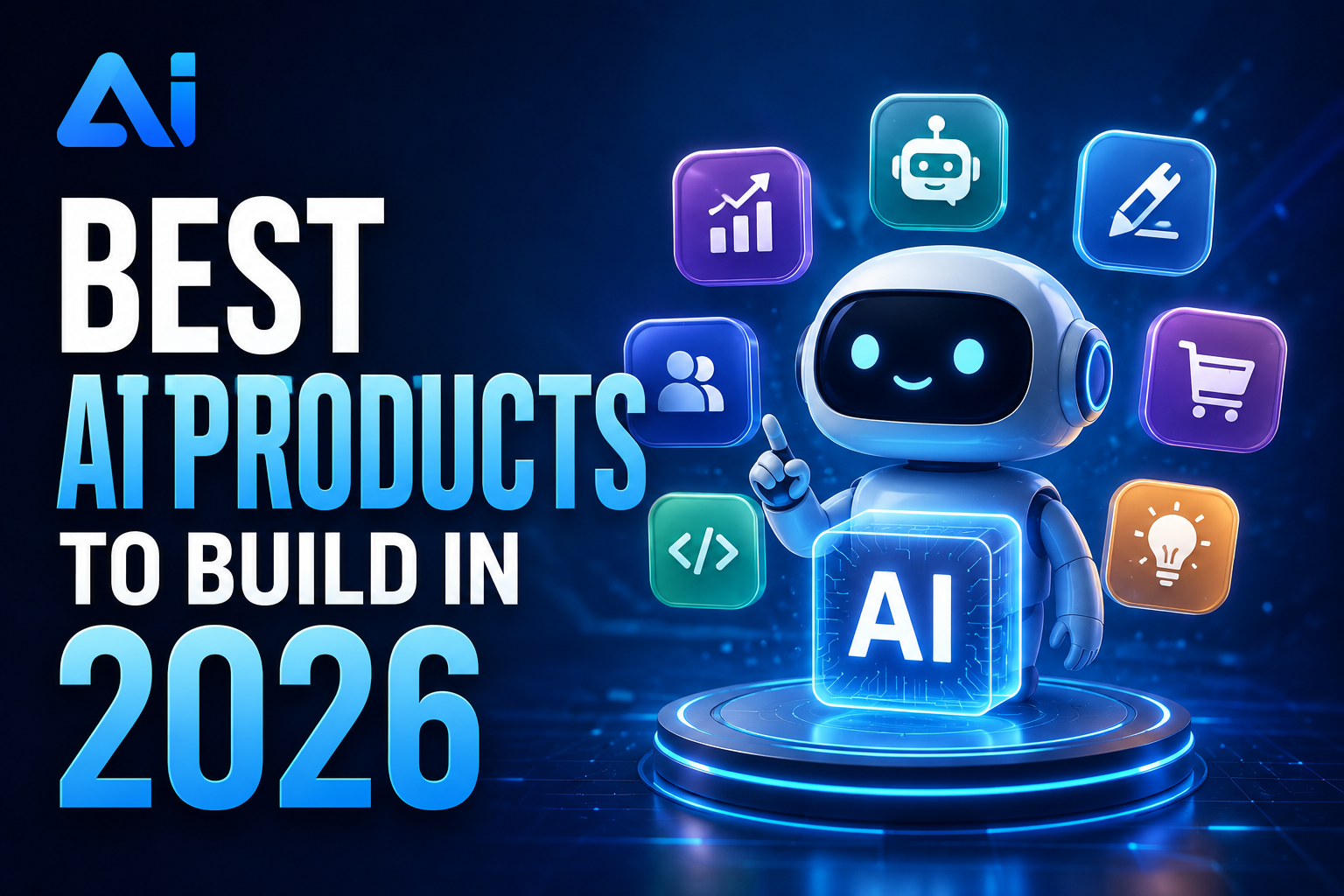

Artificial intelligence is no longer limited to chatbots and content generators. In 2026, AI has become the foundation of a new generation of software products, enabling startups and businesses to automate workflows, improve customer experiences, and create entirely new services.
The rapid adoption of large language models (LLMs), autonomous AI agents, multimodal AI, and AI-powered automation has opened countless opportunities for entrepreneurs. Whether you’re an experienced developer or a first-time founder, building an AI-powered product can be one of the fastest ways to enter a growing market.
Here are some of the most promising AI product ideas to build in 2026.
1. AI Agent Marketplace
AI agents are becoming digital employees capable of performing complex tasks independently. A marketplace where businesses can discover, purchase, and deploy AI agents has significant growth potential.
Key features:
- Agent directory
- One-click deployment
- Ratings and reviews
- Subscription management
- API integrations
- Revenue sharing for creators
2. AI Workflow Automation Platform
Businesses want to automate repetitive work without writing code.
An AI workflow platform can connect apps like Gmail, Slack, Salesforce, Notion, Shopify, and CRMs using intelligent automation.
Possible features:
- Drag-and-drop workflow builder
- Natural language automation creation
- AI decision-making
- Multi-step workflows
- Custom integrations
3. AI Customer Support Assistant
Modern AI assistants can resolve customer questions, process refunds, schedule appointments, and escalate complex cases.
Potential capabilities:
- Website chatbots
- Voice support
- CRM integration
- Knowledge base search
- Multilingual conversations
4. AI Meeting Assistant
Meetings generate valuable information that often gets lost.
An AI meeting assistant can:
- Record conversations
- Generate transcripts
- Summarize discussions
- Create action items
- Update project management tools automatically
5. AI Sales Copilot
Sales teams increasingly rely on AI for productivity.
An AI sales assistant can:
- Generate personalized emails
- Score leads
- Recommend follow-ups
- Analyze customer sentiment
- Predict deal outcomes
6. AI Marketing Studio
Marketing teams need large amounts of content across multiple platforms.
A comprehensive AI marketing platform could generate:
- Blog articles
- Social media posts
- Product descriptions
- Email campaigns
- Landing pages
- Ad copy
- SEO metadata
7. AI Video Generator
Video remains one of the fastest-growing content formats.
An AI-powered platform can generate:
- Product videos
- Marketing ads
- Training videos
- YouTube Shorts
- Reels
- Animated explainers
8. AI Website Builder
Instead of traditional website builders, AI can generate complete websites based on a simple prompt.
The platform could automatically create:
- Responsive layouts
- Images
- Copy
- Forms
- SEO settings
- Hosting configuration
9. AI App Builder
The rise of AI-assisted development has created demand for platforms that generate complete web and mobile applications from natural language instructions.
Features may include:
- Frontend generation
- Backend APIs
- Authentication
- Database setup
- Deployment automation
10. AI Code Review Platform
As AI-generated code becomes more common, developers need tools that review code quality, security, and performance.
An AI reviewer can detect:
- Security vulnerabilities
- Performance issues
- Code duplication
- Style inconsistencies
- Documentation gaps
11. AI Knowledge Management Platform
Organizations accumulate thousands of documents, making information difficult to find.
An AI knowledge platform allows employees to:
- Search documents
- Chat with internal knowledge
- Generate summaries
- Find policies instantly
- Retrieve answers from PDFs and databases
12. AI Recruitment Assistant
Hiring can be automated using AI.
The platform could:
- Screen resumes
- Rank candidates
- Generate interview questions
- Analyze interviews
- Match candidates to job requirements
13. AI Personal Finance Assistant
Consumers increasingly want intelligent financial guidance.
Features might include:
- Budget tracking
- Spending analysis
- Investment insights
- Bill reminders
- Savings recommendations
14. AI Healthcare Assistant
Healthcare organizations are adopting AI to reduce administrative work.
Possible applications:
- Appointment scheduling
- Medical documentation
- Patient communication
- Clinical summaries
- Administrative automation
15. AI Education Platform
Personalized learning continues to grow rapidly.
AI can provide:
- Personalized study plans
- Adaptive quizzes
- Instant tutoring
- Assignment feedback
- Progress tracking
16. AI Cybersecurity Platform
Cyber threats are becoming more sophisticated, increasing demand for AI-powered security tools.
Potential features:
- Threat detection
- Vulnerability scanning
- Log analysis
- Malware identification
- Incident response recommendations
17. AI Legal Assistant
Legal professionals spend significant time reviewing documents.
AI can help with:
- Contract analysis
- Legal research
- Clause comparison
- Risk identification
- Document summarization
18. AI Research Assistant
Researchers need to process large amounts of information quickly.
An AI research platform can:
- Summarize academic papers
- Compare studies
- Generate literature reviews
- Organize citations
- Answer research questions
19. AI Shopping Assistant
E-commerce platforms increasingly rely on personalization.
AI shopping assistants can:
- Recommend products
- Compare prices
- Track discounts
- Predict buying preferences
- Provide virtual shopping support
20. AI Business Intelligence Platform
Businesses generate enormous amounts of operational data.
An AI BI platform can:
- Analyze dashboards
- Predict trends
- Detect anomalies
- Generate reports
- Answer business questions in natural language
Emerging AI Trends to Watch
If you’re planning a long-term AI product, consider these rapidly growing areas:
- Autonomous AI agents
- AI-powered software development
- Multimodal AI applications
- AI-powered cybersecurity
- Personalized AI assistants
- AI workflow orchestration
- Enterprise AI search
- AI copilots for every profession
- Voice-first AI interfaces
- AI governance and compliance
Choosing the Right AI Product
Before building an AI startup, evaluate the following:
- Is there a real customer problem?
- Can AI provide a clear advantage over traditional software?
- Is the market growing?
- Can the product generate recurring revenue?
- Will users continue using it after the initial experience?
The most successful AI products solve practical business problems rather than using AI simply because it’s popular.
Final Thoughts
2026 is shaping up to be a defining year for AI-powered software. Businesses are actively seeking tools that automate tasks, reduce costs, and improve productivity, creating opportunities across nearly every industry.
Rather than competing with general-purpose AI models, entrepreneurs can succeed by building focused solutions for specific markets and workflows. Products that combine strong user experience, reliable automation, and measurable business value are likely to stand out in an increasingly competitive AI landscape.

 By
By